In this biography
Quick facts
- Born
- 21 September 1957
- Birthplace
- Nambour, Queensland, Australia
- Country
- Australia
- Nationality
- Australian
- Known for
- Two terms as Australian prime minister, the 2008 National Apology and crisis-era economic policy
- Born
- 21 September 1957, Nambour, Queensland
- Prime minister
- 3 December 2007–24 June 2010; 27 June–18 September 2013
- Federal electorate
- Griffith, Queensland; elected 1998, resigned 2013
- Foreign minister
- 14 September 2010–22 February 2012
- US ambassador
- 2023–March 2026; completed posting
- Reviewed role
- Global President and CEO, Asia Society, as at 24 October 2026
Why this life matters
His premiership joined a symbolic change in the Commonwealth’s relationship with the Stolen Generations to an interventionist response to the global financial crisis. Party conflict, climate-policy reversals and offshore asylum policy complicate that record. His later work returned to international affairs and China analysis.
Timeline
Key moments
Born in Queensland
Kevin Michael Rudd is born in Nambour and grows up around Eumundi.
Studies lead to diplomacy
He graduates from ANU and joins the Department of Foreign Affairs.
Enters federal parliament
He wins Griffith after an unsuccessful first attempt in 1996.
Labor returns to government
Rudd defeats John Howard’s Coalition and becomes prime minister on 3 December.
Apology and financial crisis
He delivers the National Apology in February; the government later introduces economic stimulus.
Leadership changes
Julia Gillard succeeds him in 2010; he serves as foreign minister and briefly returns as prime minister in 2013.
Returns to Asia Society
After his US ambassadorial posting ends in March, he resumes leadership of the international-policy organisation.
Chinese studies opened a diplomatic career
Born in Nambour, Rudd grew up in rural Queensland. After schooling there, he studied at the Australian National University, specialising in Chinese language and history and graduating in 1981. He married fellow graduate Thérèse Rein that year.
He entered the Department of Foreign Affairs and served in Stockholm and Beijing before returning to Canberra. Mandarin and sustained study of Chinese politics became enduring features of his professional life, rather than interests acquired only after reaching national office.
Queensland administration preceded federal leadership
Rudd moved into Queensland politics as an adviser to Wayne Goss in 1988. After Labor’s state election victory in 1989, he worked as the premier’s chief of staff and subsequently directed the Cabinet Office. These roles gave him experience coordinating government before he became an elected federal representative.
He lost his first contest for Griffith in 1996 but won the seat in 1998. Shadow foreign affairs responsibilities followed in 2001. In December 2006, Labor’s parliamentary caucus replaced Kim Beazley with Rudd as leader; the following November, Labor defeated John Howard’s government.
The first term combined recognition with economic intervention
Rudd became prime minister on 3 December 2007 and signed Australia’s instrument of ratification of the Kyoto Protocol that day. On 13 February 2008 he delivered the parliamentary apology to Aboriginal and Torres Strait Islander peoples, particularly the Stolen Generations, for past removal laws and policies.
The global financial crisis then redirected government priorities. Its response included stimulus spending and bank-deposit guarantees. The National Museum records praise for the crisis response alongside criticism of changing climate policy and home-insulation implementation. A favourable national economic outcome does not establish that one leader or one programme caused every part of it.
A lost leadership returned, but only briefly
Rudd’s support within Labor deteriorated and Julia Gillard succeeded him as prime minister on 24 June 2010. He retained Griffith and became foreign minister in her government after the election, resigning that portfolio in February 2012. The rivalry persisted rather than being settled by his move to foreign affairs.
On 26 June 2013 he defeated Gillard in a caucus ballot and was sworn in the next day. Labor lost the September election to Tony Abbott’s Coalition. Rudd’s second premiership ended on 18 September, and he resigned from parliament in November. Party ballots, general elections and formal changes of prime minister occurred on different dates.
The 2013 asylum policy was a consequential contested decision
During his second term, Rudd announced a regional arrangement with Papua New Guinea on 19 July 2013. His broadcast stated that new boat arrivals would be transferred for processing and resettlement and would not settle permanently in Australia. He presented deterrence of people smuggling and deaths at sea as government aims.
Contemporary ABC reporting recorded sharply different objections: Tony Abbott disputed whether the arrangement would work, while Greens leader Christine Milne condemned shifting responsibility to a poorer country. Those criticisms and the government’s rationale belong in the record; neither the announcement nor the rationale alone demonstrates later implementation or humanitarian outcomes.
International-policy work continued beyond elected office
After parliament, Rudd wrote about China and US–China relations and worked with international-policy institutions. He completed an Oxford doctorate in 2022 and served as Australia’s ambassador to the United States from 2023. The government announced that posting would conclude on 31 March 2026.
As reviewed on 24 October 2026, the Belfer Center’s current profile identifies him as Global President and CEO of Asia Society, having returned in March. This is a later institutional role, not a continuation of the premiership or ambassadorship. His own policy interpretations should likewise be distinguished from settled historical findings.
Quick answers
Frequently asked questions about Kevin Rudd
- How many times was Kevin Rudd prime minister?
- Twice: from 3 December 2007 to 24 June 2010, and from 27 June to 18 September 2013.
- When did he deliver the National Apology?
- On 13 February 2008, as a motion and address in the House of Representatives. It concerned past laws and policies, particularly forced removal of Indigenous children.
- Was Rudd still US ambassador in October 2026?
- No. His posting ended in March 2026. The current institutional profile reviewed for this article records his return as Global President and CEO of Asia Society.
- Did the apology itself create a national compensation scheme?
- No. Acknowledgment, compensation, family reunion and healing services are distinct measures. The Human Rights Commission continued to advocate comprehensive reparations after the apology.
Keep exploring
Lives connected to this story
- Julia Gillard
Their succession in 2010 and competing leadership claims shaped both premierships.
- John Howard
Rudd defeated Howard in 2007 and reversed the Commonwealth’s refusal to make a formal apology.
- Malcolm Turnbull
Turnbull’s later premiership provides another example of party-room leadership change.
Sources and further reading
Explore the evidence
These references support the biography and offer further reading. Official records, first-person accounts and independent reporting provide different perspectives; image records document attribution and licensing.
- 1. National Archives of AustraliaKevin Rudd: parliamentary career and two terms as prime minister
- 2. National Archives of AustraliaKevin Rudd: before office, Chinese studies, diplomacy and Queensland government
- 3. National Archives of AustraliaKevin Rudd: during office, climate policy, financial crisis and leadership change
The apology is dated from the parliamentary speech. This article does not repeat the Archives summary’s conflicting timing of the preceding Welcome to Country or its broad claims about the origins of the G20.
- 4. National Archives of AustraliaKevin Rudd: foreign affairs portfolio and return to the premiership
- 5. National Archives of AustraliaKevin Rudd: birth, education and historical office dates
Used for birth and historical portfolio dates, not its open-ended list of later institutional positions. Current employment is checked against the 2026 transition statement and current Belfer profile.
- 6. National Museum of AustraliaKevin Rudd: Australia’s prime minister two times
- 7. Harvard Kennedy School, Belfer CenterKevin Rudd: current Asia Society role, scholarship and diplomatic career
- 8. Prime Minister of AustraliaPress conference, 13 January 2026: end of Rudd’s ambassadorial posting
- 9. ABC NewsRudd’s self-identification as an Australian citizen, 9 February 2013
Australian nationality is supported by Rudd’s explicit self-identification as an Australian citizen, not inferred from birthplace or office.
- 10. Department of the Prime Minister and CabinetKevin Rudd: broadcast on the PNG regional resettlement arrangement, 19 July 2013
- 11. ABC NewsPNG, Nauru and Indonesia in the asylum policy debate, 24 July 2013
- 12. Australian Embassy, France / House of RepresentativesNational Apology: motion and Kevin Rudd’s speech, 13 February 2008
- 13. Human Rights and Equal Opportunity CommissionSubmission to the Stolen Generations Compensation Bill inquiry, 9 April 2008
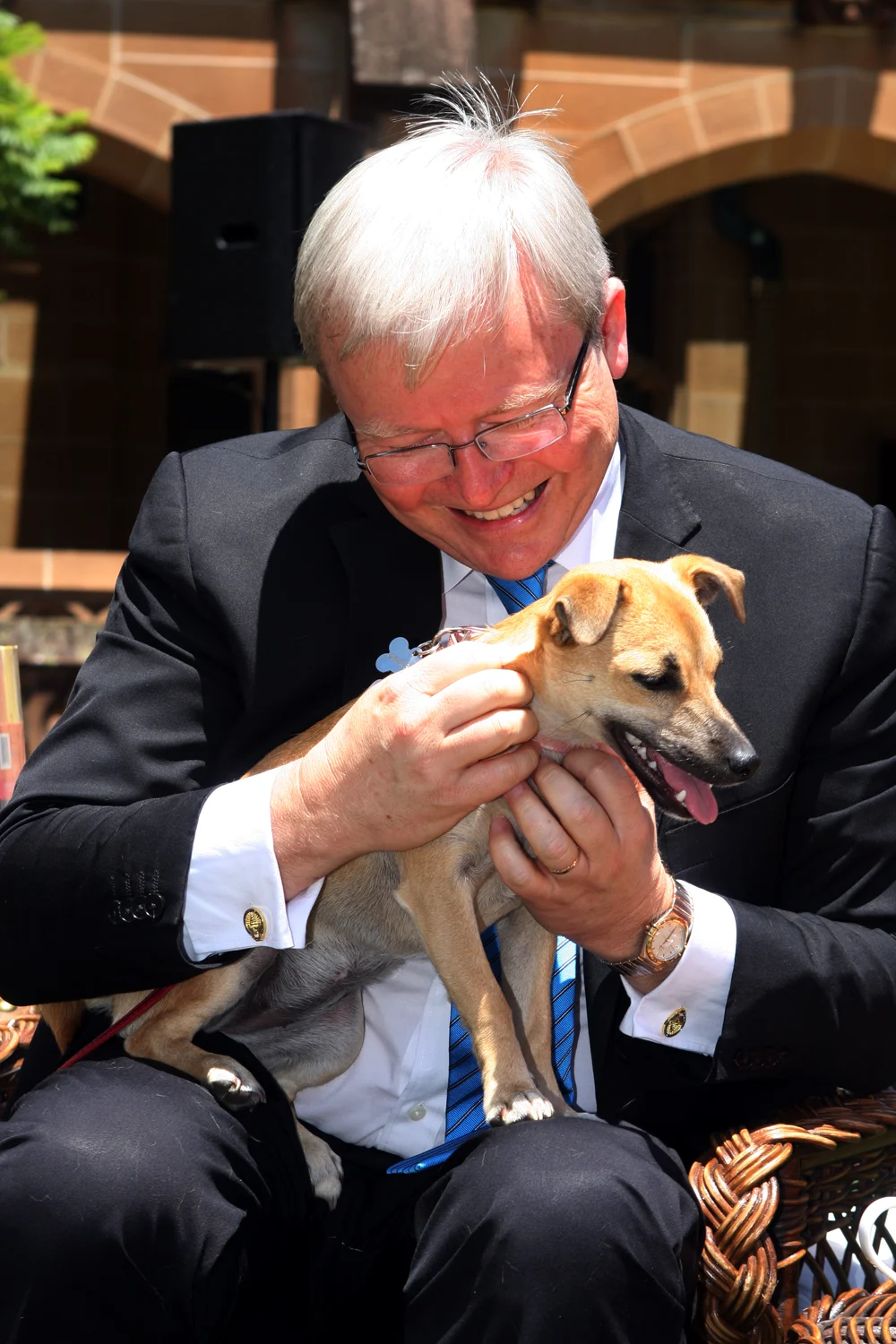
- 14. Eva Rinaldi / Wikimedia CommonsKevin Rudd (Pic 3), 16 January 2013: Flickr-reviewed CC BY-SA 2.0 photograph