
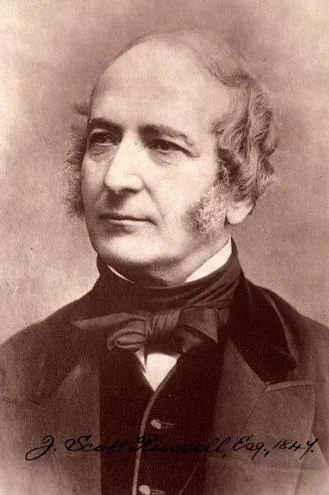
In this biography
Quick facts
- Born
- 1808
- Died
- 8 June 1882
- Birthplace
- Parkhead, near Glasgow
- Country
- United Kingdom
- Nationality
- Not independently established
- Known for
- ship-form research, steam-vessel construction and the building of Great Eastern
- Known for
- ship-form research, steam-vessel construction and the building of Great Eastern
- Life
- 1808–1882
Why this life matters
Ship-form research, steam-vessel construction and the building of Great Eastern.
Timeline
Key moments
Practical work and university study developed together
John Scott Russell was born near Glasgow on 1808, the eldest son of a minister. He studied at Scottish universities and graduated from Glasgow while still young, alongside practical engineering experience. He subsequently lectured on science and temporarily supplied Edinburgh’s natural-philosophy teaching after John Leslie’s death. His early interest in water resistance grew from questions about useful navigation, not an abstract separation between experiment and work. The historical biographies connect those investigations with the development of vessel forms and steam transport.
Sources for this section: [1]
Research entered a career in engineering and shipbuilding
Russell investigated waves and promoted the wave-line approach to ship design. He managed shipbuilding work at Greenock and later moved to London. His professional activities also included road steam carriages and technical publication. He became a Fellow of the Royal Society in 1847 and helped establish the Institution of Naval Architects. These affiliations gave his work an institutional setting, while the vessels and machinery involved commercial decisions, contracts and workers. A useful biography keeps his scientific contribution visible without making every subsequent ship project a direct demonstration of one research result.
Sources for this section: [1]
Great Eastern divided work among several contracts
Russell’s best-known construction undertaking was Great Eastern, designed under Isambard Kingdom Brunel’s direction. Bristol’s contract-volume catalogue distinguishes the hull and paddle-engine contracts with Russell from the screw-engine agreement with James Watt and Company. University of Bath’s photographic exhibition records construction from 1854 and interruptions involving fire and finance. The first attempted launch in November 1857 failed; the ship was afloat in January 1858. Those events show why commissioning a very large vessel required coordination across structures, propulsion, finance and a difficult launching operation.
His later work extended beyond one unsuccessful business
The Great Eastern difficulties damaged Russell’s business, but he continued as a consulting engineer. His later activities included technical education, naval-architecture writing, a Lake Constance railway ferry and work associated with the Vienna exhibition dome. Earlier, he had also helped advance the exhibition movement through the Society of Arts. He died at Ventnor on 8 June 1882. His career combines substantial research and technical communication with commercial reversals. Following the separate contracts and dated construction records gives a clearer account of that complexity than treating the ship as either one man’s triumph or a complete explanation of his life.
Quick answers
Frequently asked questions about John Scott Russell
- Did Russell’s hull contract also identify the screw-engine supplier?
- The volume describes a separate screw-engine agreement with the partners trading as James Watt and Company; distinct work packages should be read separately.
Keep exploring
Lives connected to this story
- John Elder
Read John Elder’s separate career to compare ship tenders and engineering choices with commercial development of compound marine engines with Charles Randolph and other specialists.
- Robert Napier
Read Robert Napier’s separate career to compare ship tenders and engineering choices with Clyde engine manufacture, early Cunard contracts and the growth of a shipbuilding enterprise.
Sources and further reading
Explore the evidence
These references support the biography and offer further reading. Official records, first-person accounts and independent reporting provide different perspectives; image records document attribution and licensing.
- 1. Dictionary of National Biography, original nineteenth-century entryRussell, John Scott
The older DNB gives 8 May 1808, while an institutional-linked portrait record gives 9 May. The biography retains 1808 without choosing a day. Brunel’s actual 1853 tender comparison was read in the 1870 Life; the archive catalogue is not represented as a full signed contract.
- 2. University of Bristol Special Collections, Brunel InstituteGreat Eastern contracts, engineer’s copy, DM 1306/11/2
- 3. University of Bath Digital ArchivesThe building of SS Great Eastern: introduction
- 4. Encyclopaedia Britannica, 1911Russell, John Scott
- 5. Isambard Kingdom Brunel, reproduced in Isambard Brunel, The Life of Isambard Kingdom Brunel, 1870Great Eastern: May 1853 tender report and contract sequence