In this biography
Quick facts
- Born
- 1943
- Birthplace
- Northern Ireland
- Country
- United Kingdom
- Nationality
- Not independently established
- Known for
- Recognising the first pulsar signals and advancing access to physics research
- First pulsar work
- Cambridge survey, 1967
- Doctorate
- Cambridge, 1969
- Major recognition
- Special Breakthrough Prize, 2018
- Graduate fund
- Launched by the Institute of Physics in 2019
Why this life matters
Her career makes observation and sustained analysis visible within a collaborative discovery, alongside the difference between scientific credit and prize selection.
Timeline
Key moments
Glasgow degree and Cambridge research
Graduated in physics and began graduate work with Antony Hewish.
Unusual signals
Recognised recurring chart features and resolved regular pulses on 28 November.
First published report
Coauthored the Nature report published on 24 February.
Doctorate
Completed the Cambridge doctorate; Apollo gives an issued date of 18 February.
Scottish scientific leadership
Served as the first woman president of the Royal Society of Edinburgh.
Prize and scholarship fund
Donated the Special Breakthrough Prize money; IOP launched the fund in March 2019.
Physics became a practical research career
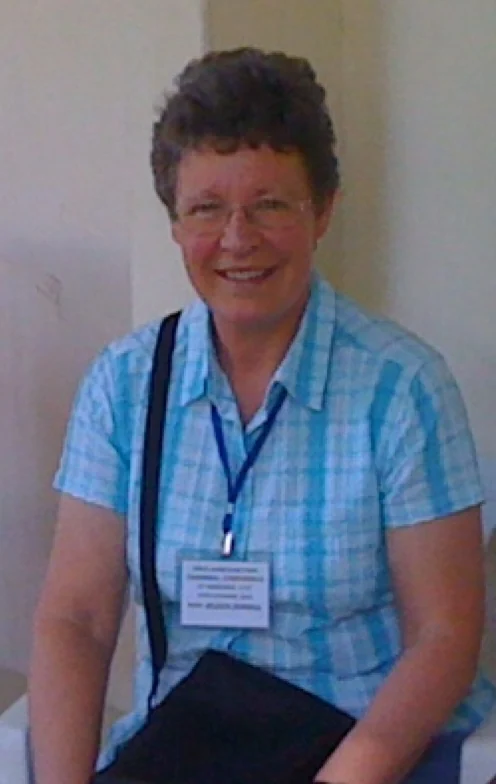
Bell Burnell was born in Northern Ireland in 1943. The Royal Society’s account describes schooling in York and a physics degree from Glasgow in 1965. She then became a Cambridge graduate student working with Antony Hewish on radio astronomy. Her doctorate concerned using interplanetary scintillation to measure the angular sizes of radio sources; it was not designed as a search for pulsars. The Cambridge repository dates the thesis record to 18 February 1969, while some shorter accounts associate her doctoral work with 1968. Here the formal record and the period of discovery are kept separate rather than forcing them into one year.
Construction and analysis were part of discovery
The new telescope depended on extensive outdoor construction as well as theoretical planning. Bell Burnell helped build the antenna system and then analysed the long paper charts generated by the survey. In her retrospective account, she describes learning the appearance of ordinary scintillating sources and familiar interference before noticing an unusual recurring feature. The crucial act was not one glance at an obviously labelled new star. It involved remembering earlier records, checking a position in the sky and arranging faster recordings. Her labour made an instrument’s output usable as evidence, a contribution that a list of senior project titles can conceal.
From recurring marks to regular pulses
A fast recording on 28 November 1967 showed pulses roughly one and one-third seconds apart. Hewish initially treated interference as a serious possibility. Further tests involved other receivers, celestial timing and the frequency dependence of the signal. Bell Burnell continued inspecting records and found additional candidate sources. The first Nature paper, published on 24 February 1968, lists Hewish, S. J. Bell, J. D. H. Pilkington, P. F. Scott and R. A. Collins. A discovery biography should preserve those names while explaining what Bell’s pattern recognition, repeated observations and persistence contributed. The paper’s authorship is not identical to the later Nobel recipient list.
Recognition and interpretation followed different paths
The first report considered compact stellar explanations without already establishing the later rotating-neutron-star account. Further observation and theory changed the interpretation. In 1974 the Nobel Prize in Physics went to Martin Ryle and Antony Hewish, with different wording for each contribution; Bell Burnell did not receive that award. Its omission of her has been widely debated. Her own later interview describes pride that the work brought astrophysics into the prize’s scope and recalls that colleagues were more upset than she was. Reporting that position does not require treating a prize committee’s selection as a complete measurement of everyone’s scientific contribution.
A career broader than one celebrated signal
Bell Burnell subsequently worked in gamma-ray, X-ray and other branches of astronomy, alongside teaching and research management. Her Royal Society profile places her career across several institutions rather than treating 1967 as its endpoint. She became president of the Royal Astronomical Society and later the first woman to lead the Royal Society of Edinburgh, serving there from 2014 to 2018. These were distinct offices with different organisations. They should not be confused with a professorship or with ownership of a later astronomical discovery. Her experience of research careers also informed her work to widen participation in physics.
A prize redirected into opportunities for others
The Special Breakthrough Prize was announced in September 2018 for her discovery contribution and scientific leadership. The US-dollar award and the approximately £2.3 million donation describe the same prize in different currency contexts, not two separate awards. She donated the money to the Institute of Physics, whose graduate scholarship fund launched in March 2019. Its stated purpose was to support people from groups underrepresented in physics working towards doctorates. The donation and the fund’s published purpose are documented; they are not, by themselves, proof of a measured long-term change in the entire profession. That distinction respects both the generosity and the evidence.
Quick answers
Frequently asked questions about Jocelyn Bell Burnell
- Did Bell Burnell receive the 1974 Nobel Prize?
- No. Ryle and Hewish were the recipients. Her discovery contribution appears in the paper, participant accounts and later institutional recognition.
- What was her doctorate about?
- It used interplanetary scintillation to investigate angular sizes of compact radio sources. Pulsars emerged as an unexpected finding during that programme.
Keep exploring
Lives connected to this story
- Antony Hewish
Read the survey supervisor’s separate account of instrument design, follow-up observations and the wider team.
- Rosalind Franklin
Compare a different scientific history in which experimental work and later recognition require careful source comparison.
- Dorothy Hodgkin
Compare another British scientist’s research, collaborative practice and institutional career.
Sources and further reading
Explore the evidence
These references support the biography and offer further reading. Official records, first-person accounts and independent reporting provide different perspectives; image records document attribution and licensing.
- 1. Royal SocietyDame Jocelyn Bell Burnell: portrait unveiled, 28 November 2020
- 2. Jocelyn Bell Burnell; University of Cambridge Apollo repositoryThe measurement of radio source diameters using a diffraction method: catalogue record
Only the catalogue, abstract and issued-date metadata were inspected; no claim is made to have read the complete doctoral thesis.
- 3. University of Cambridge; interview by Louise WalshJourneys of discovery: Jocelyn Bell Burnell and pulsars
- 4. S. Jocelyn Bell Burnell; Cosmic Search, reproduced by NRAOLittle Green Men, White Dwarfs or Pulsars? Retrospective account
This is retrospective first-person testimony, not the original laboratory log. The first Nature report and later lecture provide different evidence types.
- 5. Hewish and colleagues; Pennsylvania State University course-hosted copyOriginal 1968 Nature article scan, with later contributor cover sheet
The contributor-hosted scan contains a later cover sheet. Selected original printed pages 709, 710 and 713 were visually read. Adjacent articles on the shared journal pages are excluded.
- 6. Nobel FoundationThe Nobel Prize in Physics 1974: recipients and citation
- 7. Breakthrough PrizeSpecial Breakthrough Prize announcement, 6 September 2018
- 8. Institute of PhysicsBell Burnell Graduate Scholarship Fund: 2019 guide
- 9. Antony Hewish; Nobel FoundationPulsars and High Density Physics, Nobel Lecture, 12 December 1974