In this biography
Quick facts
- Born
- 1893
- Died
- 1973
- Birthplace
- Hawthorn, Melbourne, Australia
- Country
- Australia
- Nationality
- Not independently established
- Known for
- Early land plants and fossil pollen
Why this life matters
She helped make plant material visible at different scales, from branching bodies to the details of grains in sediments.
Timeline
Key moments
Manchester research
Cookson takes Australian material to British specialists.
Early plant fossils
Cookson and Lang describe material from Victoria.
Fossil pollen paper
Cookson publishes a comparison of proteaceous-type grains.
Botany at the museum
Cookson was born in Hawthorn and studied at the University of Melbourne. Her botanical training initially concerned living plants. Work as a research student at the National Museum of Victoria gave her access to fossil collections and introduced questions about recognizing a plant from fragments. She catalogued specimens rather than beginning with a fully reconstructed plant. Collection work made those observations available for later comparisons.
Comparing plants across collections
Cookson visited Britain in the 1920s to consult specialists and worked in Manchester with William Lang. She brought Australian material that could be compared with specimens held there. Their work on early land plants included Baragwanathia longifolia from Victoria. An old plant fossil can have its own description while the age of the rock and the history of the associated material remain separate subjects for study.
Plant evidence at a smaller scale
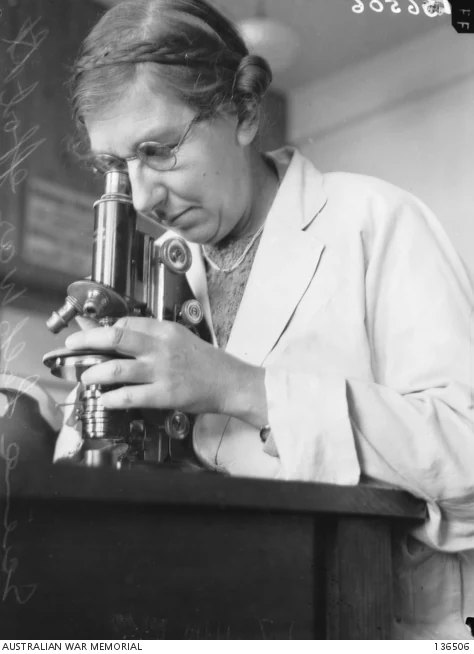
Cookson later examined microscopic plant remains, including spores and pollen. The scale of the research changed. A large plant fossil might show stems or branches, while grains in sediments offered another set of features to compare. Her 1950 paper on pollen of proteaceous type examined grains in Australian deposits. A catalogue still records one of the fossil names she established, Proteacidites rectomarginis.
Keeping identifications usable
Her research depended on sharing descriptions other people could use across different samples. A name attached to a fossil grain is a way to return to that comparison. It does not make every observation equivalent to an identification of a modern species. Cookson’s work helps readers see how botanical expertise and geological evidence meet in the examination of small and often incomplete remains.
Quick answers
Frequently asked questions about Isabel Cookson
- Did Cookson work only on plant fossils visible without a microscope?
- No. She also studied fossil spores, pollen and other microfossils.
Keep exploring
Lives connected to this story
- Dorothy Hill
Compare another Australian scientist linking descriptions to evidence from rock sequences.
- Birbal Sahni
Read a different career that compared fossil plant structures with living plants.
Sources and further reading
Explore the evidence
These references support the biography and offer further reading. Official records, first-person accounts and independent reporting provide different perspectives; image records document attribution and licensing.
- 1. Australian Dictionary of BiographyIsabel Clifton Cookson
- 2. Museums VictoriaIsabel Cookson: one tough Cookie
- 3. Museums Victoria collectionsBaragwanathia longifolia
- 4. Isabel C. Cookson, Australian Journal of Biological Sciences, 1950Fossil Pollen Grains of Proteaceous Type From Tertiary Deposits in Australia
The original title uses a family resemblance formulation, “proteaceous type.”
- 5. GNS Science fossil spores and pollen catalogueProteacidites rectomarginis Cookson 1950
The catalogue follows a fossil taxon and later identifications rather than proving one modern species.