In this biography
Quick facts
- Born
- Circa 1870–1872
- Died
- 1 April 1965
- Birthplace
- Kraków, now Poland
- Country
- Australia
- Nationality
- Not independently established
- Known for
- Building a beauty business in Melbourne and developing it into an international cosmetics enterprise
- Early business base
- Melbourne, Victoria
- Signature early product
- Crème Valaze
- International expansion
- London from 1908, followed by Paris and New York
- Australian connection
- Foundational salon business and later support for artists; not a claim of Australian nationality
Why this life matters
Her Australian beginnings show how a consumer brand can combine a physical product with service, trusted presentation and an aspirational identity, while making commercial success no guarantee of the truth of its claims.
Timeline
Key moments
Birth in Kraków
Institutional accounts disagree on the exact year.
Australia
Moves to Australia and spends time in Victoria before establishing the Melbourne business.
Melbourne beginnings
Australian accounts date the first salon to 1902; the Jewish Museum dates Helena Rubinstein & Co. to 1903.
An expanded institute
A larger Melbourne service business accompanies the growing product line.
International growth
London and Paris expansion precedes a wartime move into the American market.
Philanthropic institutions
Establishes a foundation and later an Australian travelling art scholarship.
Death
Dies in New York on 1 April.
A migrant’s career emerged from work in Victoria
Born in Kraków, Rubinstein came from a Polish Jewish background and moved to Australia in the 1890s. Her early years have accumulated contradictory dates and stories. The Australian Dictionary of Biography itself marks her birth year as uncertain, so a precise birthday should not be used to give a misleading impression of certainty.
She spent time in Coleraine and worked in domestic service and Melbourne tearooms before entering beauty retailing. The business did not emerge from an already-established international corporation. Australia was where she first developed an enterprise, though her later Polish-American identity and international career cannot be reduced to a single national label.
Melbourne supplied more than a picturesque origin story
Australian accounts place her first salon in 1902; the Jewish Museum dates Helena Rubinstein & Co. to 1903. Those descriptions should not be compressed into an invented exact incorporation date. What is clear is the early Melbourne combination of Crème Valaze, personal beauty advice and a business carrying her name.
Capital and collaborators mattered. Poynter’s account identifies support from tea-company manager J. T. Thompson, an artist, a printer and her sister Ceska. A founder-centred story can obscure such practical contributions. Money, labels, introductions and labour helped turn a proposed product into something that customers could recognise, purchase and return for.
Prestige and scientific language were commercial tools
Rubinstein promoted a story of rare European ingredients and specialist knowledge. In ABC’s interview, National Portrait Gallery director Angus Trumble challenged the imported-herbs narrative and identified a Melbourne manufacturing connection. The criticism is material to understanding the enterprise: a claim of distant expertise could make an ordinary preparation seem exclusive.
The salons also supplied consultation, treatment and an environment of luxury. These could help a customer regard cosmetics as a respectable, considered purchase rather than a theatrical indulgence. Yet the appearance of a laboratory or a specialist consultation was not proof of every therapeutic promise. The commercial innovation and the questionable claims need to be considered together.
International growth extended both the product and the persona
From 1908 Rubinstein expanded into London, followed by Paris, and entered the American market during the First World War. Family collaborators helped operate an increasingly international business. Her name became a link among products, salons and publicity, rather than merely the name above one Melbourne room.
Art and design became part of this presentation. The Metropolitan Museum documents commissions for salons and homes, while the Jewish Museum interprets her portraits, clothing and interiors as elements of self-promotion. A consumer could encounter the brand through packaging or retail distribution without visiting a flagship salon. The highly visible salon helped give a much wider product business its character.
Her legacy includes institutions as well as a consumer brand
Rubinstein established a foundation in 1953 and an Australian travelling art scholarship in 1957. Art patronage was not simply a hobby detached from her business: collecting, commissioned portraits and salon design had long interacted with her public identity. Philanthropic institutions gave part of that interest a life beyond individual purchases.
She died in New York in April 1965. The later dispersal and exhibition of her collections made it possible to examine how commerce and visual culture had reinforced one another. Her career widened the possibilities available to a woman entrepreneur while also selling standards of appearance. That tension is more informative than either an uncomplicated empowerment legend or a dismissal of the enterprise as mere advertising.
Quick answers
Frequently asked questions about Helena Rubinstein
- Why is she included in the Australia archive?
- Melbourne was the foundational business setting. This is not a claim that her entire career or nationality was Australian.
- Is her exact birth year settled here?
- No. Reviewed institutional accounts range from about 1870 to 1872.
- Did she build the business without collaborators?
- No. Financial, design, printing and family contributions were part of the Melbourne beginnings.
- Does sales success prove the product’s scientific claims?
- No. Commercial demand, product branding and demonstrated therapeutic effectiveness are different questions.
Keep exploring
Lives connected to this story
- Mary Reibey
Compare a migrant woman’s enterprise with the later simplifications of a founder legend.
- Naomi Simson
Compare a consumer business built around experience, service and a recognisable public identity.
Sources and further reading
Explore the evidence
These references support the biography and offer further reading. Official records, first-person accounts and independent reporting provide different perspectives; image records document attribution and licensing.
- 1. J. R. Poynter / Australian Dictionary of BiographySelected indexed passages: uncertain birth, Melbourne collaborators, foundation and death
Indexed biography passages read; direct page access failed. Uncertain birth and early chronology retained rather than relying on the more categorical life-summary fields.
- 2. Angus Trumble / National Portrait Gallery2 October 2018 Study in Scarlet: selected Australian business and brand passages
- 3. Louise Maher / ABC News8 August 2018: Australian origins and historian’s critique of the product mythology
Historian’s critique is attributed, not converted into an unreviewed court finding or clinical assessment.
- 4. Rachel Boate / Metropolitan Museum of ArtModern Art Index Project: identity, international expansion and selected art-commission passages
Used for Polish-American identity, selected expansion and art commissions. Conflicting arrival, marriage and first-New-York-salon details are not adopted.
- 5. Mason Klein / The Jewish Museum2014–15 exhibition account: salon model, self-presentation and art collection
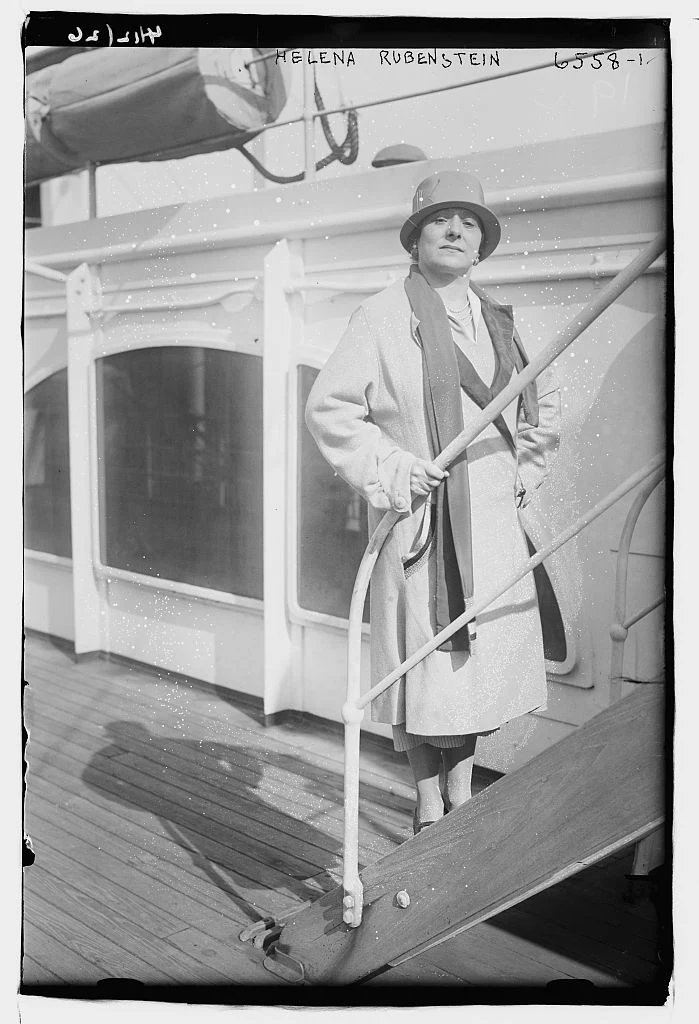
- 6. Bain News Service / Library of Congress, Wikimedia Commons recordHelena Rubenstein LCCN2014719292.jpg: exact full-negative identity, provenance, assessment and two file versions
Full-negative source and both versions reviewed. A 1926 catalogue date is not independently established first-publication evidence; the rights basis also uses the official collection-specific statement.
- 7. Library of Congress, Prints & Photographs DivisionGeorge Grantham Bain Collection: collection-specific rights statement, revised November 2015