
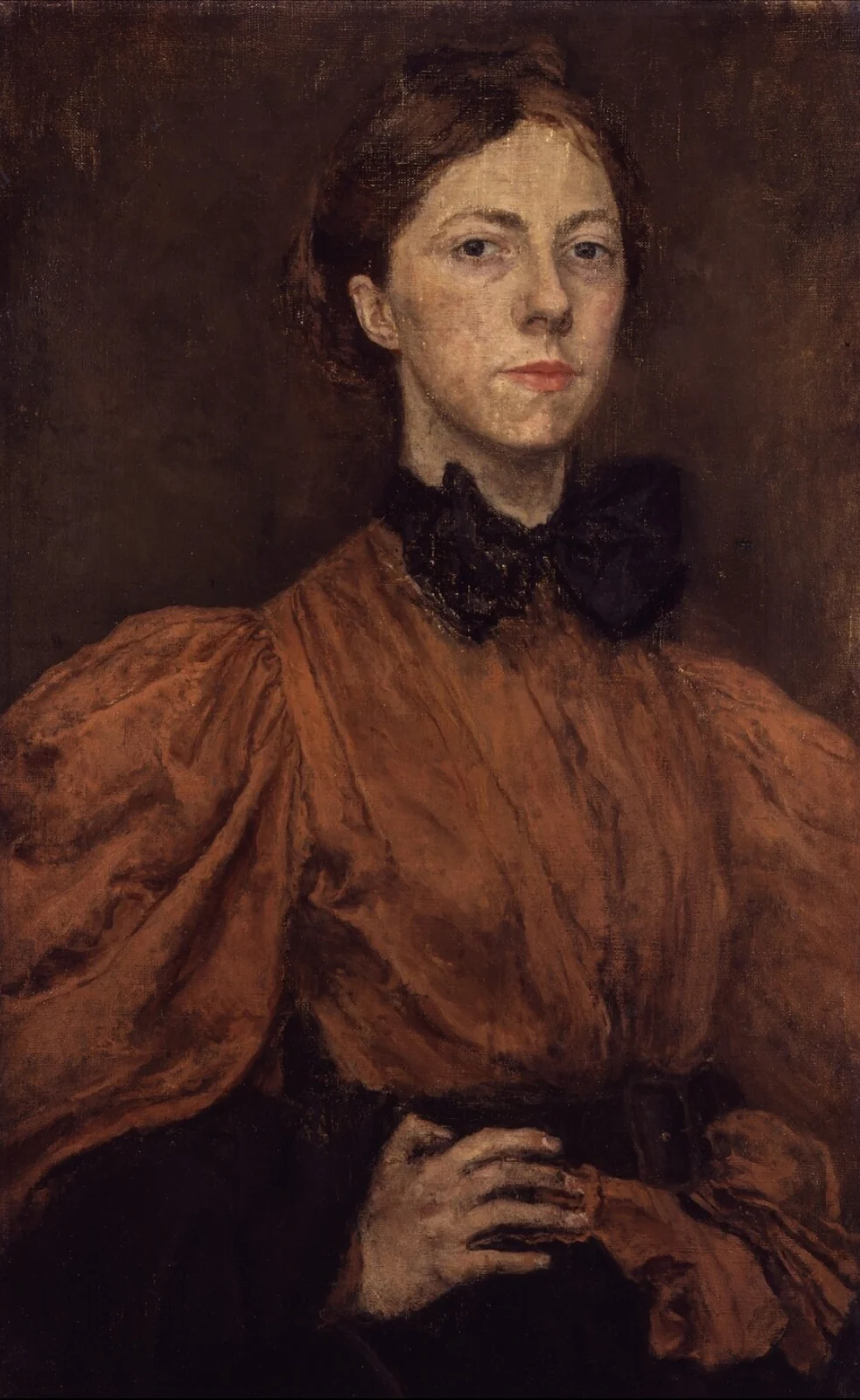
In this biography
Quick facts
- Born
- 1876
- Died
- 1939
- Birthplace
- Haverfordwest, Wales
- Country
- United Kingdom
- Nationality
- Not independently established
- Known for
- Quietly structured portraits, interiors and drawings made in Wales and France
Why this life matters
Her repeated subjects make careful changes of tone, touch and arrangement a central part of modern painting.
Timeline
Key moments
Slade training
Formal study in London developed sustained work from life.
Paris
Modelling and painting supported a working life in France.
Religious subjects
Conversion and the Poussepin commission informed later work.
A larger public record
Museum Wales acquired extensive drawings and studio material.
A Welsh student in a changing art world
Gwen John was born in Haverfordwest, Wales, in 1876. She studied at the Slade School of Fine Art in London from 1895 to 1898, part of a generation of women gaining access to sustained professional training. Henry Tonks emphasised drawing from life. Her classmates included William Orpen and her brother Augustus, but a shared school did not produce identical careers. John developed an especially concentrated practice of looking, drawing and revisiting subjects rather than treating a quickly recognisable public manner as her principal goal.
Making a working life in France
After a walking journey through France with Dorelia McNeill in 1903, John settled in Paris by early 1904. Modelling helped support her painting; Auguste Rodin was both an employer and a romantic partner. Her small rented rooms became subjects as well as places to work. The Paris interiors therefore belong to a practical history of finding space and income. They also demonstrate that a modest domestic setting could sustain ambitious decisions about shape, light and the relations between objects.
Repeated figures and a wider circle
John later lived in Meudon and became a Catholic around 1913. Parishioners, nuns and children entered her drawings and paintings. A commission to portray the convent founder Mère Marie Poussepin required work from an existing image and repeated versions. Her career was supported by the American collector John Quinn, while correspondence with fellow artist Ursula Tyrwhitt maintained a lasting professional friendship. These connections complicate the familiar description of John as an isolated figure: solitude in an image is not evidence of an artist without a working community.
Drawings, collections and a longer reputation
Drawing occupied an important place in John’s later practice, including swiftly made observations that could gain force when seen together. She died in France in 1939. Museum Wales had purchased Girl in a Blue Dress in 1935; a much larger acquisition from her estate followed in 1976. Those drawings, sketchbooks and studies broaden the public account beyond a few subdued oil paintings. Her achievement lies in the range of attention brought to recurring subjects, not simply in an appearance of quietness.
Quick answers
Frequently asked questions about Gwen John
- Was Gwen John only a portrait painter?
- No. Interiors, still lifes and numerous drawings are essential parts of her practice.
- Did she work entirely alone?
- Her independent practice included patrons, fellow artists, modelling work and long correspondence.
Keep exploring
Lives connected to this story
- Grace Cossington Smith
Compare another artist who made domestic space and sustained attention important to modern painting.
- William Orpen
Compare another Slade-trained artist whose portraits and interiors developed in a different professional setting.
Sources and further reading
Explore the evidence
These references support the biography and offer further reading. Official records, first-person accounts and independent reporting provide different perspectives; image records document attribution and licensing.
- 1. Ashmolean Museum, Eliza GoodpastureGwen John’s Quiet Genius
Curatorial discussion of letters was read; the private correspondence itself was not inspected.
- 2. Amgueddfa Cymru – Museum WalesA corner of the artist’s room in Paris, NMW A 3397
The guide follows Museum Wales object NMW A 3397. Sheffield and private room versions are not merged into its date, dimensions or provenance.
- 3. Amgueddfa Cymru – Museum WalesBritish Art around 1900: looking to France
- 4. Amgueddfa Cymru – Museum WalesMajor Gwen John Retrospective