In this biography
Quick facts
- Born
- 12 December 1915
- Died
- 14 May 1998
- Birthplace
- Hoboken, New Jersey, United States
- Country
- United States
- Nationality
- American
- Known for
- Interpretive popular singing, Capitol concept albums and the founding of Reprise Records
- Full name
- Francis Albert Sinatra
- Capitol period
- Recording relationship began in 1953
- Record label
- Founded Reprise in 1960
- Acting award
- Supporting-actor Oscar, 1954, for From Here to Eternity
Why this life matters
His work connected big-band singing, intimate recorded performance, cinema and the long-playing album, with arrangers and musicians central to the resulting sound.
Timeline
Key moments
Born in Hoboken
Francis Albert Sinatra was born on 12 December in New Jersey.
The Hoboken Four
The vocal group appeared on Major Bowes and His Original Amateur Hour.
Capitol recording chapter
Sinatra joined Capitol and began the collaboration with Nelson Riddle that helped renew his recording career.
A film-acting Oscar
The Academy honored his supporting performance in the 1953 film From Here to Eternity.
Reprise founded
He formed his own record label, seeking greater artistic independence.
Death in Los Angeles
Sinatra died on 14 May, leaving a recording and screen career spanning decades.
A singer from Hoboken
Francis Albert Sinatra was born in Hoboken, New Jersey, on 12 December 1915. His mother, Dolly, was active in local politics, and his father worked as a tavern owner and firefighter after boxing. The Hoboken Historical Museum places his upbringing within a city divided by ethnicity and class, but also filled with clubs, dances and informal opportunities for young singers. His beginnings were local and practical, rather than the product of a conservatory qualification.
In 1935 he joined the Hoboken Four for a national radio amateur contest. Work with Harry James and Tommy Dorsey brought him into the big-band world before solo fame. By the 1940s, his intimate delivery and extraordinary following had made him a major public figure. The singer's relationship with an audience became part of the performance itself.
The voice was a collaborative instrument
Sinatra's recorded identity depended on interpretation: the placement of a phrase, the pacing of a line and the emotional stance taken toward a song. It also depended on written arrangements and musicians. His 1953 move to Capitol opened a particularly influential chapter. Nelson Riddle became a central collaborator, but the familiar pairing should not erase other contributors.
Songs for Young Lovers, released in 1954, illustrates the distinction. Riddle conducted the sessions, while George Siravo supplied most of the arrangements; Riddle arranged Like Someone in Love. Later Capitol projects involved Gordon Jenkins and Billy May as well. These names describe different musical jobs and approaches, not interchangeable backing. Sinatra's achievement was partly the ability to work within such carefully designed settings while making a recorded performance feel personal.
Album-length moods and a screen career
In the Wee Small Hours, released in 1955, organized a full program around heartbreak, with Riddle's arrangements and Voyle Gilmore's production. Songs for Swingin' Lovers! followed in 1956 with a markedly brighter approach. The contrast shows why Sinatra's albums are more than containers for familiar songs: selection and sequence could establish an emotional world across a whole record.
Cinema gave him another kind of interpretive work. His performance in From Here to Eternity earned the supporting-actor Oscar at the Academy's March 1954 ceremony, honoring a film released in 1953. The award belongs to acting rather than record sales, and its date should not be confused with the film's release. His public career consequently moved between media, instead of following a single uninterrupted path through the record industry.
Reprise and room to make choices
In 1960 Sinatra formed Reprise Records, pursuing greater freedom over his recording work. The label became a business as well as an artistic vehicle and eventually released work by many other performers. Founding a label did not make every subsequent recording a solitary creation: producers, arrangers, instrumentalists and other singers continued to shape the results.
The distinction between his labels remains useful when exploring the catalog. Capitol's 1950s album programs belong to a particular recording chapter; Reprise projects represent another. Later compilations can place selections from different periods together, and modern editions may carry new release or remastering dates. Those products preserve and recirculate the music, but their packaging should not replace the original chronology of Sinatra's artistic decisions.
A long career and a continuing recorded legacy
Recognition continued well beyond the Capitol years. The Recording Academy gave Sinatra its Lifetime Achievement Award in 1966, and his later recording work remained part of its awards history. His career cannot be reduced to one arranger, one vocal mood or the polished image attached to a handful of signature songs. It involved repeated changes of setting and collaboration across several decades.
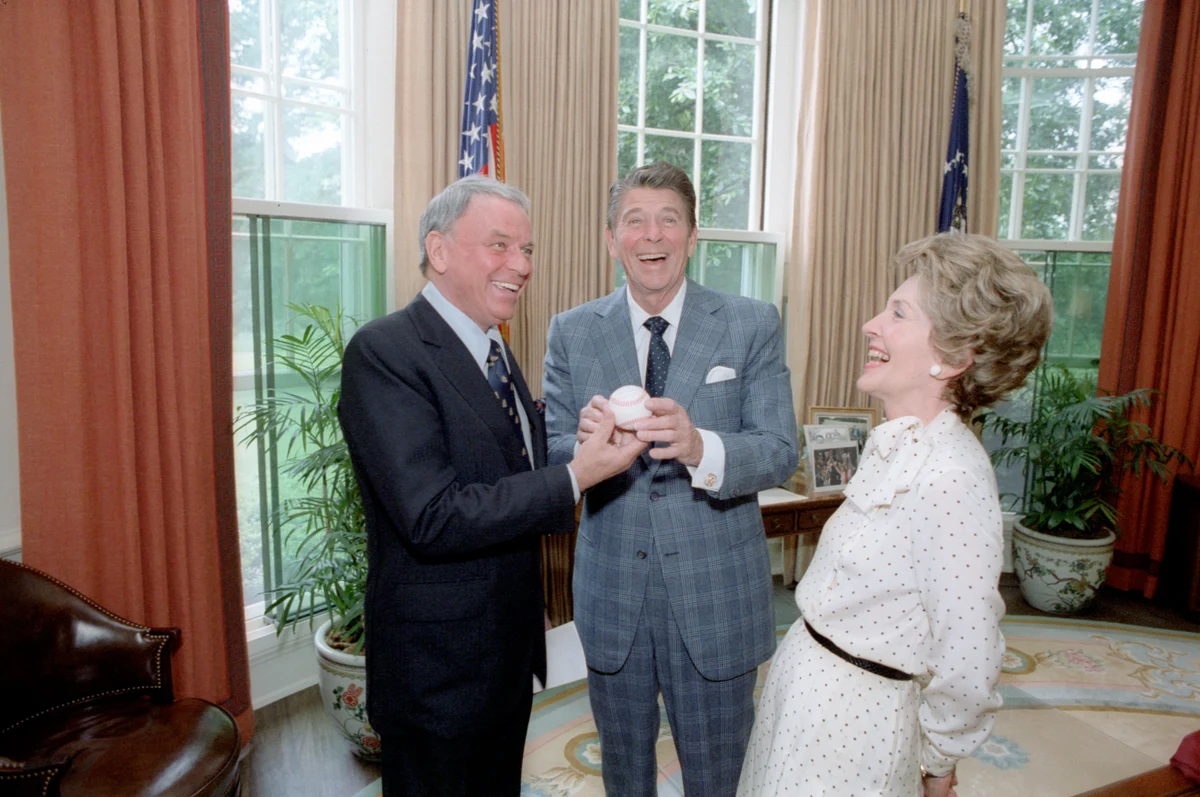
Sinatra died in Los Angeles on 14 May 1998. In Hoboken, fans gathered at his birthplace memorial, making the connection between the international celebrity and the city of his youth visible again. The photograph on this page is from a 1981 White House visit, not a Capitol recording session. His enduring cultural importance rests above all in performances whose apparent ease emerged from detailed musical preparation and shared work.
Quick answers
Frequently asked questions about Frank Sinatra
- What was Frank Sinatra's full name?
- His full name was Francis Albert Sinatra. He was born in Hoboken, New Jersey, on 12 December 1915.
- Did Nelson Riddle arrange all of Sinatra's Capitol recordings?
- No. Riddle was a major collaborator, but George Siravo, Gordon Jenkins, Billy May and others also contributed arrangements. Riddle conducted Songs for Young Lovers while Siravo arranged most of its selections.
- When did Sinatra found Reprise Records?
- He formed Reprise in 1960, seeking greater artistic independence. Its releases should be distinguished from the original Capitol album programs.
- When did Sinatra win his acting Oscar?
- He won the supporting-actor award on 25 March 1954 for From Here to Eternity, which had been released in 1953.
Keep exploring
Lives connected to this story
- Ella Fitzgerald
Compare another major interpreter of the American song repertoire, with a different approach to phrasing and recorded programs.
- Billie Holiday
Explore another singer whose interpretation could change a song's emotional meaning.
- Duke Ellington
Read about bandleading, arrangement and the distinctive musical contributions of an ensemble.
Sources and further reading
Explore the evidence
These references support the biography and offer further reading. Official records, first-person accounts and independent reporting provide different perspectives; image records document attribution and licensing.
- 1. Hoboken Historical MuseumFrank Sinatra, The Voice
- 2. Frank Sinatra EnterprisesFrank Sinatra Timeline
Used for the Hoboken Four and Harry James period. The separate timeline page 2's 1955 label for Songs for Young Lovers is not used; the LOC original-album chronology is preferred.
- 3. Library of Congress, National Recording RegistrySongs for Young Lovers — essay by James Kaplan
James Kaplan's complete three-page Registry essay supplies the original 1954 album date and Siravo/Riddle distinction. Its loose 1939 Dorsey-debut dating is not repeated as a precise start date.
- 4. Blue Note RecordsFrank Sinatra: In the Wee Small Hours, 70th Anniversary
- 5. Capitol/Blue Note and Frank Sinatra EnterprisesSongs for Swingin' Lovers!: 70th Anniversary Edition
- 6. Academy of Motion Picture Arts and SciencesThe 26th Academy Awards, 1954
- 7. Frank Sinatra Enterprises/UMeThe Romance of Frank Sinatra Goes Digital with Reprise Rarities Volume 2
Official indexed article text identifies the 1960 founding of Reprise. Direct opening returned an internal retrieval error; no absolute industry-first claim is taken from its promotional language.
- 8. Capitol/UMe and Frank Sinatra EnterprisesFrank Sinatra: Platinum
- 9. Recording AcademyFrank Sinatra: Awards and Biography
- 10. Ronald Reagan Presidential Library and MuseumMeeting with Celebrities: C2232-34
C2232-34 identifies the 3 June 1981 White House visit. The later contextual image is not presented as a 1950s studio photograph; individual White House staff photographer remains unidentified.
- 11. National Archives / Wikimedia CommonsExact photograph, creator and rights record