In this biography
Quick facts
- Born
- 7 April 1915
- Died
- 17 July 1959
- Birthplace
- Philadelphia, Pennsylvania, United States
- Country
- United States
- Nationality
- American
- Known for
- Innovative jazz phrasing, Strange Fruit and a major recorded vocal legacy
- Birth name
- Eleanora Fagan
- Professional nickname
- Lady Day, given by Lester Young
- First commercial records
- Recorded with Benny Goodman in 1933
- Strange Fruit
- Recorded Abel Meeropol's song for Commodore on 20 April 1939
- Memoir
- Lady Sings the Blues, with William Dufty, 1956
- Late album
- Lady in Satin, recorded for Columbia in 1958
Why this life matters
Holiday made interpretation a powerful form of musical authorship. Her recordings reshaped jazz singing, while her performance of Strange Fruit carried an anti-lynching protest to a wide audience.
Timeline
Key moments
Born in Philadelphia
Born Eleanora Fagan; she grew up in Baltimore before moving into New York's musical world.
Recording debut
John Hammond arranged her first commercial recordings with Benny Goodman.
Teddy Wilson collaborations
Began the small-group recording partnership that helped establish her distinctive jazz voice.
Strange Fruit on record
Recorded the anti-lynching song for Commodore after performing it at Café Society.
Return at Carnegie Hall
Performed at Carnegie Hall shortly after leaving prison, returning to a major public concert platform.
Death in New York
Died at forty-four after a career that included swing-era singles, concert appearances and later studio albums.
From Baltimore to the recording studio
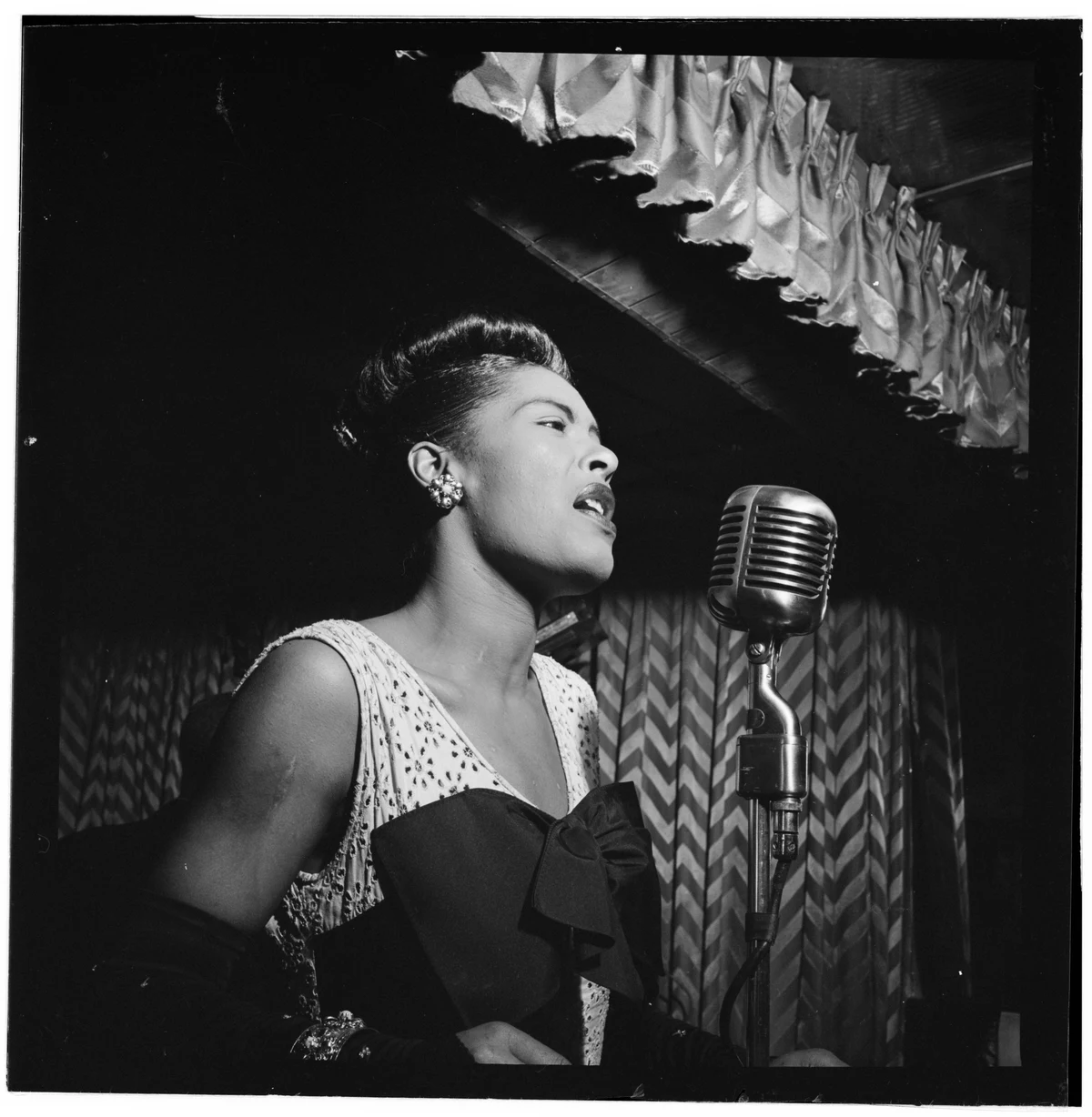
Billie Holiday was born Eleanora Fagan in Philadelphia on 7 April 1915 and grew up in Baltimore. Records by Bessie Smith and Louis Armstrong helped shape her early musical imagination. In New York, she developed through nightclub work rather than a conservatory course, learning to make a song communicate within the practical demands of a working room and an accompanying band.
Producer John Hammond helped bring her into the studio with Benny Goodman in 1933. Recording introduced a setting different from the nightclub: a short performance could circulate far beyond the people present in the room. Holiday's emerging art was not based on overpowering volume. It depended on the placement of words, a flexible rhythmic line and the ability to make familiar material feel personally considered.
A singer among improvising musicians
From 1935, Holiday's recordings with pianist Teddy Wilson placed her alongside leading swing musicians. Her partnership with tenor saxophonist Lester Young became especially important. He called her Lady Day; she called him the Prez. Their musical exchange helps explain why her singing is often discussed in relation to instrumental improvisation rather than simply the delivery of a written melody.
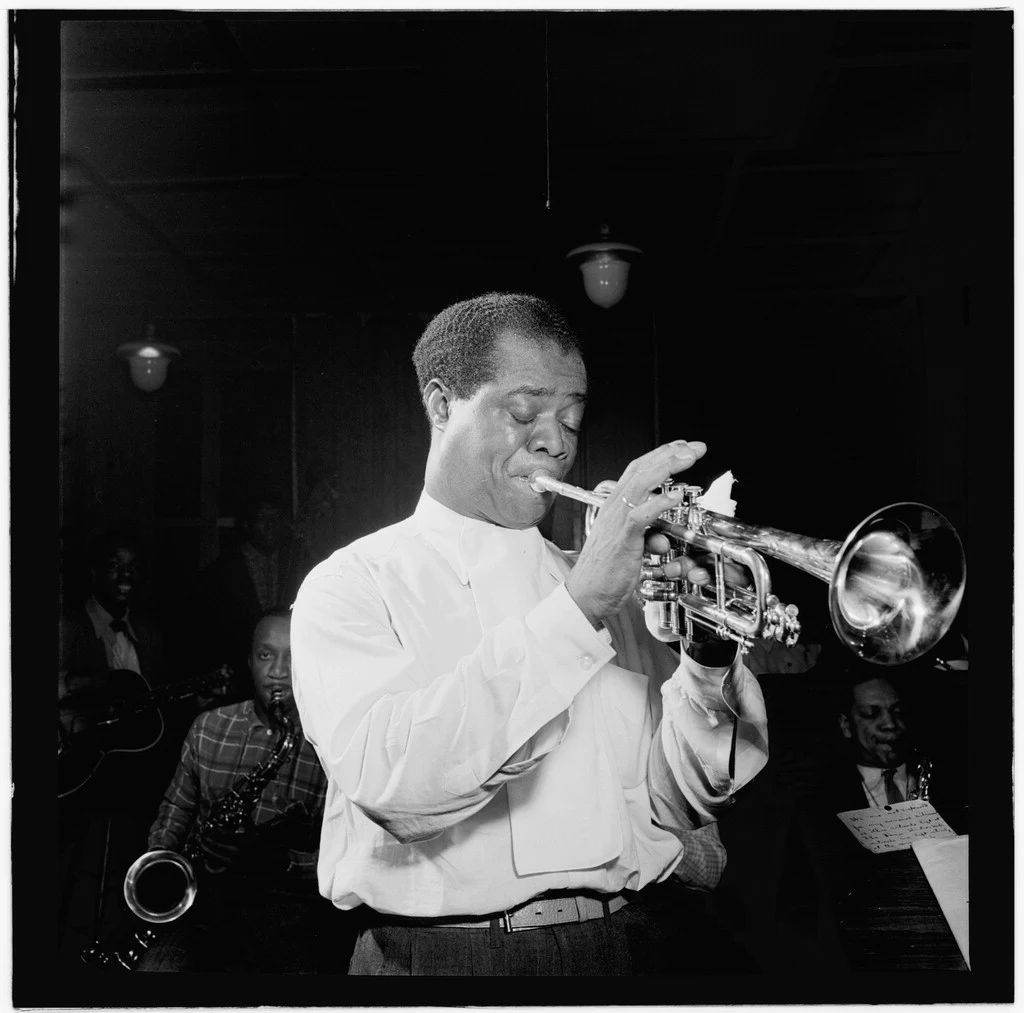
Holiday could alter emphasis and timing while keeping a song recognizable. The result made the singer an active musical interpreter, not an interchangeable voice placed in front of an arrangement. Her later work with Armstrong also connected inspiration to collaboration: they shared concert programs, appeared in the film New Orleans and made a joint studio session in 1949. Her career belonged to a community of musicians as well as to a celebrated individual voice.
Touring and the choice to sing Strange Fruit
Holiday toured with Count Basie in 1937 and Artie Shaw in 1938, working within a music business divided by racial barriers. Professional visibility did not protect a Black singer from segregated audiences and unequal treatment. By the end of the decade, her engagement at Barney Josephson's integrated Café Society offered another kind of setting for a public performance.
There she made Strange Fruit central to her repertoire in 1939. Abel Meeropol wrote the words and music; Holiday's contribution was the interpretation that brought its anti-lynching protest to a broad public. Columbia declined to record it but allowed a session for the independent Commodore label. The 20 April 1939 recording therefore reflects both her artistic choice and the importance of a producer and label willing to issue it.
Records, restrictions and the concert stage
Holiday's career continued across changing record companies and performance settings. She recorded for Decca in the 1940s, then worked with Norman Granz's Clef and Verve labels in the 1950s. Small-group sessions remained an important part of her musical life even as the record business increasingly organized performances into long-playing albums.
Her 1947 narcotics conviction and imprisonment also had professional consequences. The loss of her New York cabaret card restricted work in city clubs serving alcohol; it was not a nationwide ban on singing. On 27 March 1948, soon after her release, she returned to a major audience at Carnegie Hall. Concerts and work outside those licensed New York clubs remained possible. The distinction matters because punishment constrained her livelihood without ending her activity as a performer.
Later work beyond the tragic legend
In 1956 Holiday collaborated with journalist William Dufty on the memoir Lady Sings the Blues. The book helped shape a public life story that should be distinguished from the records themselves. Her work also continued in the studio: Lady in Satin, made for Columbia in 1958, belongs to a late career in which listeners and critics have debated the relationship between a changing voice and expressive command.
Holiday died in New York on 17 July 1959, aged forty-four. Addiction, racism and abusive relationships are part of her history, but they do not explain away her musical decisions. Her lasting achievement rests on interpretation as creative work: a phrase could be delayed, redirected or given a new emotional weight. Remembering that craft restores the working musician to a biography too often reduced to suffering alone.
Quick answers
Frequently asked questions about Billie Holiday
- What was Billie Holiday's birth name?
- She was born Eleanora Fagan in Philadelphia on 7 April 1915 and grew up in Baltimore. She became professionally known as Billie Holiday and was nicknamed Lady Day by Lester Young.
- Did Billie Holiday write Strange Fruit?
- No. Abel Meeropol wrote its words and music, using the pen name Lewis Allan. Holiday made the song famous through her performances and her 1939 Commodore recording.
- Was Holiday banned from performing everywhere?
- No. Losing her New York cabaret card restricted work in city clubs serving alcohol. She could still perform in concert halls and elsewhere, including her major Carnegie Hall return in March 1948.
- Why is Holiday important to jazz singing?
- Her flexible timing, phrasing and interpretation made familiar songs sound newly personal. Her work with improvising musicians helped establish the singer as a creative musical participant.
Keep exploring
Lives connected to this story
- Louis Armstrong
Explore an important early influence who later became Holiday's film, concert and recording collaborator.
- Ella Fitzgerald
Compare another major jazz singer's career and a different approach to vocal improvisation.
- Paul Robeson
Consider another singer whose public career joined artistic interpretation to struggles over race and political freedom.
Sources and further reading
Explore the evidence
These references support the biography and offer further reading. Official records, first-person accounts and independent reporting provide different perspectives; image records document attribution and licensing.
- 1. Estate of Billie HolidayBillie's Story
Used selectively for career and collaborations. Excluded its statement that Strange Fruit's music was written specifically for Holiday, its absolute Shaw-band first, its God Bless the Child year and its incorrect New Orleans film year.
- 2. Library of CongressCary O'Dell: Strange Fruit—Billie Holiday (1939)
Used for 20 April 1939 recording and career context; its stated session age of 23 conflicts with her verified 7 April 1915 birth. No exact release day or speculative childhood detail adopted.
- 3. Library of CongressJulia Blackburn: Strange Fruit—Billie Holiday (1939)
Used for Columbia's permission and Commodore pathway. Did not adopt the guest author's speculative song-to-arrest/cabaret-card causation or identification of the inspiring lynching photograph.
- 4. Smithsonian National Museum of American HistoryStrange Fruit; Fine and Mellow: Commodore record
- 5. Smithsonian National Portrait GalleryBillie Holiday: Roy DeCarava portrait and sitter dates
- 6. Louis Armstrong House MuseumShe Just Sends Me All Over: Billie Holiday and Louis Armstrong
- 7. PBS / Florentine FilmsJazz: Risk, Episode 8—official transcript
Read the relevant official documentary transcript, including the cabaret-card restriction and continued concert work; no claim of watching the entire episode or listening to recordings.
- 8. Carnegie Hall ArchivesCelebrating Black History at Carnegie Hall
- 9. Library of CongressBillie Holiday at the Downbeat, circa February 1947