
In this biography
Quick facts
- Born
- 1906 or 1908 (disputed)
- Died
- 2004
- Birthplace
- Queens, New York City, United States
- Country
- United States
- Nationality
- American
- Known for
- Co-founding Estée Lauder Cosmetics with Joseph Lauder in 1946 and developing demonstration-led prestige cosmetics retailing
- Birth name
- Josephine Esther Mentzer
- Birth year
- 1908 in company and White House accounts; 1906 also reported
- Company founding
- 1946, with Joseph Lauder
- Youth-Dew
- Bath oil and fragrance introduced in 1953
- International expansion
- Harrods in London became the first overseas account in 1960
- National recognition
- Presidential Medal of Freedom, posthumously in 2004
Why this life matters
Her career illustrates the commercial importance of branding, customer demonstrations and distribution, alongside the collaborators and family members behind an expanding company.
Timeline
Key moments
Queens beginnings
Born Josephine Esther Mentzer; 1908 is used in the company account, while some published accounts give 1906.
Company established
Estée and Joseph Lauder founded the cosmetics business together.
Youth-Dew introduced
A bath oil that could also serve as perfume became an important branded product.
An overseas account
The business began international expansion with Harrods in London.
Retirement and a public company
The corporate founder account dates her retirement to this year; the company also made its stock-market debut.
Death and posthumous honor
Lauder died in April; her sons accepted the Presidential Medal of Freedom on her behalf in June.
Learning beauty work in Queens
Estée Lauder grew up in Queens, New York, as Josephine Esther Mentzer, the daughter of immigrant parents. Her company’s biography dates her birth to 1908 and explains Estée as a version of the childhood nickname Esty. Other accounts give 1906, a reminder that the public image of a celebrated entrepreneur can become clearer than some details of her early life.
A chemist uncle introduced her to making and applying skin creams. She began selling beauty preparations through salons, where she could demonstrate them directly to customers. This work combined learning about products with observing how people responded to them. Her later department-store business developed from practical selling and repeated contact with customers, rather than from a single isolated invention.
A business founded with Joseph Lauder
In 1946, Estée and her husband Joseph Lauder established the company together. Her name became its public identity, but Joseph was a co-founder, not a peripheral figure added to an otherwise solitary enterprise. The corporate family history describes a small operation that initially depended on their own work before it developed a larger organization.
Department stores provided a route to customers seeking prestige cosmetics. By the late 1940s, Saks Fifth Avenue was carrying the products, giving the business a position beyond individual salon demonstrations. Growth also became a family project: Leonard Lauder joined in 1958 and Ronald Lauder in 1964. Their subsequent responsibilities make the company’s history broader than the founder’s personal story alone.
Demonstrations, samples and a recognizable brand
Lauder emphasized showing customers how a product looked and felt, rather than relying only on an advertisement or a sealed package. Samples and gifts accompanying purchases became recognizable parts of the company’s approach. PBS’s account emphasizes the opportunity to try cosmetics before committing to a purchase, connecting those promotions with the expanding consumer market after the Second World War.
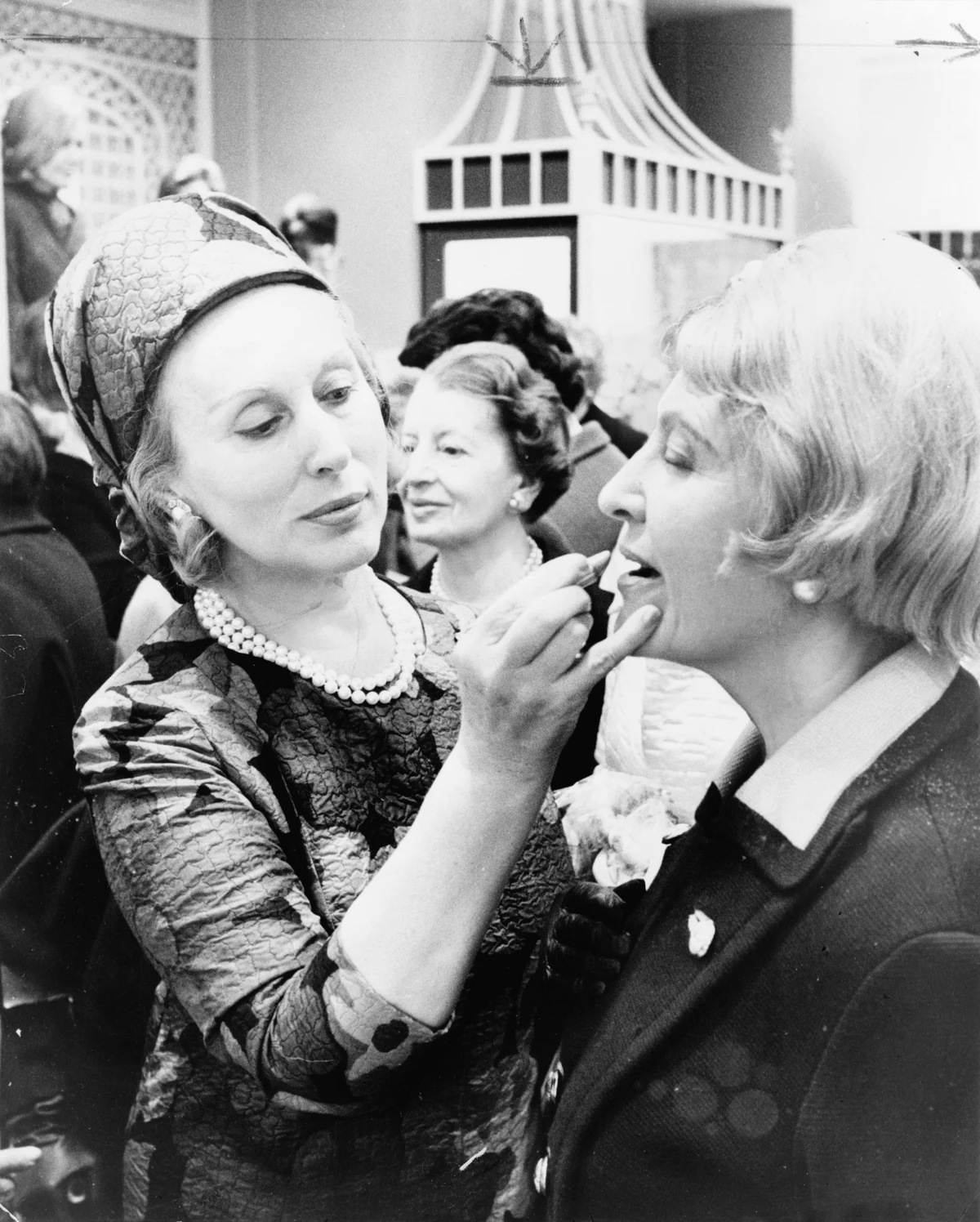
The 1966 photograph of Lauder applying lipstick to a customer captures that face-to-face method. Packaging and display also helped distinguish the brand within a crowded retail setting. These practices linked service with promotion: customers received attention while encountering products the business hoped they would buy. Their importance does not require claiming that Lauder invented every form of sampling or personal selling.
Fragrance and international expansion
Youth-Dew, introduced in 1953, combined a bath oil with a product that could be worn as perfume. The company presents it as a way of encouraging women to purchase fragrance for themselves rather than waiting to receive it as a gift. That interpretation describes the firm’s marketing strategy, not a universal account of what every customer wanted.
In 1960, Harrods in London became the company’s first overseas account. Further expansion included distinct brands rather than simply more items under one label. The 1968 Clinique launch involved dermatologist Norman Orentreich, beauty editor Carol Phillips and members of the Lauder family. Estée’s leadership operated through a growing network of specialists, retailers and managers, not through personally formulating every later product.
A founder’s legacy beyond the counter
The company dates Lauder’s retirement to 1995, the same year it became publicly traded. Family leadership continued, but the expanding group was no longer equivalent to the small operation established in 1946. Its retrospective celebrates her persistence; the historical record also shows the importance of distribution, employees and successive generations of management.
Lauder supported civic and cultural projects, including children’s play areas in New York. After her death in April 2004, President George W. Bush awarded her the Presidential Medal of Freedom posthumously. Leonard and Ronald accepted it at the June ceremony. Her legacy rests in the business she helped build and in a model of retailing that made personal attention part of a large-scale branded service.
Quick answers
Frequently asked questions about Estée Lauder
- Was Estée Lauder born in 1906 or 1908?
- Both years are reported. The company’s biography and the 2004 White House tribute use 1908, while other published accounts give 1906. The available accounts do not establish one uncontested date.
- Did she establish the company alone?
- No. Estée and Joseph Lauder founded the company together in 1946. Their sons and other employees later helped develop its brands, operations and international reach.
- What was Youth-Dew?
- It was a branded bath oil introduced in 1953 that could also be worn as perfume. The company describes its marketing as encouraging women to buy fragrance for themselves.
- When did the business expand overseas?
- The company dates its first overseas account to Harrods in London in 1960. That was an expansion of a business already operating in the United States, not its founding.
Keep exploring
Lives connected to this story
- Indra Nooyi
Compare women’s business leadership across different generations and distinguish a founder’s role from later corporate management.
- Steve Wozniak
Compare product expertise, collaboration and the commercial work needed to turn a small enterprise into a wider business.
Sources and further reading
Explore the evidence
These references support the biography and offer further reading. Official records, first-person accounts and independent reporting provide different perspectives; image records document attribution and licensing.
- 1. The Estée Lauder CompaniesOur Founder — corporate retrospective
Corporate retrospective used with attribution for product and selling strategy. It and the White House use 1908; Grazia’s published account gives 1906. No unqualified exact birth date or age-at-death calculation is asserted.
- 2. The Estée Lauder CompaniesThe Lauder Family — co-founders and historical family roles
- 3. The Estée Lauder CompaniesOur Heritage — dated products, international expansion and public-company debut
Product and brand names identify the company’s commercial offerings. Promotional quality, medical efficacy, first-ever industry and current-market leadership claims are not adopted as independent conclusions.
- 4. Library of CongressBusiness of Beauty — history of the beauty business
LOC and PBS give 1948 for Saks, while the company’s current founder account places its first order in 1947. Public prose uses late 1940s rather than silently treating the competing dates as settled.
- 5. PBS / WGBHWho Made America? Estée Lauder — demonstrations and sampling in a postwar consumer market
- 6. Library of CongressBill Sauro’s 1966 Estée Lauder photograph — item 94500466 and rights advisory
Official indexed record identifies Bill Sauro, the World Journal Tribune staff photo, 1966 and the item-level NYWT&S rights advisory. Direct item-page fetch returned 403; resource and institutional rights statement were accessible. The complete Commons full scan is used, not crop or blur derivatives.
- 7. White House / National ArchivesPresident Bush presents the Presidential Medal of Freedom, 23 June 2004
- 8. White House / National Archives2004 Medal of Freedom announcement and charitable work, 18 June 2004
- 9. Grazia México, Isabel CarusLa dama de la belleza, Estée Lauder — alternative published 1906 birth year only
