In this biography
Quick facts
- Born
- 10 January 1938
- Birthplace
- Milwaukee, Wisconsin, United States
- Country
- United States
- Nationality
- Not independently established
- Known for
- The analysis of algorithms, The Art of Computer Programming, TeX and literate programming
- Early degrees
- BS and MS mathematics, Case Institute of Technology, 1960
- Doctorate
- Mathematics, Caltech, 1963
- Stanford
- Joined faculty in 1968; emeritus from 1993
- Turing Award
- 1974; algorithm analysis, language design and his books
Why this life matters
Knuth helped establish algorithm analysis as a systematic field and made the communication of programs and mathematics a central technical concern.
Timeline
Key moments
Birth
Born on 10 January in Milwaukee.
Case degrees
Received mathematics bachelor’s and master’s degrees.
Doctorate
Completed Finite Semifields and Projective Planes at Caltech.
Book and Stanford appointment
The first Art of Computer Programming volume appeared; he joined Stanford.
Turing Award
Recognised for algorithm analysis, programming-language design and his books.
TeX development
Began the typesetting project associated with his publishing work.
Literate Programming paper
Published the WEB methodology in The Computer Journal.
CWEB adaptation
Silvio Levy adapted WEB to C, followed by joint development with Knuth.
Emeritus appointment
Became professor emeritus at Stanford.
Mathematics, music and early computing
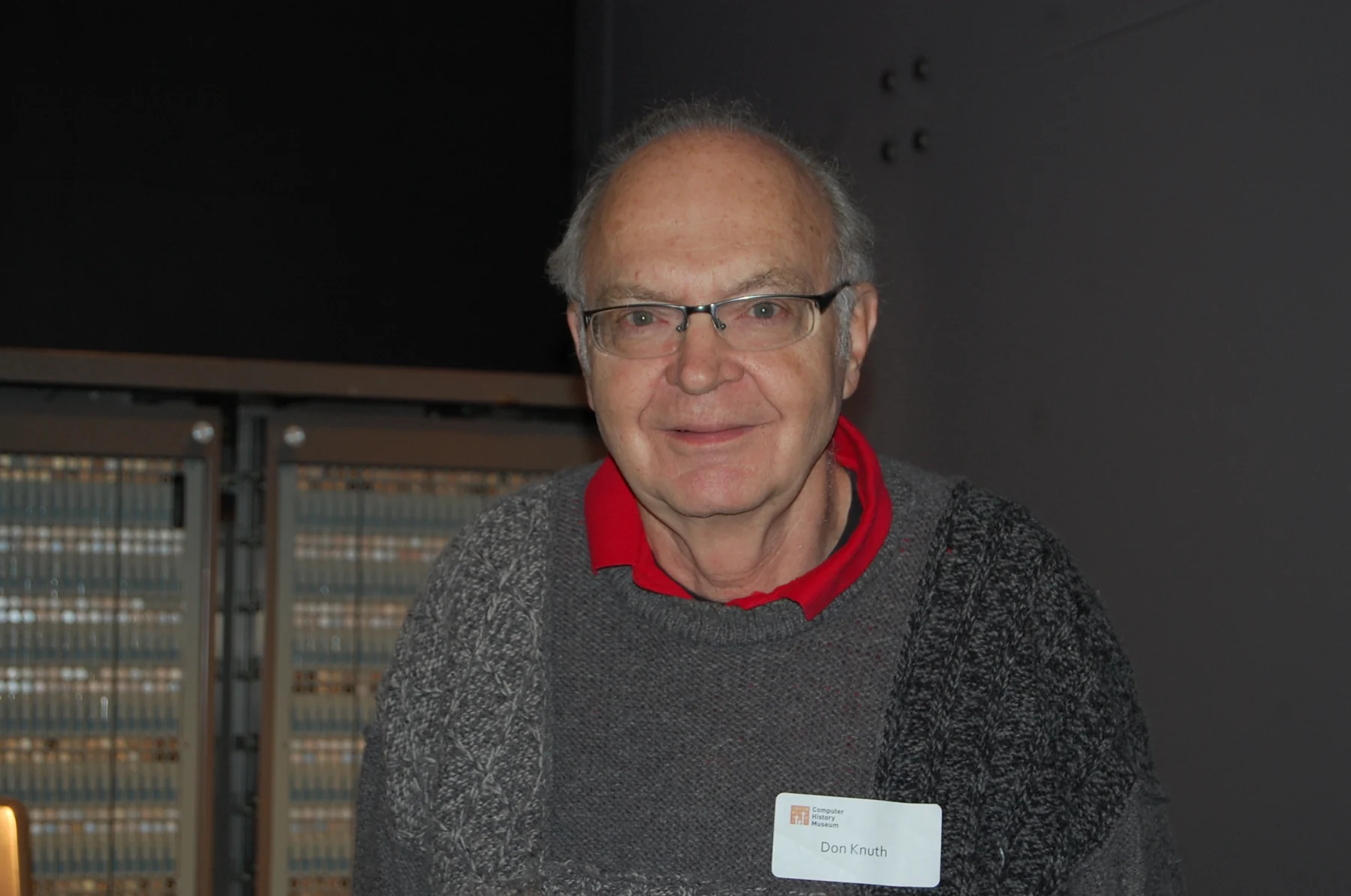
Donald Ervin Knuth was born on 10 January 1938 in Milwaukee, Wisconsin. Music and mathematical puzzles were early interests, and he entered Case Institute of Technology on a physics scholarship before concentrating on mathematics. He encountered its IBM 650 computer and began writing programs. In 1960 he received a mathematics bachelor’s degree and, by a special faculty decision, a master’s degree at the same time. He then studied at Caltech, earning a mathematics doctorate in 1963. His thesis, Finite Semifields and Projective Planes, concerned algebra rather than typesetting or the later subject of literate programming.
A compiler book grew into a study of algorithms
A request from Addison-Wesley for a book about compilers developed into The Art of Computer Programming. As Knuth gathered and checked techniques, the project widened into a systematic account of algorithms and their mathematical analysis. Its first volume appeared in 1968, followed by volumes on seminumerical algorithms and sorting and searching. He joined Stanford’s faculty in 1968. The books combined precise descriptions, historical references, exercises and analyses of resource use. Their influence came through that sustained organisation and teaching, not through a claim that he invented every algorithm included in them.
Technical recognition had a defined scope
The ACM awarded Knuth its 1974 A. M. Turing Award for contributions to algorithm analysis and programming-language design, especially his book series. That was before the TeX work and the 1984 literate-programming paper, so the award should not be described as a prize for either of those later projects. Stanford also records the 1971 Grace Murray Hopper Award and the 1979 National Medal of Science. These honours mark different achievements and dates. Keeping the citation’s scope visible makes the history more informative than treating every award as interchangeable recognition of a lifetime.
Publishing quality became a software problem
Dissatisfaction with proposed typography for his books led Knuth to develop TeX beginning in 1977. The project concerned the composition of documents, particularly mathematics, with close control over their appearance. METAFONT addressed the related but distinct problem of describing and rendering letterforms. Stanford lists the resulting books and programs as substantial works of technical scholarship. These tools connected computer science with publishing through implemented systems. TeX’s role in typesetting should therefore be distinguished from the algorithms being explained in a book, even when that same book is an application of TeX.
WEB joined program text with explanation
In WEB, Knuth combined a documentation language with a programming language. A common source could produce formatted explanation and compilable program text through separate processing routes. The idea supported writing in an order helpful to a human reader while assembling code in the order required by the compiler. His manual also credited predecessors and collaborators, including Pierre-Arnoul de Marneffe, Luis Trabb Pardo, Ignacio Zabala, David Fuchs and Arthur Samuel. Literate programming was therefore both an identifiable design contribution and a synthesis of earlier approaches, developed in a practical software community.
Sources for this section: [5]
Collaboration and continuing scholarly work
Silvio Levy adapted WEB to C in 1987. Knuth’s own CWEB account credits both men with subsequent revisions, so CWEB should not be assigned to him alone. He became professor emeritus at Stanford in 1993 and continued the broader work of writing and research. His bibliography includes Concrete Mathematics with Ronald Graham and Oren Patashnik, among many collaborations. The connections across algorithms, books, typography and program explanation are central to this career: making a system work and making its reasoning available to other people were continuing parts of the same scholarly practice.
Quick answers
Frequently asked questions about Donald Knuth
- Was Knuth’s Turing Award for TeX?
- No. The 1974 citation concerned algorithm analysis, programming-language design and The Art of Computer Programming. TeX came later.
- Is WEB the same thing as TeX?
- No. WEB combines documentation and program text; its WEAVE processor produces TeX input, while TANGLE produces compilable Pascal text.
- Who adapted WEB to C?
- Silvio Levy made the 1987 adaptation. Levy and Knuth subsequently revised and extended CWEB together.
Keep exploring
Lives connected to this story
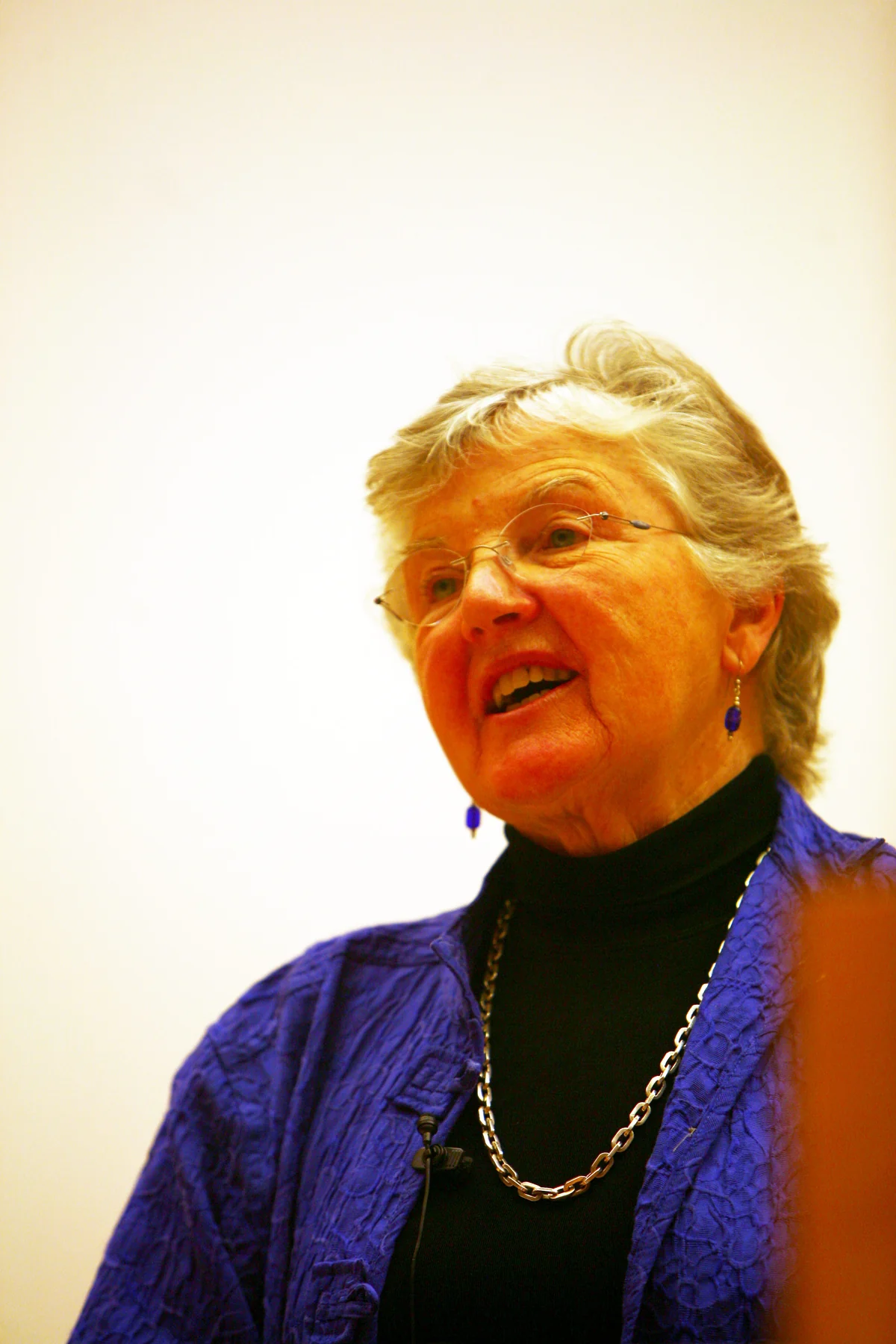
- Frances Allen
Compare explaining a program to readers with analysing it for safe compiler transformations.
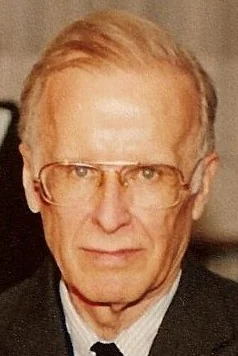
- John McCarthy
Compare another mathematician’s distinct contribution to programming languages.
Sources and further reading
Explore the evidence
These references support the biography and offer further reading. Official records, first-person accounts and independent reporting provide different perspectives; image records document attribution and licensing.
- 1. Association for Computing MachineryDonald E. Knuth: 1974 citation, education and career
Direct ACM page returned 403; the indexed institutional biography, exact citation, birth and education entries were read. Case mathematics qualifications also checked against CHM.
- 2. Computer History MuseumDonald Knuth, 1998 Fellow
- 3. Stanford UniversityDonald Knuth: appointments, education, honours and bibliography
Stanford profile’s narrative is marked via Wikipedia. Use its separately maintained professional-education, award and bibliography fields, supplemented by ACM, CHM and author sources, rather than treating that narrative as independent confirmation.
- 4. MacTutor, University of St AndrewsDonald Ervin Knuth: mathematical biography
- 5. Donald E. Knuth; CTANThe WEB System of Structured Documentation: manual
Downloaded complete22-page manual. Opening workflow, module rules and named influences read. Appendix programs not independently reproduced.
- 6. Donald E. Knuth, Stanford UniversityKnuth and Levy: CWEB
Author’s indexed Stanford page read; direct host requests failed. It dates Levy’s C adaptation to 1987 and explicitly credits later joint development.
- 7. Donald E. Knuth; Tufts University teaching archiveLiterate Programming: author manuscript corresponding to Computer Journal27(2),97–111(1984)
Downloaded 15-page author manuscript; footer says submitted to The Computer Journal, with receipt September 1983. Opening two pages and related-work/limitations sections read; Stanford bibliography establishes 1984 journal publication. The full prime-printing implementation was not independently executed or verified.
- 8. The Franklin InstituteDonald Ervin Knuth: 1988 Franklin Medal and technical scope