In this biography
Quick facts
- Born
- 4 February 1922
- Died
- 24 January 2011
- Birthplace
- Gadag area, then Dharwad district, Bombay Presidency, British India (now Karnataka, India)
- Country
- India
- Nationality
- Indian
- Known for
- Kirana gharana khayal, bhajans, abhangs and the Sawai Gandharva festival
- Principal guru
- Sawai Gandharva, a disciple of Abdul Karim Khan
- Festival
- Sawai Gandharva festival in Pune, established in 1953
- Akademi fellowship
- Sangeet Natak Akademi, 1998
- Bharat Ratna
- Announced in 2008; presented at his Pune home on 10 February 2009
Why this life matters
His legacy includes both performances and the work of sustaining a concert institution in memory of his teacher, Sawai Gandharva.
Timeline
Key moments
Born in the Gadag area
His childhood musical interests led to a search for a teacher.
Learning from Sawai Gandharva
Training linked him to the Kirana lineage of Abdul Karim Khan.
A public career develops
Concerts and recordings brought him beyond the training household.
A musical memorial in Pune
The festival associated with his guru became a lasting part of his work.
Institutional recognition
The Sangeet Natak Akademi fellowship preceded the Padma Vibhushan.
Bharat Ratna
Announcement and presentation took place in different calendar years.
Death and the festival’s new name
He died on 24 January; the festival subsequently included his name beside his guru’s.
A search for music in the Gadag region
Bhimsen Gururaj Joshi was born on 4 February 1922 in the Gadag area of what is now Karnataka. Published sources differ between the locality Ron and the broader Gadag identification; the regional description preserves what can be stated securely. Obituaries describe a boy who left home in search of musical instruction before returning to train near his own region.
His learning was practical and demanding. Sangeet Natak Akademi records early study with musicians including Mushtaq Hussain Khan and his later discipleship under Sawai Gandharva, also known as Rambhau Kundgolkar. The latter connected Joshi to Abdul Karim Khan’s Kirana tradition. A lineage names a network of teaching, rather than a claim that a student merely reproduced a teacher.
A khayal singer with a wider repertoire
The Akademi citation identifies khayal as Joshi’s principal field and describes systematic raga development in alap. It also records thumri, devotional and stage songs, film singing and a substantial repertoire of Purandaradasa compositions. His work therefore joined extended classical elaboration to forms with different devotional and theatrical uses.
The musical reputation often centres on vocal force, but range of repertoire matters too. A long khayal and a compact devotional song do not make the same demands on time or audience attention. Joshi could become familiar to listeners who did not follow a complete raga recital, while the classical discipline remained a central part of his professional identity.
A guru’s memory becomes institutional work
After Sawai Gandharva’s death in 1952, disciples gathered to pay musical tribute. The Pune festival dates its establishment to 1953. Joshi’s contribution included bringing musicians and cultivating listeners, work that extended beyond his own appearances on stage.
Arya Sangeet Prasarak Mandal, founded in 1951, became the organising institution. Shrinivas Joshi’s later interview describes an informal gathering that grew into a festival during the mid-1960s. Remembering those different stages makes the origin more intelligible than imagining the mature festival arriving fully formed in its first year.
The audience beyond the classical hall
Parliament’s condolence reference singled out Mile Sur Mera Tumhara as a connection between Joshi and a broad public. The national-integration film gave a mass audience a recognisable encounter with the singer, including people who would not ordinarily attend a classical recital.
That public role is distinct from the details of his training and concert repertoire. It explains one route by which the performer entered everyday cultural memory. Broadcast recognition can introduce a voice, but it does not by itself convey the duration, improvisation or relationship with accompanists that shape a full concert.
Sources for this section: [4]
Honours and the risk of merging their dates
The Sangeet Natak Akademi elected Joshi a fellow in 1998; its citation also records the Padma Vibhushan in 1999 and an honorary doctorate from Gulbarga University in 1986. The honorary qualification recognised an existing musical career and is not evidence of a conventional student degree.
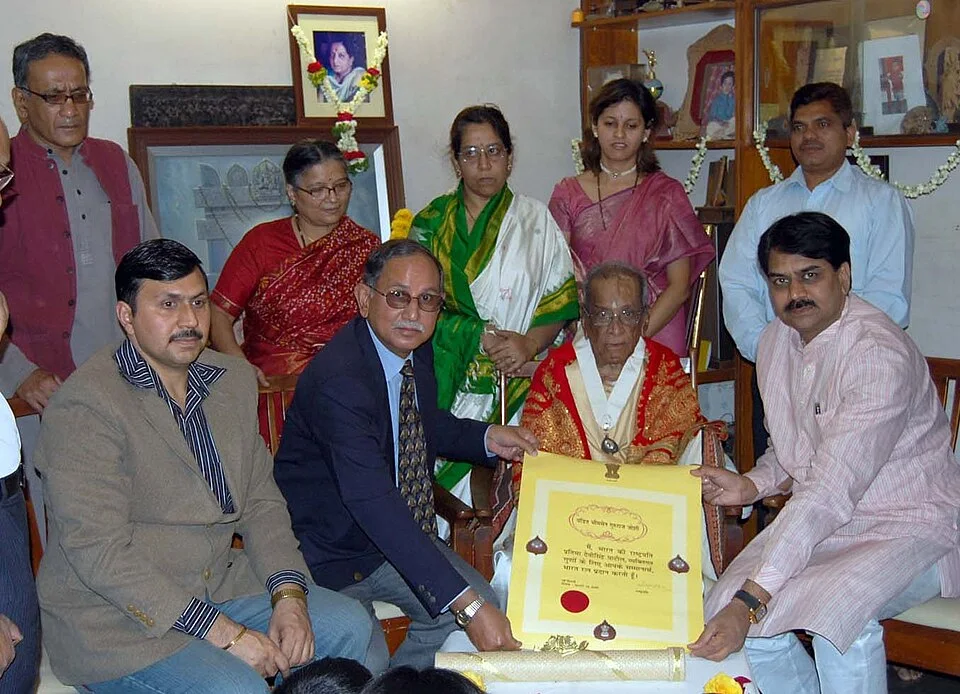
The Bharat Ratna was announced in 2008. The exact official photograph records Additional Secretary A. E. Ahmad of the Home Ministry presenting it in Pune on 10 February 2009. This is the ceremony shown here. A later festival timeline that assigns another day and a presidential presentation is not followed.
A performer’s death and an institution’s continuation
Joshi died in Pune on 24 January 2011. Contemporary reporting described renal and respiratory illness. His dates indicate that he was eighty-eight, shortly before his eighty-ninth birthday; some tributes rounded his age to eighty-nine. Retaining the dates avoids reproducing that inconsistency.
The festival was renamed Sawai Gandharva Bhimsen Mahotsav in 2011, preserving the teacher’s name and adding the disciple’s. Its survival depends on organisers, musicians, sponsors and listeners, not the continued presence of one singer. That institutional afterlife is an important part of a career too easily reduced to an extraordinary voice.
Quick answers
Frequently asked questions about Bhimsen Joshi
- What was Bhimsen Joshi’s gharana?
- He trained in the Kirana tradition through Sawai Gandharva, a major disciple of Abdul Karim Khan. His repertoire also included thumri, bhajans, abhangs and other forms.
- Was his Bharat Ratna awarded in 2008 or 2009?
- It was announced in 2008 and physically presented at his Pune home on 10 February 2009. These are different events.
- Did he establish Arya Sangeet Prasarak Mandal in 1953?
- The Mandal dates from 1951. The festival it organises dates its establishment to 1953; the two dates describe different things.
Keep exploring
Lives connected to this story
- Bismillah Khan
Compare another Hindustani musician’s connection between intensive training, public performance and a wider national audience.
- Ravi Shankar
Compare vocal performance and festival building with a sitarist’s different route to international concert audiences.
Sources and further reading
Explore the evidence
These references support the biography and offer further reading. Official records, first-person accounts and independent reporting provide different perspectives; image records document attribution and licensing.
- 1. Sangeet Natak Akademi1998 fellowship citation: training, repertoire and honours
- 2. Maharashtra State Bureau of Textbook ProductionIndian Music: 4 February 1922 birth and 24 January 2011 death
State teaching text and obituary support 4 February 1922. Birthplace is kept at Gadag-area level because Ron and Gadag town appear in different accounts.
- 3. The Indian Express / agencies24 January 2011 obituary and career account
- 4. Lok SabhaCondolence reference: national audience and Mile Sur Mera Tumhara
Condolence reference supports public reach through Mile Sur. Its age of 89 is not adopted against the exact birth and death dates.
- 5. Arya Sangeet Prasarak MandalMandal, teacher, singer and festival origins
Used for Mandal 1951, festival 1953 and training. Its birth-anniversary wording is not used to override the organiser’s memorial explanation in the 2019 interview.
- 6. Dipanita Nath / The Indian Express2019 interview with Shrinivas Joshi on organising the festival
- 7. The Times of India2012 report confirming the 2011 renaming
- 8. Ministry of Home Affairs / PIB via Wikimedia Commons10 February 2009 award presentation: exact photograph record
Exact caption names A. E. Ahmad and 10 February 2009; no President is pictured. Award announcement, presentation and later retrospective errors are separated.
- 9. Press Information BureauPermission for accurate credited reproduction