In this biography
Quick facts
- Born
- 7 April 1920
- Died
- 11 December 2012
- Birthplace
- Benares, British India (now Varanasi, Uttar Pradesh, India)
- Country
- India
- Nationality
- Indian
- Known for
- Hindustani classical sitar, film scores, international concerts and sitar concertos
- Principal teacher
- Allauddin Khan at Maihar, beginning in 1938
- Radio work
- Music director, All India Radio, New Delhi, 1949–1956
- Film collaboration
- Music for Satyajit Ray’s Apu Trilogy
- First sitar concerto
- LSO commission; premiere at Royal Festival Hall, 28 January 1971
Why this life matters
He expanded audiences and compositional settings for Indian music while sustaining an exacting classical practice and a long commitment to teaching.
Timeline
Key moments
Born in Benares
Born on 7 April into a Bengali family, with the birth name Robindro Shaunkor Chowdhury.
Dance and travel
Joined his brother Uday Shankar’s company and encountered music and performance across Europe and the United States.
Training at Maihar
Left the dance career for sustained study of sitar and Indian classical music with Allauddin Khan.
All India Radio
Directed music in New Delhi and formed a national instrumental ensemble.
The Apu Trilogy
Collaborated on the music for Satyajit Ray’s three films.
Different festival settings
Performed at Monterey in 1967 and Woodstock in 1969; these were separate events.
Concerto and benefit concerts
Premiered the first sitar concerto with the LSO and helped organise the Concert for Bangladesh with George Harrison.
Later collaboration and teaching
Released Passages with Philip Glass, continued composing and teaching, and died on 11 December 2012.
A Bengali childhood and an international stage
Ravi Shankar was born Robindro Shaunkor Chowdhury on 7 April 1920 in Benares, now Varanasi, into a Bengali family. His mother, Hemangini Devi, raised him largely in India while his father worked abroad. At ten he travelled to Paris with his elder brother Uday Shankar’s dance company. Touring made performance, languages and travel part of his early education.
He worked as both dancer and musician in the troupe. Exposure to Western classical music, jazz and theatre preceded the later fame of his sitar playing. This early international experience helps explain his ease in unfamiliar settings, but it did not replace the concentrated training through which he became a classical musician. His career joined these different forms of learning.
Study with Allauddin Khan
Allauddin Khan joined Uday’s company during its 1935 travels and became a decisive influence. In 1938 Shankar gave up the touring dance career and went to Maihar for sustained study with him. The training continued into the 1940s. Its demands placed him within a living tradition of teaching, repertoire and disciplined practice, rather than treating improvisation as unrestricted spontaneity.
The Foundation’s account identifies this period as the basis of his later work. Shankar’s main instrument was the sitar, but his activity also encompassed composition and teaching. Raga supplies a framework for melodic development; a performer’s invention operates within inherited musical knowledge. His later ventures into new ensembles drew on that foundation instead of beginning with the expectations of a rock audience.
Radio, theatre and cinema in India
After his training Shankar composed and performed in Bombay and Delhi. From 1949 to 1956 he worked as music director at All India Radio in New Delhi and established the national instrumental ensemble Vadya Vrinda. Broadcasting and ensemble writing gave him ways to address audiences beyond the solo recital and to think about combinations of instruments.
Film music formed another substantial part of his work. His collaboration with Satyajit Ray on the Apu Trilogy brought the sitar into a carefully shaped cinematic sound world. Pather Panchali appeared in 1955, followed by Aparajito and Apur Sansar. These collaborations belong to the history of Indian film and music in their own right; their value cannot be measured solely through subsequent Western recognition.
New listeners and the demands of listening
Solo touring from the 1950s and collaborations with Yehudi Menuhin helped Shankar reach international listeners before the height of his association with George Harrison. The Monterey Pop Festival in 1967 and Woodstock in 1969 placed Indian classical performance inside very different festival environments. The two appearances are often merged in popular memory but were separated by two years.
Philip Glass later remembered Shankar as an energetic teacher who sometimes interrupted performance to address smoking, drinking and drugs. That testimony complicates any assumption that he simply endorsed the counterculture surrounding him. The interest of rock musicians created opportunities, while the music continued to demand attention on its own terms. Shankar’s importance extends well beyond teaching a Beatle to play sitar.
A composer across different institutions
The London Symphony Orchestra commissioned Shankar’s first sitar concerto in 1970. He played the solo part at its Royal Festival Hall premiere on 28 January 1971, with André Previn conducting. Four raga-based movements placed the sitar within orchestral writing. This was a specific compositional experiment, distinct from simply transferring an ordinary recital onto a larger stage.
Also in 1971, Shankar and Harrison organised the Concert for Bangladesh. Later work included the second sitar concerto and Passages, the 1990 collaboration with Glass. These projects involved different musical relationships and purposes: orchestral composition, humanitarian fundraising and exchange between composers. Treating them all as one vague meeting of East and West conceals the choices each required.
Teaching, family and later recognition
Shankar established schools, taught students and continued working with his daughter Anoushka, herself a sitarist and composer. His other daughter, Norah Jones, developed a separate musical career. Music education remained part of his public activity rather than an incidental accompaniment to touring. Institutional honours included the Fukuoka Grand Prize in 1991, the Praemium Imperiale in 1997 and the Polar Music Prize in 1998.
He remained active into old age and died on 11 December 2012 in California. A Recording Academy tribute by Glass places their personal collaboration beside Shankar’s wider influence on musicians and listeners. His recordings, compositions and pupils preserve several dimensions of the career: the exacting classical performer, the organiser of musical encounters and the teacher who expected audiences to learn as well as applaud.
Quick answers
Frequently asked questions about Ravi Shankar
- What was Ravi Shankar’s birth name?
- The Polar Music Prize biography records his birth name as Robindro Shaunkor Chowdhury. Ravi Shankar became his established professional name.
- Who taught Ravi Shankar?
- His principal guru was Allauddin Khan. Shankar left his dance career in 1938 for sustained classical training at Maihar.
- Did Ravi Shankar play at Monterey or Woodstock?
- Both: Monterey in June 1967 and Woodstock in August 1969. They were different festivals with different performances and accompanying musicians.
- Did he write music as well as perform?
- Yes. His work included radio ensembles, film scores, original ragas, sitar concertos and collaborations with other composers.
Keep exploring
Lives connected to this story
- Satyajit Ray
Read about the director with whom Shankar collaborated on Pather Panchali and the Apu Trilogy.
- Rabindranath Tagore
Compare another Bengali artist whose work connected composition, performance, education and international exchange.
- Ali Akbar Khan
Continue with another musical career and a study of lesson records.
Sources and further reading
Explore the evidence
These references support the biography and offer further reading. Official records, first-person accounts and independent reporting provide different perspectives; image records document attribution and licensing.
- 1. Polar Music PrizeRavi Shankar: 1998 laureate, childhood and career
- 2. Ravi Shankar Foundation / East Meets West MusicAbout Ravi Shankar and the Foundation label
Read the Foundation label’s career text; its 1985 date for Anoushka’s appearance at her father’s 75th birthday is arithmetically inconsistent, so it is omitted. The LSO/Warner records control the first concerto’s 1971 premiere.
- 3. Japan Art Association / Praemium ImperialeRavi Shankar: 1997 laureate biography
Read the biographical and chronological text. Its claim that Harrison shared Woodstock’s stage and several compressed work dates conflict with more specific records and are not repeated.
- 4. Philip Glass / Recording AcademyLifetime Achievement Award: Ravi Shankar
Read Glass’s personal tribute, explicitly framed as a 2013 award tribute despite the migrated 2014 page timestamp. Memories are attributed to him, not treated as comprehensive concert documentation.
- 5. Recording AcademySitarist Ravi Shankar Dies
- 6. Fukuoka PrizeRavi Shankar: 1991 Grand Prize citation
- 7. Michael Lydon / CriterionMonterey Pop: The First Rock Festival
- 8. Bethel Woods Center for the ArtsRavi Shankar: 50 Years of Peace & Music
- 9. Warner ClassicsShankar: Concerto for Sitar & Orchestra
- 10. London Symphony OrchestraFirst Performances: 1971 world premiere
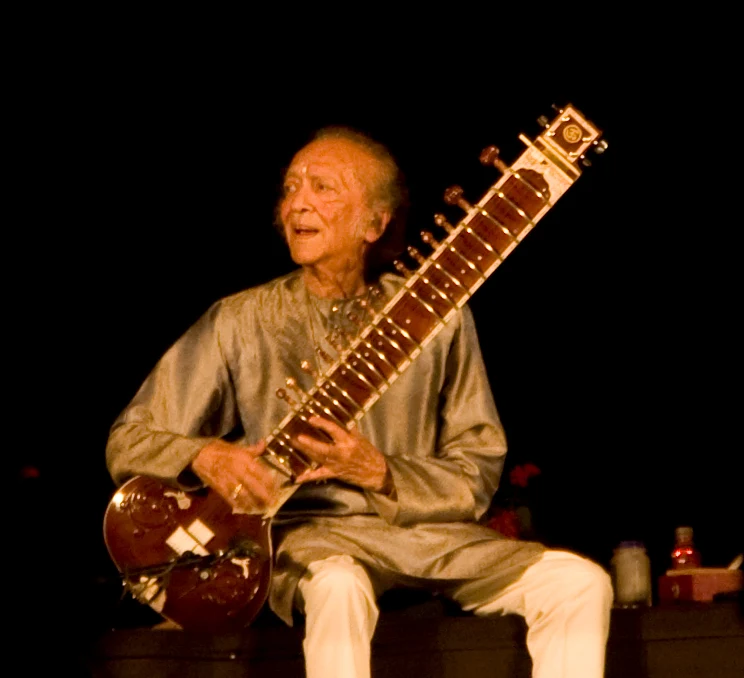
- 11. Wikimedia Commons / Alexandra IgnatenkoRavi Shankar 2009: exact photograph and licence record
The record describes a Delhi performance with Anoushka, but the supplied frame shows Ravi alone. Caption follows the visible frame and does not invent a second visible person. Original full frame retained under CC BY-SA 3.0.