In this biography
Quick facts
- Born
- 21 March 1916
- Died
- 21 August 2006
- Birthplace
- Dumraon, British India (now Bihar, India)
- Country
- India
- Nationality
- Indian
- Known for
- Bringing the shehnai to the classical concert stage and India’s national celebrations
- Birth name
- Qamaruddin, also transliterated Qamruddin
- Teacher
- His maternal uncle Ali Bux, in Banaras
- Concert breakthrough
- All India Music Conference, Calcutta, 1937
- Civilian honour
- Bharat Ratna, 2001
Why this life matters
He expanded the public standing of an existing ceremonial instrument while remaining closely associated with Banaras and its shared musical life.
Timeline
Key moments
Born in Dumraon
He belonged to a family of hereditary musicians.
Learning in Banaras
His uncle Ali Bux taught him within the city’s temple and musical environment.
Calcutta conference
The All India Music Conference became an important breakthrough.
A national ceremonial sound
Government accounts associate his playing with independence and the first Republic Day.
An international audience
Concerts abroad and commercial recordings extended the shehnai’s reach.
Bharat Ratna
India’s highest civilian honour recognised his musical contribution.
Death in Banaras
He died on 21 August, leaving an extensive recorded and teaching legacy.
A musician’s family before the famous name
Bismillah Khan was born on 21 March 1916 in Dumraon, now in Bihar. His father, Paigambar Bux, worked in a courtly musical setting. Qamaruddin, also written Qamruddin, was his birth name; the familiar account of a grandfather’s exclamation of Bismillah explains the name by which he became known, but remains a family story rather than a surviving birth record.
The instrument was already part of his family’s livelihood. He did not invent the shehnai. His achievement developed within a history of musicians who played at courts, weddings and religious occasions, work whose skill was not always accompanied by high social or concert status.
Banaras as a place of training and work
In Banaras, now also called Varanasi, Khan learned from his maternal uncle Ali Bux. Accounts of his development repeatedly return to temple precincts, the river and sustained practice. The city was a working environment of teachers, listeners, ceremonies and fellow musicians, not simply an atmospheric backdrop to a solitary genius.
His Muslim religious life and his performance within Hindu settings later made him a public symbol of coexistence. That association has a concrete basis in musical work across communities. It should not turn a complex city or a lifetime of professional relationships into an uncomplicated claim that religious conflict had disappeared.
From ceremonial occasions to a featured concert
The government’s commemorative account identifies the All India Music Conference in Calcutta in 1937 as a breakthrough. Sruti’s account distinguishes this from an earlier public appearance in Allahabad. A concert breakthrough is therefore not necessarily a musician’s first time playing before an audience.
The change concerned what the instrument could be expected to do. An extended raga performance asks an audience to attend to development and musical argument, rather than hearing the shehnai only as a sign that a ceremony is beginning. Khan’s reputation helped expand that expectation without making its older uses disappear.
A public sound associated with the republic
A 2008 government release links Khan’s playing to Independence Day on 15 August 1947 and the first Republic Day on 26 January 1950. His shehnai became associated with national celebration through ceremonies and broadcasting. This later official account establishes the commemorative association; it is not a contemporary programme documenting the exact order of the 1947 events.
Khan received the Bharat Ratna in 2001. The honour recognised an instrumental career whose public meaning had extended beyond the concert hall. Describing that meaning requires care: a musician’s symbolic place in national life is different from a complete account of the government, society or religious relations of the period.
Sources for this section: [1]
Recordings, colleagues and listeners abroad
Khan’s international career included concerts and recordings with other Indian musicians. Ken Hunt’s obituary discusses the Duets album with sitarist Vilayat Khan, issued in 1967, and later collaborations with violinist V. G. Jog, sarod player Amjad Ali Khan and shehnai player Bageshwari Qamar. The list reveals a musician in conversation with other performers, including a woman instrumentalist in a field often described through men.
Accounts disagree over the precise year of the first Edinburgh appearance, commonly giving 1965 or 1966. This profile retains the broader mid-1960s chronology. The music’s international circulation is secure without assigning a disputed festival date more precision than the checked evidence supports.
A celebrated musician and a vulnerable musical economy
Khan died in Varanasi on 21 August 2006. The survival of his recordings did not guarantee secure work for later shehnai players or makers. Suanshu Khurana’s 2017 reporting describes musicians facing fewer concert opportunities and instrument artisans taking other work.
Those later conditions complicate a triumphant ending to the story. One performer can change the standing of an instrument without permanently securing its whole professional world. His legacy includes musical models and public recognition, but its continuation also requires teaching, commissions, skilled instrument making and opportunities for other players to be heard.
Quick answers
Frequently asked questions about Bismillah Khan
- Did Bismillah Khan invent the shehnai?
- No. It was an existing instrument used in ceremonial, courtly and religious settings. He helped expand its standing as a featured classical concert instrument.
- Where was his musical home?
- Banaras, also called Varanasi, where he trained with Ali Bux and remained closely connected to the city’s musical and religious life.
- When did he receive the Bharat Ratna?
- In 2001. The government’s 2008 commemorative account records the honour separately from his 1947 and 1950 ceremonial associations.
Keep exploring
Lives connected to this story
- Bhimsen Joshi
Compare a vocalist’s training, devotional repertoire and work sustaining a concert institution.
- Ravi Shankar
Explore a sitarist’s distinct route through international concert and recording audiences.
Sources and further reading
Explore the evidence
These references support the biography and offer further reading. Official records, first-person accounts and independent reporting provide different perspectives; image records document attribution and licensing.
- 1. Ministry of Communications / PIB2008 commemoration: birth, conference, national occasions and Bharat Ratna
Later official commemoration supports the 1937 conference, independence and Republic Day associations and 2001 Bharat Ratna. No exact 1947 performance order is inferred.
- 2. The TribuneDumraon family and the lifelong Banaras connection
- 3. Ken Hunt / The Independent2006 obituary: instrument, recordings and collaborators
Named obituary supplies recording collaborations and documents uncertainties in early accounts. The unsupported identity-substitution rumour it reports is not repeated as fact.
- 4. SrutiEarlier public appearance and the 1937 Calcutta breakthrough
- 5. Playbill2006 obituary: family, training and shared religious settings
- 6. Suanshu Khurana / The Indian Express2017 reporting on shehnai players, makers and patronage
2017 reporting is a dated account of musicians and makers, not a verified statement of October 2026 employment or university provision.
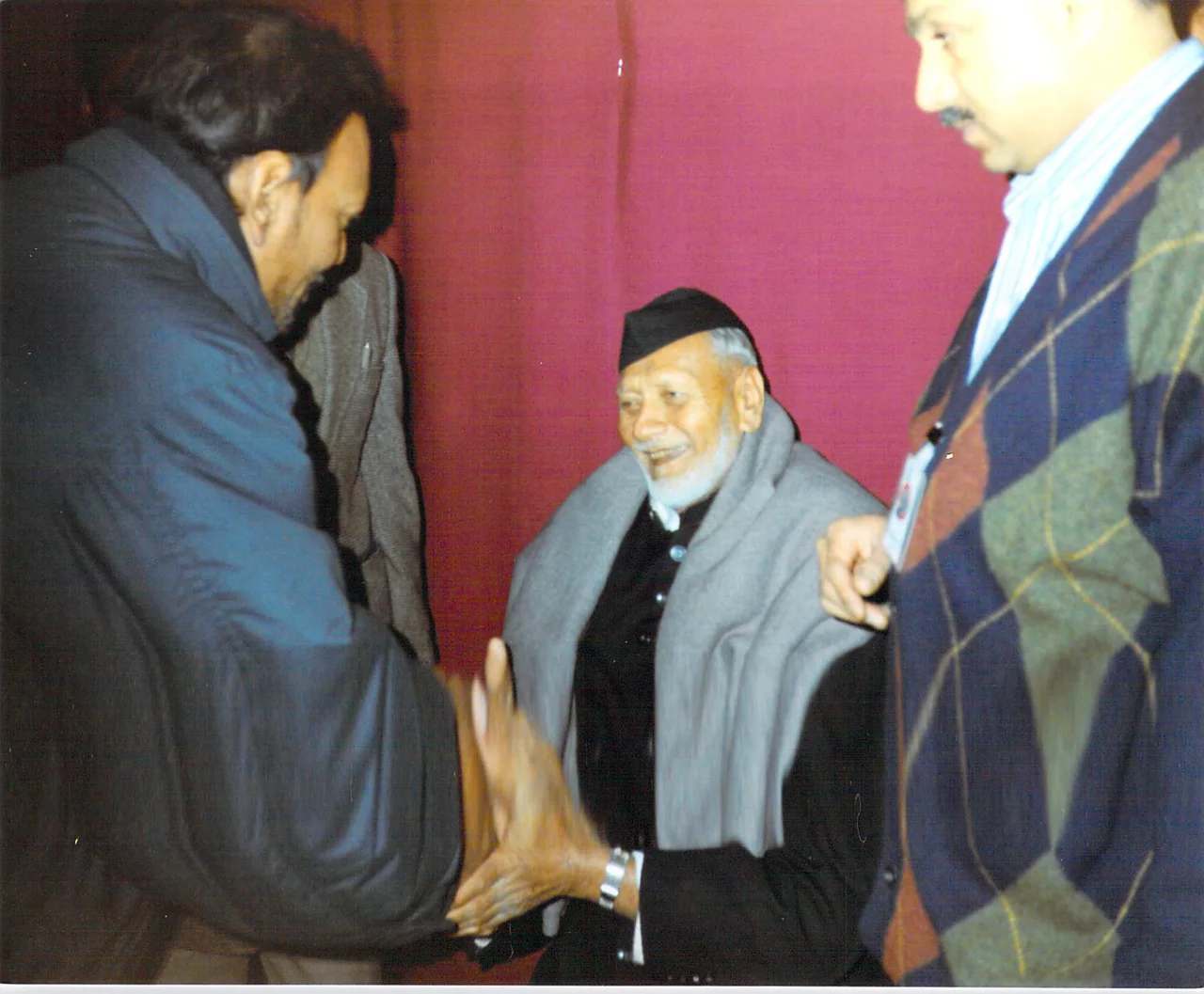
- 7. Wikimedia Commons / Jonathansammy1993 Leicester photograph: exact original and CC BY-SA grant
Named uploader’s own 1993 Leicester photograph and explicit CC BY-SA 4.0 grant inspected. Original PNG acquired; full frame reduced proportionally without restoring visible scan wear.