
The short answer
Why was labelled amino-acid incorporation in a cell-free system not automatically proof of a complete functional protein?
Read the evidence
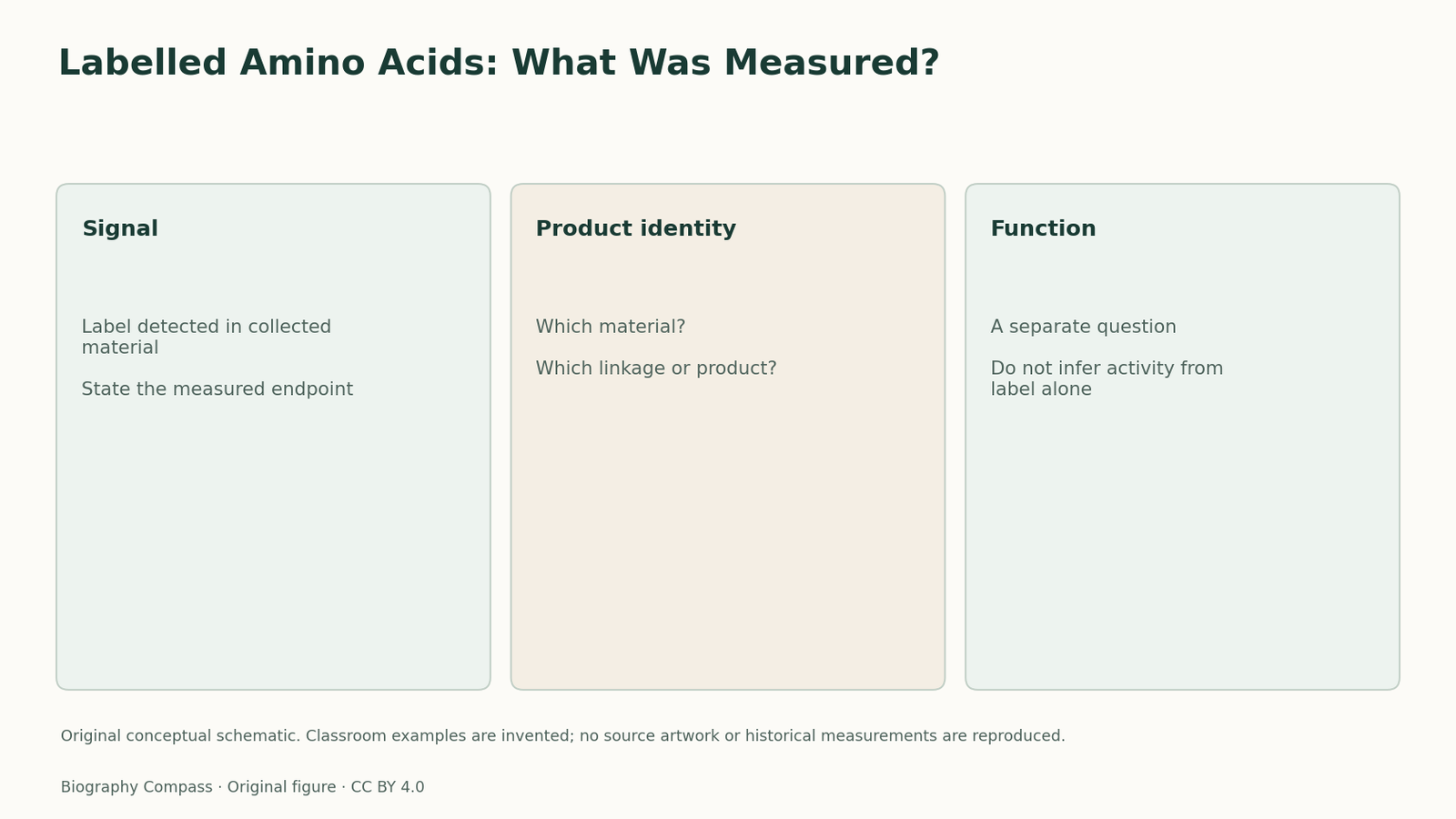
Labelled Amino Acids: What Was Measured?
Compare a measured signal with the stronger product claims that need additional evidence.
| Record or comparison | What the record supports | What remains separate |
|---|---|---|
| 1954 incorporation study | Label was traced into defined material while cellular fractions were compared | A fraction-level signal is not automatically identification of a particular functional full-length product |
| 1958 intermediate investigation | An RNA-associated stage and transfer were investigated separately | Evidence for an intermediate is not a complete explanation of every synthesis step |
An incorporation signal was the endpoint
Keller, Zamecnik and Loftfield’s 1954 paper describes the use of radioactive amino acids to investigate protein synthesis in several settings. Its opening explicitly considers the possibility of labelled amino acids exchanging into existing proteins and discusses evidence relevant to that alternative. This is useful because the authors did not treat the appearance of a signal as self-explanatory. They asked what process could account for it. The guide concerns that measurement problem, not a claim that the paper had already reconstructed every step of protein production.
Sources for this section: [3]
A fraction is not the whole cellular system
The summary reports that both microsomal and soluble fractions were required for incorporation in the cell-free system. The discussion also proposes separating particle types for further testing. These statements make the research productive rather than complete: identifying necessary material directs the next question without identifying the role of every constituent. The later 1958 RNA-intermediate paper illustrates how another stage could be investigated separately. A necessary fraction, an intermediate carrier and a complete functional protein are different levels of explanation.
An original signal-to-product exercise
Imagine a classroom report stating that label has appeared in a material collected as a protein fraction. Give students three possible conclusions: labelled material is associated with that fraction; a particular full-length enzyme has been produced; and that enzyme has its expected activity. Only the first is supplied by the invented report. Ask what additional records would address the others. Suitable answers include evidence identifying the product and its completeness, followed by an appropriate function test. Next ask why a control excluding unbound label would matter. It would address whether the recorded signal came from material carried through the collection process rather than the claimed product. These are conceptual evidence questions, not a laboratory protocol or an assertion that the historical authors failed to perform a particular control. No invented signal count is presented as a 1954 result.
Sources for this section: [3]
What the historical comparison teaches
The National Academy memoir places the incorporation studies within a wider experimental programme. That context helps explain why incomplete answers were valuable: a system that exposed one stage could support the next investigation. The original interpretation developed through specific comparisons, not by assigning every property of a completed protein to any labelled fraction. Readers can use the same discipline when encountering a summary today: identify the signal, name the collected material, examine alternatives and distinguish demonstrated product properties from questions still requiring another kind of evidence.
Continue the chronology
Related history guides
Biography context
Explore United States through connected lives
Connected biographies
Researchers and related questions
1912–2009
Paul Zamecnik
Physician and biochemistPaul Zamecnik connected medical research with experimental biochemistry, helping make protein synthesis accessible to investigation outside intact cells.Read biography1921–2009
Mahlon Hoagland
Physician, biochemist and science writerMahlon Hoagland helped investigate the biochemical steps connecting amino acids with protein synthesis and later became an influential communicator of biology.Read biography1922–1993
Robert W. Holley
Biochemist and transfer-RNA researcherA sabbatical with James Bonner at Caltech helped focus Holley's interest on protein synthesis.Read biographyQuick answers
Common questions
- Does a labelled protein fraction identify a complete functioning enzyme?
- Not by itself. Product identity, completeness and function require evidence addressing those properties.
- Did the 1954 authors ignore alternative explanations?
- No. Their opening explicitly discusses possible exchange into existing proteins and evidence relevant to that question.
Primary and institutional sources
How this history was checked
Selected original 1954 and 1958 passages are compared with scoped institutional and colleague biographies. The guide distinguishes measurement from an original interpretive exercise. This article was reviewed on 7 November 2026.