
The short answer
How did soluble RNA connect amino-acid activation with transfer into protein?
Read the evidence
Soluble RNA: Binding Versus Transfer
Compare evidence for association, transfer and a complete mechanism.
| Record or comparison | What the record supports | What remains separate |
|---|---|---|
| RNA-associated amino acid | An intermediate association could be investigated | Association alone does not establish every later fate |
| Transfer and discussion in 1958 | Subsequent appearance in protein supported a carrier interpretation | The paper still left linkage details and parts of the sequence unresolved |
Holding an amino acid was not the complete question
Hoagland’s 1985 recollection describes unexpected amino-acid labelling in soluble RNA while the group investigated cellular reactions. Association alone could not establish the whole role of that material in protein synthesis. The central question was what happened next. The 1958 paper’s summary connects amino-acid binding with subsequent transfer to microsomal protein, distinguishing stages that a simple statement that RNA was involved would conceal. This is evidence about a functional intermediate, rather than the later complete structural characterisation of a particular transfer-RNA molecule.
The original discussion preserved uncertainty
The 1958 discussion proposes a carrier role but says that a specific structure for the amino-acid–RNA linkage could not yet be assigned. It also presents a working hypothesis for later stages. A careful reader should preserve that division: the experimental transfer result and the speculative sequence were not equivalent findings. The modern name transfer RNA can help identify the subject, but it should not cause a historical account to describe every part of the 1958 model as a verified modern mechanism.
Sources for this section: [3]
An original carrier-evidence activity
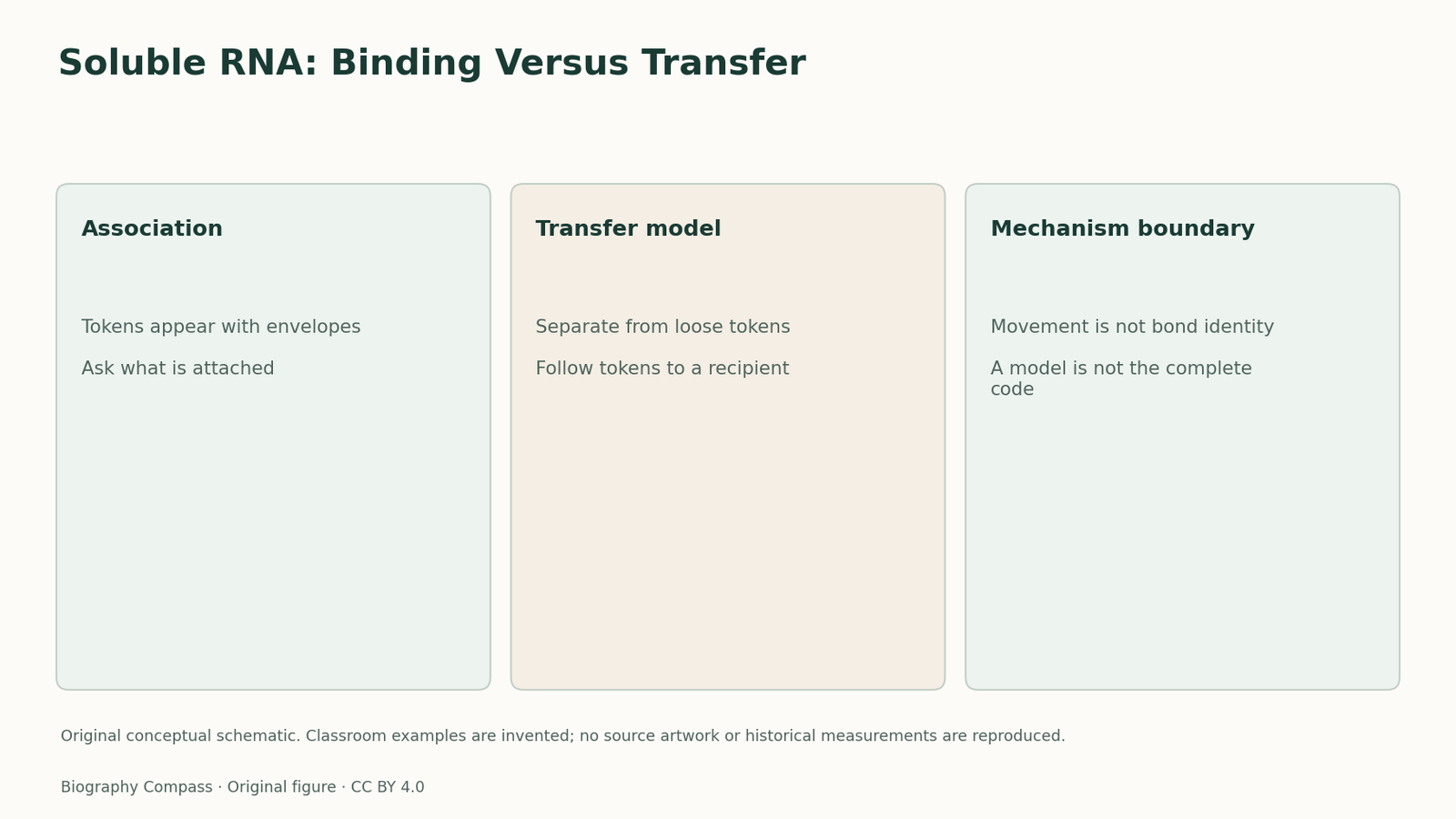
Use an invented model with tokens and labelled envelopes. In the first observation, tokens are found in the envelope group. In the second, envelopes are separated from loose tokens and then connected with a recipient group, where tokens subsequently appear. Ask which observation offers stronger support for a carrier interpretation and why. The second follows material through an additional stage, though alternative explanations still require checking. Now ask whether either observation identifies the chemical bond holding a token or the complete instructions specifying the final token order. Neither does. The model distinguishes association, movement and mechanism; its envelopes are not RNA molecules, and no timing or token count reconstructs the original experiment. Students should state those limits before extending the analogy.
A dated recollection is another kind of record
Hoagland’s commentary explains how he later understood the discovery’s significance, while the original paper records the narrower contemporaneous argument. The Academy memoir supplies the career context and later scientific communication. Reading these together helps answer the guide’s question without converting a retrospective explanation into another experiment. Binding evidence locates an association; transfer evidence follows a subsequent fate; chemical and coding mechanisms require their own records. The value of the historical work lies partly in making those next questions experimentally approachable.
Continue the chronology
Related history guides
Biography context
Explore United States through connected lives
Connected biographies
Researchers and related questions
1921–2009
Mahlon Hoagland
Physician, biochemist and science writerMahlon Hoagland helped investigate the biochemical steps connecting amino acids with protein synthesis and later became an influential communicator of biology.Read biography
1912–2009
Paul Zamecnik
Physician and biochemistPaul Zamecnik connected medical research with experimental biochemistry, helping make protein synthesis accessible to investigation outside intact cells.Read biography1922–1993
Robert W. Holley
Biochemist and transfer-RNA researcherA sabbatical with James Bonner at Caltech helped focus Holley's interest on protein synthesis.Read biographyQuick answers
Common questions
- Was the complete molecular mechanism established in 1958?
- No. The paper explicitly left linkage details unresolved and identified parts of its sequence as a working hypothesis.
- Is evidence of association the same as evidence of transfer?
- No. Following material into a subsequent stage addresses a different question from detecting it in an intermediate fraction.
Primary and institutional sources
How this history was checked
Original discussion and summary passages are compared with a complete participant recollection and scoped institutional biographies. Historical working hypotheses are labelled as such. This article was reviewed on 7 November 2026.
- Cold Spring Harbor Laboratory DNA Learning CenterBiography21: Mahlon Hoagland
- National Academy of SciencesMahlon Hoagland — Biographical Memoirs
- Journal of Biological ChemistryA Soluble Ribonucleic Acid Intermediate in Protein Synthesis
- Current Contents / University of Pennsylvania archiveA soluble ribonucleic acid intermediate — Citation Classic