
The short answer
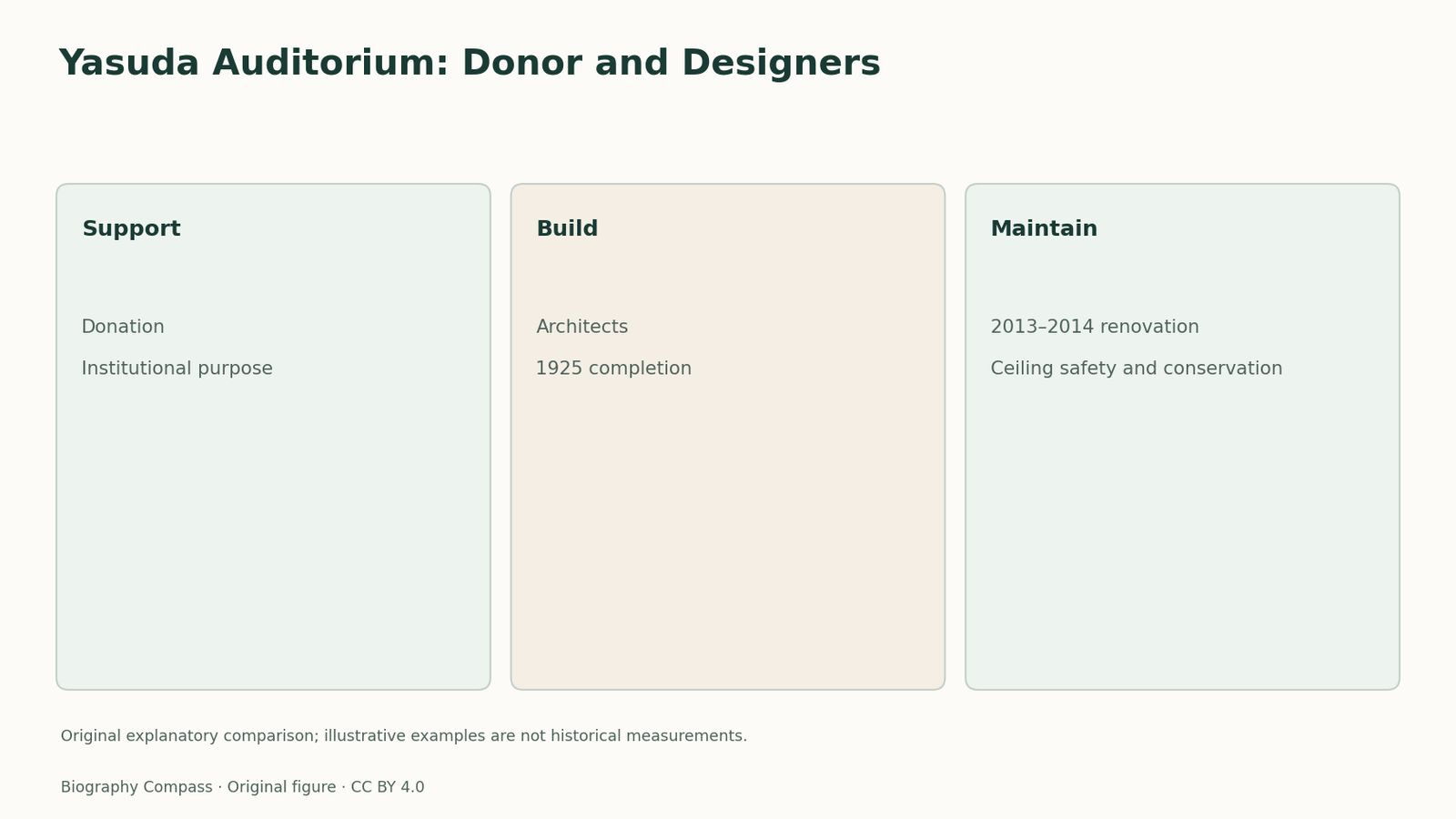
Yasuda Auditorium illustrates the difference between funding a building and completing all the work required to keep it useful. Zenjiro Yasuda died in 1921, while the University of Tokyo dates completion to 1925. The campus map names architects Uchida and Hideto Kishida. Much later, a Shimizu technical paper documents seismic renovation of its ceiling. Comparing those records makes the building an institutional collaboration across generations: the initial benefactor, original designers and later engineers each addressed a different part of its life.
A worked comparison
What each part contributes
Use the specific distinctions developed in the study.
| Part or record | What it establishes | Why the distinction matters |
|---|---|---|
| Benefactor | Yasuda’s donation | Before 1925 completion |
| Original design | Uchida and Kishida | Architectural responsibility |
| Later renovation | Ceiling engineers | Safety and preservation |
A donor’s name and a building’s longer life
Yasuda Auditorium illustrates the difference between funding a building and completing all the work required to keep it useful. Zenjiro Yasuda died in 1921, while the University of Tokyo dates completion to 1925. The campus map names architects Uchida and Hideto Kishida. Much later, a Shimizu technical paper documents seismic renovation of its ceiling. Comparing those records makes the building an institutional collaboration across generations: the initial benefactor, original designers and later engineers each addressed a different part of its life.
Why the donation was made
The university’s campus history connects Yasuda’s support with concern that the institution lacked temporary resting quarters for the Emperor. It describes a building that became a symbol of the research university. This is a more specific purpose than the vague assertion that he wanted an impressive monument to himself. The same page identifies design inspiration cautiously rather than as proven copying. A donor’s objective helped create an opportunity, while architects determined how spaces and appearance would give that programme a physical form.
Sources for this section: [6]
The chronology needs more than one date
The university’s campus map places the project’s beginning in 1921 and completion in 1925. A later contractor paper describes construction beginning in 1922. Those different descriptions should not be flattened into an invented exact start day; they may refer to different stages, but the inspected records do not settle that distinction. Completion in 1925 is consistent across the principal sources. Because Yasuda died in 1921, the building’s delivery necessarily involved people carrying a project forward after the donor could no longer direct it.
Safety work with an original design to preserve
The 2015 Shimizu paper, by Fumihiko Sakuraba, Kenji Suzuki and Akihiro Ogata, reports renovation work undertaken in 2013–2014. Its abstract describes a directly fixed ceiling system developed using knowledge gained after the 2011 earthquake, and identifies shaking-table verification. The opening discussion links lighter ceiling materials with retaining the original design. That is a concrete engineering problem: reducing falling-component risk while conserving the appearance of a historic hall. The inspected abstract and opening do not justify claims about every experiment or the seismic performance of the entire building.
Sources for this section: [5]
Compare responsibility at three stages
Match three questions to three kinds of evidence. Who supplied the original funds? Use the donation history. Who designed the hall? Use the campus’s architectural record. What ceiling system was introduced inrenovation? Use the engineers’ technical paper. The answer assigns different responsibilities without ranking all contributors under one title of “creator.” It also gives a useful test for a memorial name: a building can bear a donor’s name while its physical design and continuing safety depend on other professionals. Recognition becomes more informative when the task attached to each name stays visible.
Continue the chronology
Related history guides
Okura’s 1900 Commercial School
Explore Okura’s 1898 plan and 1900 commercial school, linking international business, a teaching institution and the university’s later development.
Read the timeline1876Mitsui 1876: Trade, Management and Credit
Read the 1876 Mitsui founding sequence through agreements, management and bank finance, separating the trading company from the similarly dated bank.
Read the timelineBiography context
Explore Japan through connected lives
Connected biographies
People and wider context
1838–1921
Zenjiro Yasuda
banker and institutional benefactorZenjiro Yasuda was a banker and institutional benefactor, known for Yasuda banking group and university patronage.Read biographyQuick answers
Common questions
- Did Yasuda personally complete or design the auditorium in 1925?
- No. He died in 1921. His donation supported a building designed and completed by others, with later renovations documented separately.
Primary and institutional sources
How this history was checked
Read the cited original records, institutional accounts and later interpretations. The comparison and exercise explain the specific evidence used in this study. This article was reviewed on 8 November 2026.
- National Diet LibraryYasuda Zenjiro I
- Makoto Kasuya, University of TokyoDean’s address,1 October 2025
- University of Tokyo CASEERHongo Area Campus Map 2023
- Mizuho Financial Group corporate historyMizuho origins: Zenjiro Yasuda
- Fumihiko Sakuraba, Kenji Suzuki and Akihiro Ogata, Shimizu Research Report 92,2015Retrofitting of Yasuda Auditorium: ceiling seismic work
- University of TokyoYasuda Auditorium campus history