
The short answer
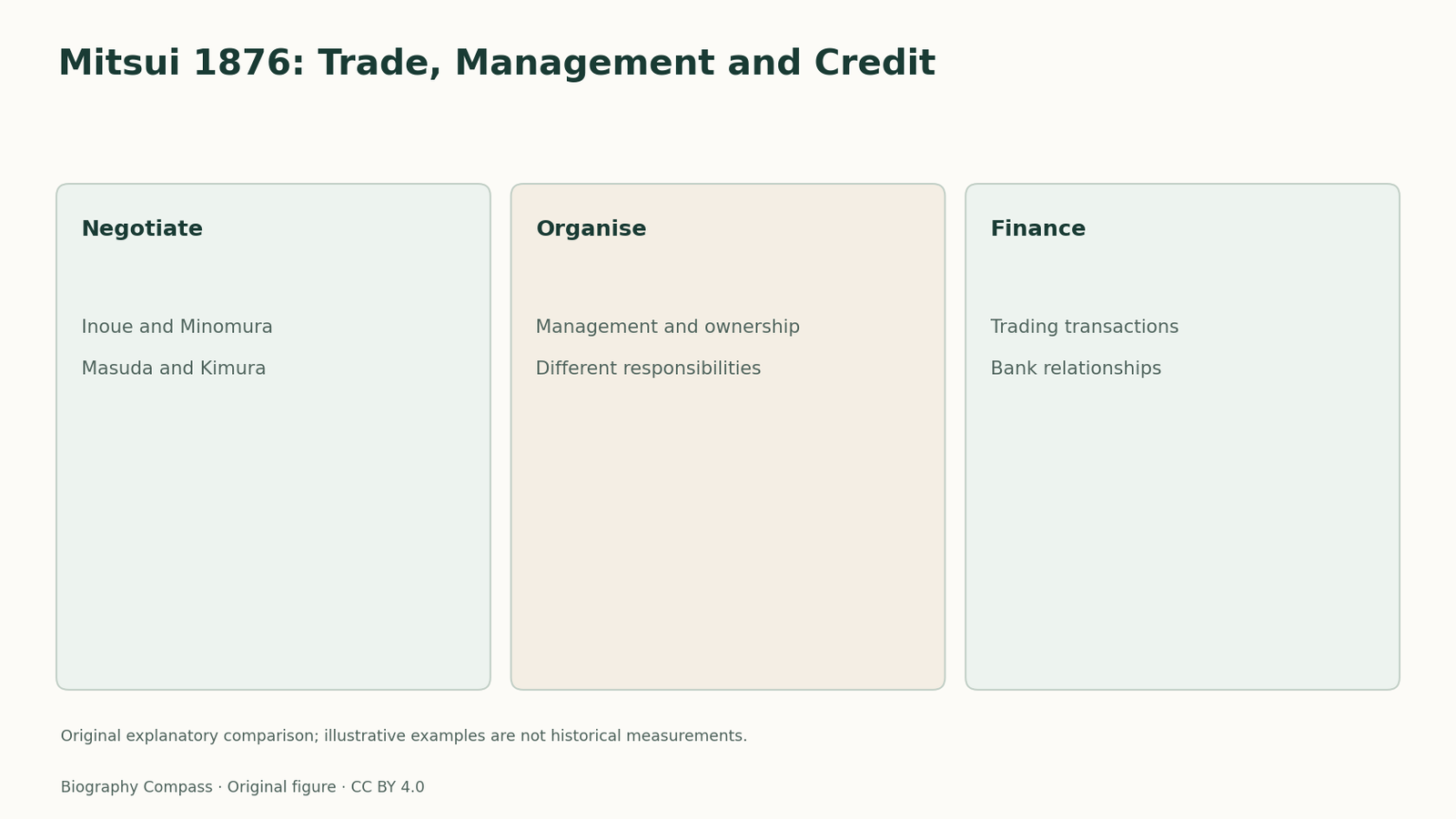
Mitsui’s 1876 development included both a bank and a trading company. A shared name and founding year do not make them one institution. Takashi Masuda headed the former Mitsui Bussan trading business, which needed financial relationships with banks rather than being identical with a bank. The Mitsui archives’ founding narrative identifies negotiations, management agreements and borrowing arrangements. Comparing those elements explains a concrete organisational question: how could a trading company operate through managers and credit before its later capital structure was fully established?
A worked comparison
What each part contributes
Use the specific distinctions developed in the study.
| Part or record | What it establishes | Why the distinction matters |
|---|---|---|
| 13 June | Agreements signed | Negotiation and commitment |
| 1 July | Dated founding | Company chronology |
| Bank finance | External credit relationships | Not identical with trading-company equity |
Bank and trading company were separate enterprises
Mitsui’s 1876 development included both a bank and a trading company. A shared name and founding year do not make them one institution. Takashi Masuda headed the former Mitsui Bussan trading business, which needed financial relationships with banks rather than being identical with a bank. The Mitsui archives’ founding narrative identifies negotiations, management agreements and borrowing arrangements. Comparing those elements explains a concrete organisational question: how could a trading company operate through managers and credit before its later capital structure was fully established?
Negotiations before the founding date
The archive describes discussions among Inoue, Minomura and Masuda, followed by agreements signed on 13 June 1876. It reproduces a short passage from the company journal identifying the gathering and the takeover of Senshu Kaisha’s operations. The company’s founding was dated 1 July, while official approval arrived later that month. These are different steps, not competing claims that one event occurred on three days. The journal entry is especially useful because it identifies an agreement being reached, rather than merely giving a retrospective anniversary date.
Managers and owners did different things
The founding arrangements distinguished Masuda’s management from the owners’ interests, while Kimura helped arrange financial support. The archive also describes conditions requiring consent for new commitments. This was neither unrestricted personal control nor a company existing only on paper. It was an organisation distributing decisions among people with different interests. A useful comparison asks who could negotiate ordinary business, who had to approve expansion, and which institutions supplied finance. The answers need not be the same individual or household.
Sources for this section: [2]
Credit is not the same as initial capital
The archive describes fund-raising agreements with Mitsui Bank and the First National Bank, while noting that formal initial capital was not established at the beginning. A loan or credit arrangement supplies funds with obligations attached; equity capital describes a different relationship. The later establishment of capital cannot simply be moved backward to the founding date. Modern corporate histories also warn that the present Mitsui company is a separate legal entity. Institutional heritage can connect companies historically without proving uninterrupted legal identity across all later reorganisations.
An original balance-sheet exercise
Imagine a new trading firm with ten thousand yen of owners’ capital and access to a twenty-thousand-yen bank loan. Its potential funds are thirty thousand yen if the loan is fully drawn, but its owners have not thereby supplied thirty thousand yen of equity. Twenty thousand remains borrowed money. This invented example illustrates the distinction in the founding account without claiming an actual 1876 balance sheet. The same method separates three historical questions: when agreements were signed, when the firm began business, and how it financed transactions. One founding date cannot answer all three.
Sources for this section: [2]
Continue the chronology
Related history guides
Yasuda Auditorium: Donor and Designers
Compare Yasuda’s support, the auditorium’s 1925 completion and its 2013–2014 ceiling renovation, preserving the roles of donor, designers and engineers.
Read the timeline1884–1887Mitsubishi: Shipping and Industrial Assets
Compare Mitsubishi’s 1884 lease,1885 shipping merger,1886 reorganisation and 1887 yard purchase to distinguish operating activities from asset ownership.
Read the timelineBiography context
Explore Japan through connected lives
Connected biographies
People and wider context
1848–1938
Takashi Masuda
trading-company executive and business organiserTakashi Masuda was a trading-company executive and business organiser, known for First presidency of the former Mitsui Bussan.Read biographyQuick answers
Common questions
- Was Masuda president of Mitsui Bank because both enterprises began in 1876?
- No. These records identify him as president of the former Mitsui Bussan trading company. A shared name and year do not merge the separate institutions.
Primary and institutional sources
How this history was checked
Read the cited original records, institutional accounts and later interpretations. The comparison and exercise explain the specific evidence used in this study. This article was reviewed on 8 November 2026.
- National Diet LibraryMasuda Takashi
- Mitsui ArchivesThe Founding of Mitsui Bussan, story 30
- Mitsui & Co.The founding of the former Mitsui & Co.
- Mitsui Public Relations CommitteeTakatoshi’s descendants
- National Diet Library AuthoritiesMasuda Takashi authority heading
- Takashi Masuda, reproduced by Mitsui ArchivesMitsui Bussan journal,13 June 1876 entry