
The short answer
A bound-to-free ratio is neither a concentration nor a percentage bound. Yalow and Berson’s 1960 paper explains how a comparison with standards can turn a binding signal into an inference. A separate fictional example makes the distinction checkable without reproducing a diagnostic assay.
Original source comparison
Which denominator or comparison is being used?
Name it before interpreting the number.
| Country | What the evidence supports | What it does not establish |
|---|---|---|
| B/F | Bound signal compared with free signal | The fraction of the combined signal that is bound |
| B/(B+F) | Bound signal compared with the stated total | A concentration without a calibration |
| Standard comparison | A conditional inference within an appropriate system | A universal biological activity or a treatment instruction |
Chronology
A timeline of the turning points
Partnership begins
Yalow and Berson worked together before the assay was established.
Detailed original paper
The publisher record describes the endogenous-insulin assay.
Later lecture
Yalow explains competition, standards and interpretation.
Fictional calibration
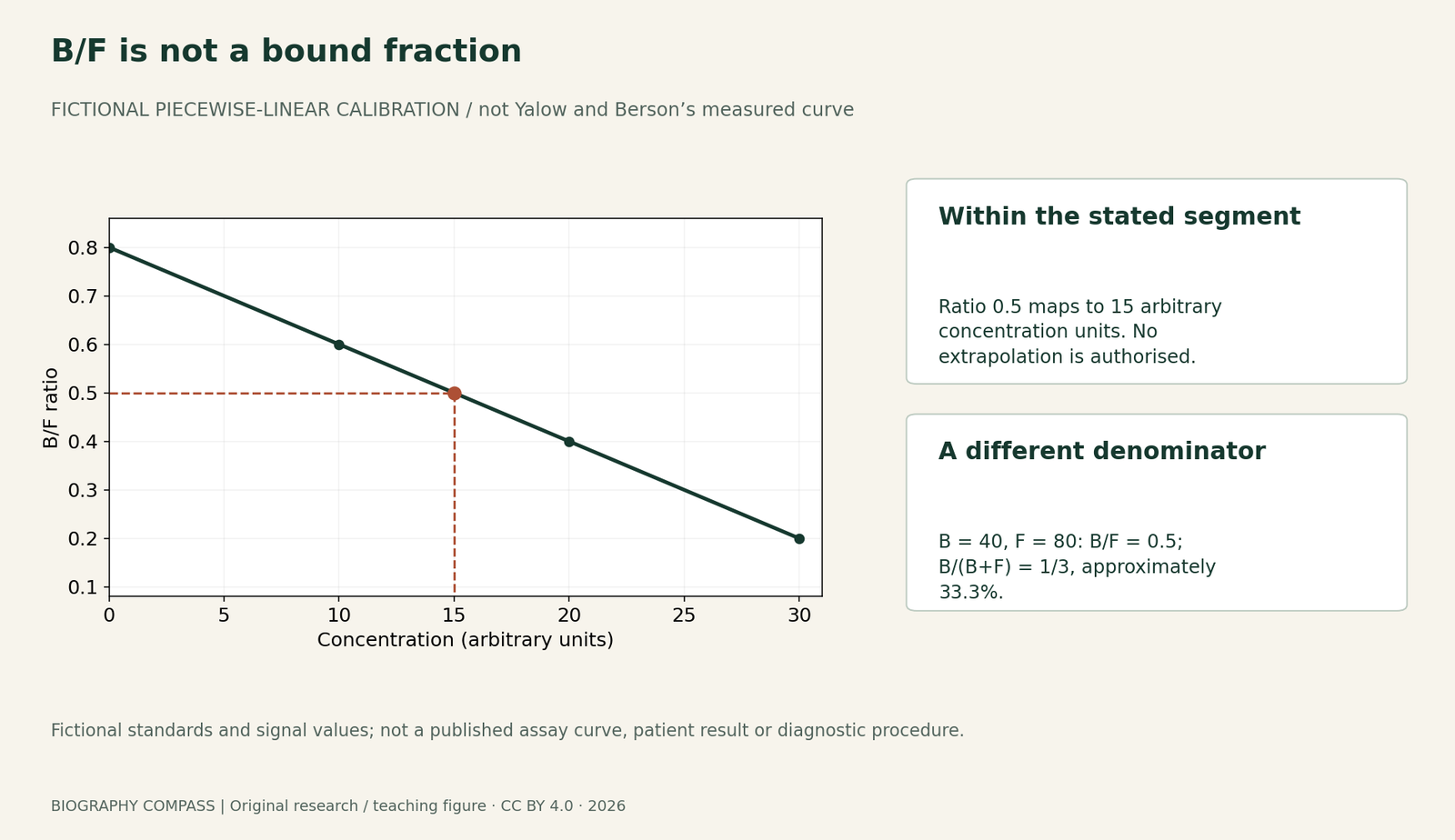
0.5 ratio maps to 15 only within the stipulated segment.
The original problem was measurement specificity
The 1960 Journal of Clinical Investigation paper compares an immunologic approach with earlier methods based on biological effects associated with insulin. Its introduction explains why an effect on glucose metabolism did not necessarily identify insulin alone: other substances and inhibitors could influence the response. The new assay therefore addressed a problem of what a measurement represented, not just whether an instrument could detect a small signal. Selected introduction and principles paragraphs were read from the publisher’s PDF. The complete experimental procedures, patient data and clinical conclusions were not independently reproduced.
Sources for this section: [1]
Competition connected an unknown with known standards
In the principles section the authors describe competition involving labelled insulin, antibodies and unlabelled insulin. The effect of an unknown was compared with known concentrations of human insulin. The measured B/F ratio depended on several features of that system, including binding conditions and the materials involved. It was not a universal conversion from any two readings. Yalow’s later lecture explains the role of comparing unknowns with standards and of their appropriate immunologic behaviour. That requirement should not be replaced by an assumption that all substances with a similar biological effect must produce an equivalent assay response.
A ratio and a fraction have different denominators
Write B for the specified bound signal and F for the specified free signal. The ratio B/F compares those two quantities. The bound fraction B/(B+F) compares one with their combined total. If the fictional signals are B = 40 and F = 80 arbitrary signal units, B/F = 0.5 but B/(B+F) = 40/120, approximately one third. Calling 0.5 a 50% bound fraction would change the denominator without justification. These invented values illustrate arithmetic only; they are not a patient sample, a preparation recipe or measurements copied from the original paper.
Sources for this section: [1]
Original exercise: read a stipulated calibration
Use an invented piecewise-linear calibration whose concentration inputs are 0, 10, 20 and 30 arbitrary units and whose corresponding B/F values are 0.8, 0.6, 0.4 and 0.2. Straight lines join only these stated points. For an unknown ratio of 0.5, calculate the concentration implied within the stipulated segment. Then calculate the bound fraction corresponding to that ratio. Finally consider a result outside the supplied range, such as B/F = 0.1. Decide whether the exercise authorises extrapolation. None of these inputs is a published Yalow–Berson calibration or a clinical reference interval.
Reference answers preserve the model’s boundaries
A ratio of 0.5 lies halfway between 0.6 and 0.4, so the stated linear segment gives 15 arbitrary concentration units. Its bound fraction is 0.5/(1+0.5) = 1/3, or about 33.3%. The supplied calibration does not authorise a result at 0.1: that would require an additional assumption or more calibration evidence. The straight segments are an editorial construction, not a claim that every real assay has a linear response. Changing reagents, sample behaviour or measurement conditions can also change whether a standard comparison is applicable. Correct interpolation cannot repair a comparison whose underlying conditions are inappropriate.
Immunologic measurement and biological activity remain distinct
Yalow’s 1977 lecture emphasises appropriate immunologic behaviour of unknowns and standards, while distinguishing this from identical biological activity or chemical identity. That distinction limits what the result means. An immunoreactive amount and the strength of a biological effect need not answer the same question. Place the original paper, the retrospective lecture and the fictional calculation in separate rows of a reading record. The paper identifies an assay system, the lecture explains its significance and qualifications, and the exercise teaches a denominator and calibration problem. None should be silently substituted for the others or used as a treatment decision.
Continue the chronology
Related history guides
Kandel and Greengard: From Synaptic Changes to Memory Claims
Compare a different measurement or inference question through original records and a worked exercise.
Read the timeline1959 original paper; 1981 participant accountHubel and Wiesel’s 1959 Study: Stimuli, Cells and Sample Limits
Compare a different measurement or inference question through original records and a worked exercise.
Read the timeline1985 paperTsien’s Calcium Indicators: Why a Ratio Needs Calibration
Compare a distinct calibration equation and its explicit assumptions.
Read the timelineBiography context
Explore United States through connected lives
Connected biographies
People behind the work
1921–2011
Rosalyn S. Yalow
Medical physicist and measurement researcherRosalyn S. Yalow was an American medical physicist who developed radioimmunoassay with Solomon Berson. Their work turned an unexpected observation about insulin binding into a method for measuring very small amounts of biologically important substances.Read biography
1952–2016
Roger Y. Tsien
Chemist and biological-imaging researcherRoger Y. Tsien was an American chemist who designed molecules to investigate activity inside cells. His research ranged from calcium indicators to improved fluorescent proteins, connecting chemical structure with the kinds of biological questions that researchers could measure.Read biographyQuick answers
Common questions
- Is B/F = 0.5 the same as 50% bound?
- No. Under the stated two-component example, the bound fraction is 0.5/1.5, or one third.
- Does the plotted calibration reproduce the 1960 paper?
- No. Its points and straight segments are explicitly fictional teaching assumptions.
Primary and institutional sources
How this history was checked
Compare the identified original texts, participant accounts and institutional records; the teaching examples are separately labelled. This article was reviewed on 27 October 2026.
- Rosalyn S. Yalow and Solomon A. Berson; Journal of Clinical InvestigationImmunoassay of endogenous plasma insulin in man, JCI39,1157–1175,1960
- Rosalyn S. Yalow; Nobel FoundationRadioimmunoassay: A Probe for Fine Structure of Biologic Systems, 8 December1977
- Nobel Foundation; Rosalyn YalowRosalyn Yalow: autobiographical account