
The short answer
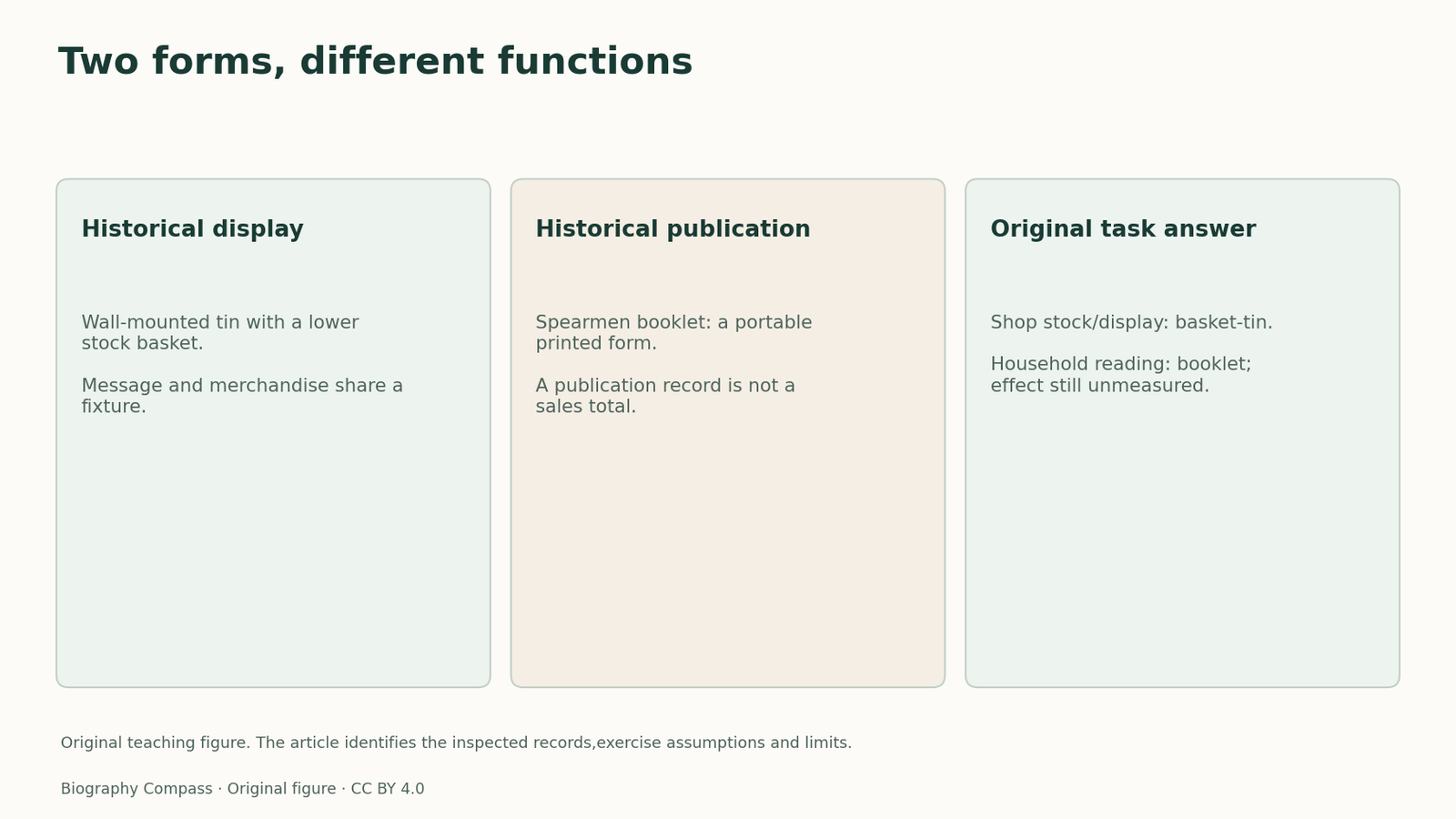
A brand can meet customers through an object that holds merchandise and through a publication that can travel separately. Their functions can complement one another without being interchangeable.
The records answer different questions
Keep the measures separate
The question changes when the object, unit or reporting period changes.
| Record or measure | What it establishes | What it does not establish |
|---|---|---|
| Basket-tin | A recorded wall-display and stock function | An independently measured campaign effect |
| Booklet | A portable printed advertising form | A complete distribution or purchase record |
| Original requirements | Which supplied form fits a defined function | A real historical campaign budget |
Chronology
A timeline of the turning points
Company combination
Manufacturing and marketing organisations join.
Publication record
A particular booklet is catalogued.
A display could also hold the product
The Smithsonian’s Juicy Fruit tin was designed to hang against a wall or flat surface, with gum held in a lower basket.
Its form joined a visible brand message to accessible stock at the selling point. This is a specific physical function recorded by the catalogue, not a capacity estimate inferred from a photograph. The record does not supply the number of packs it held or a measured increase in sales.
Sources for this section: [1]
Print could address a reader elsewhere
The University of Chicago Library records a 1915 Spearmen booklet, Book No. 2, and describes illustrated promotional publications, including material aimed at children.
The selected record identifies a publication and a character-based advertising approach. It does not establish that every copy was mailed, that every reader bought gum, or that its words described the manufacturer’s factory process. A booklet can carry a message without physically dispensing the product.
The business’s early gum came from Zeno, with the organisations combining in 1910.
Manufacturing, selling and addressing readers should therefore be kept visible as different activities.
Original form-and-requirement task
An invented shop needs a branded fixture that both presents a message and holds packs against a wall. A second project needs a paper item a household can keep and read. Use only the two forms described above; assume suitable stock and printing can be supplied. Which form directly fits each requirement? Could either alone establish that the campaigns increased purchases?
Reference answer: the hanging basket-tin fits the shop’s combined display-and-stock requirement; the booklet fits the portable reading requirement. Neither alone establishes increased purchases. To test that effect, add dated distribution, exposure and sales evidence with an appropriate comparison. The model chooses forms from supplied functions rather than inventing historical campaign totals or a conversion rate.
Why this matters for Wrigley’s business
Wrigley invested heavily in advertising and promoted recognisable flavours.
The two records show different ways that strategy could take material form. The display is tied to stock and a shop surface; the publication can address a reader without a purchase occurring at that moment. Understanding the difference gives a more concrete account of promotion than treating every branded object as either a wrapper or proof of a completed sale.
Continue the chronology
Related history guides
Biography context
Explore United States through connected lives
Connected biographies
The connected careers
1861–1932
William Wrigley Jr.
Manufacturer and marketerWrigley built a branded gum business.Read biographyQuick answers
Common questions
- Does the catalogue establish how every booklet was distributed?
- No. The selected record does not establish a universal mailing route.
Primary and institutional sources
How this history was checked
Read these dated records together; the original task states its own assumptions and separates them from reported facts. This article was reviewed on 31 October 2026.
- National Museum of American HistoryJuicy Fruit Gum Tin, nmah 1360055
- University of Chicago Library, Sweet Home Chicago exhibitionThe Wrigley Spearmen at Work and Play
- Encyclopedia of Chicago / Chicago Historical Society and Newberry LibraryWrigley (Wm. Jr.) Co.
- Harvard Business School, Great American Business LeadersWilliam Wrigley, Jr.