
The short answer
A customer publication can carry more than one kind of message. Separate what a retailer says about its own offer from products advertised to the same readers by other businesses.
The records answer different questions
Keep the measures separate
The question changes when the object, unit or reporting period changes.
| Record or measure | What it establishes | What it does not establish |
|---|---|---|
| Price notice | Terms presented to shoppers | Quantity actually sold |
| Magazine advertisement | A product promoted to readers | Automatic proof of the retailer’s inventory |
| Warehouse illustration | A representation of infrastructure | An itemised transaction |
Chronology
A timeline of the turning points
Stall
A price proposition takes shape.
Publication department
A separate promotional activity.
A recognisable price proposition
Marks’s early penny-priced stall developed into the Penny Bazaar format.
Its household and sewing goods were displayed for browsing. The offer concerned useful small purchases, not the ready-made fashion range associated with the later company.
The commercial distinction is between a conspicuous rule that makes browsing simple and a claim that one shop supplies everything a reader may want. Those are not equivalent propositions.
A publication was not a complete stock list
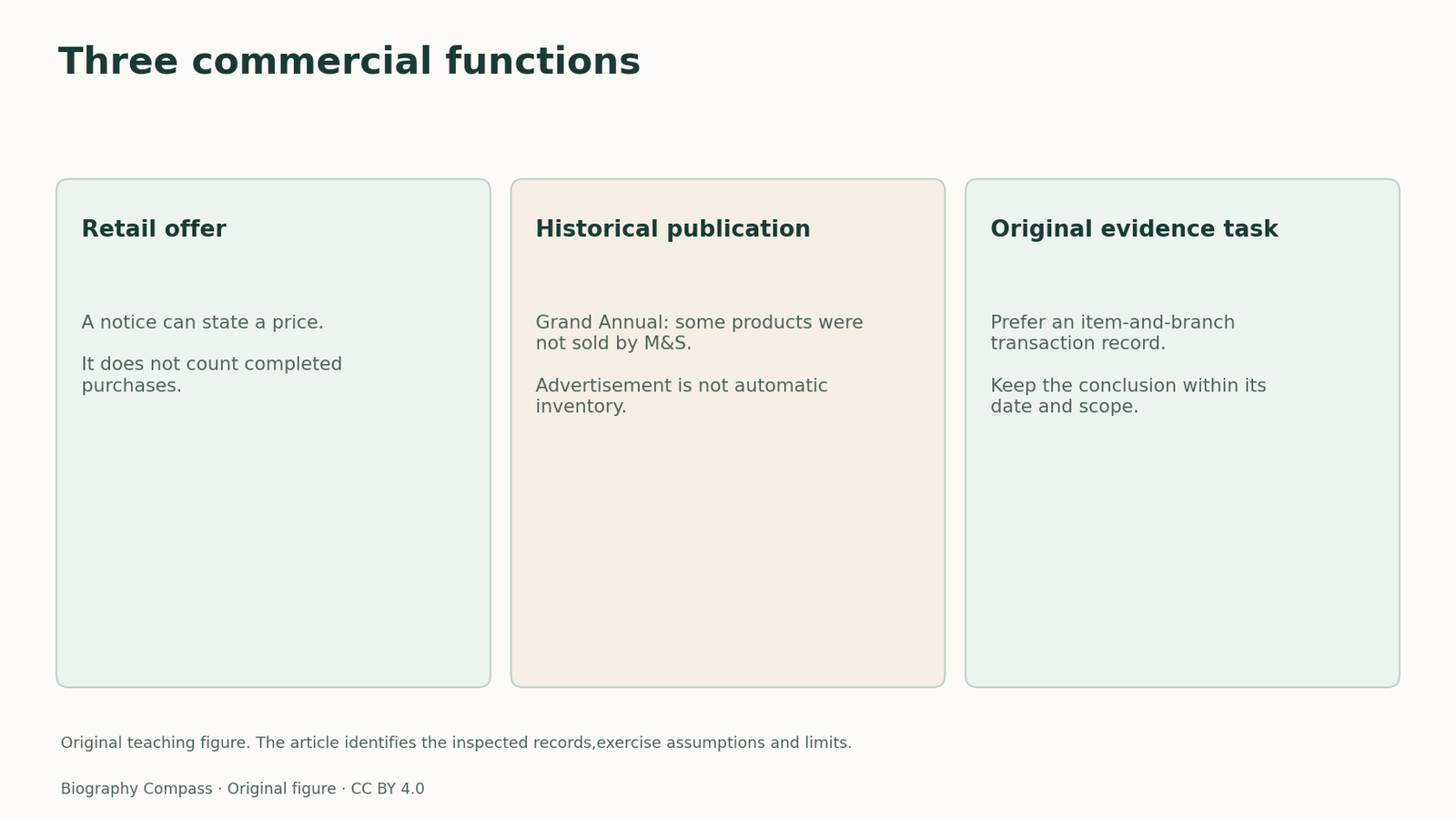
The archive dates an advertising and publication department to 1909. The Grand Annual promoted goods including products not sold by M&S. A c. 1903–1905 bag, by contrast, listed stores and depicted the warehouse.
London Museum’s later letterhead names Simon Marks and Israel Sieff in company leadership.
Together these records distinguish the trading offer, a promotional channel and a corporate identity. They also prevent later management or branding from being casually assigned to the founder.
The archive’s 1913 entry describes a Grand Annual advertisement promoting the firm’s own penny offer. That sits alongside its warning about other advertised products. A publication can therefore contain both an in-house message and paid or otherwise supplied outside promotion. The record does not disclose the financial terms for each advertisement, so no advertising-revenue total is inferred.
An original merchandising evidence exercise
A fictional researcher has four cards: A, a retailer’s own dated price notice; B, a third-party product advertisement in its magazine; C, a warehouse illustration on a shopping bag; D, a transaction ledger identifying an item and branch. Which best supports a specific stocked-and-sold claim? Which establishes a stated price offer? Which cards are insufficient alone to prove a completed sale?
Reference answer: D is strongest for the specified transaction; A establishes the advertised offer rather than actual purchases. B and C cannot alone establish a sale: an advertisement may concern another supplier, while a warehouse image represents infrastructure. Even D should be kept within its item, branch and date rather than generalised to the entire chain.
Why the distinction matters for this business
The comparison allows a retailer to be understood as both a seller and a publisher without collapsing those activities. A simple price message could attract shoppers while a magazine addressed a broader set of needs. A historian who treats every advertisement as inventory would reconstruct a different and unjustifiably larger range. The original exercise tests that precise error; it is not advice about present pricing or a reconstruction of every early product.
Continue the chronology
Related history guides
Biography context
Explore United Kingdom through connected lives
Connected biographies
The connected careers
Quick answers
Common questions
- Is an advertised product necessarily a stocked product?
- No. Establish the advertiser, the seller and the relevant transaction or stock record before combining them.
Primary and institutional sources
How this history was checked
Read these dated records together; the original task states its own assumptions and separates them from reported facts. This article was reviewed on 31 October 2026.