
The short answer
Why does a later advertisement with a familiar name need a different institutional context from the breakaway league?
The records answer different questions
Competition, settlement and advertisement
Compare the particular functions and conditions identified in this study.
| Record or measure | What it establishes | What it does not establish |
|---|---|---|
| Governing-body history | A competition’s institutional setting | The contents of an unplayed advertisement |
| Catalogue entry | An item’s date, agency and interpreted purpose | A measured audience response |
| Original caption | A claim whose missing link can be identified | An independent match-statistics audit |
Chronology
A timeline of the turning points
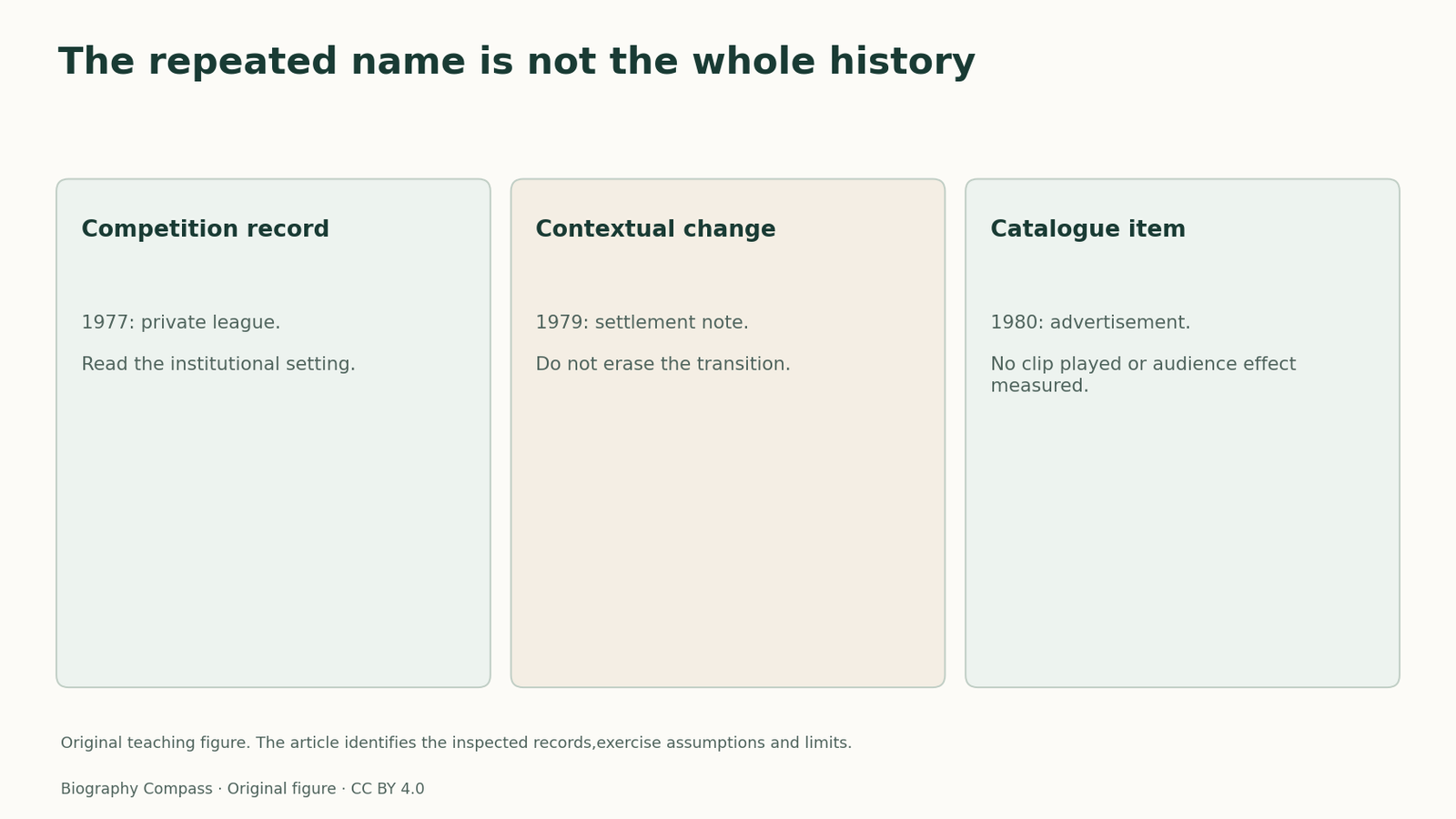
Competition
The governing-body account identifies a private league.
Settlement
The catalogue supplies the changed context.
Advertisement
A later item retains a familiar name.
The competition sat outside the established structure
ICC’s history places Packer’s private league outside the international structure in 1977 and describes its two-year duration.
That is a governing-body account of the competition’s institutional position. It is not a claim that professional players or limited-over internationals began with this enterprise. Reading the surrounding chronology is important before turning a dramatic commercial episode into a first-ever statement.
Sources for this section: [1]
The later catalogue describes a different setting
NFSA dates its Aussie Team advertisement to 1980. Its note connects the campaign to the mid-1979 agreement and identifies Mojo Partners as the agency. The stated aim was to downplay the rebel/establishment division.
This is evidence about a catalogued advertisement and the curator’s explanation of its purpose. A purpose is not an audience-effect measurement. The item can illuminate how the reunited field was promoted without being evidence that the original breakaway continued unchanged.
Sources for this section: [2]
Original timeline repair
An invented display caption says: “The same name appears on an earlier competition and a later advertisement, so the event retained the same status throughout.” Rewrite it in two sentences. Your answer must distinguish competition, settlement and advertising, without claiming to have watched or heard the item.
Reference answer: “The earlier competition was a private breakaway outside the established international structure. The later advertisement belongs to the post-settlement setting described in its catalogue; its familiar name does not itself establish unchanged competition status.” A stronger exhibition could add the dates from the identified records, but the claim must not exceed them.
Do not replace one first-ever myth with another
ICC dates the first limited-over international to 1971 and the first men’s World Cup to 1975.
The commercial episode can still have mattered without creating every format associated with modern television. Distinguish an earlier sporting format from its later promotion and organisation. This comparison uses written institutional accounts only: no advertisement was played, no jingle transcribed and no match’s statistical status independently audited.
Sources for this section: [1]
Continue the chronology
Related history guides
Biography context
Explore Australia through connected lives
Connected biographies
The connected careers
1937–2005
Kerry Packer
Media proprietorOwning a channel could lead to reorganising the event it wanted to show.Read biographyQuick answers
Common questions
- Does an archive title establish the same competition status at every date?
- No. Read the item’s date, type and contextual note before drawing that conclusion.
Primary and institutional sources
How this history was checked
Read these dated records together; the original task states its own assumptions and separates them from reported facts. This article was reviewed on 31 October 2026.