
The short answer
How can a container change the assembly problem, and what can a simple geometry model explain without pretending to reproduce a real production line?
The records answer different questions
Geometry, assembly and preparation
Compare the particular functions and conditions identified in this study.
| Record or measure | What it establishes | What it does not establish |
|---|---|---|
| Food processing | Preparation and storage requirements | A container’s exact geometry |
| Package geometry | A nominal final position | Reliable factory yield |
| Original calculation | A result from stated dimensions | Dimensions of the historical product |
Chronology
A timeline of the turning points
Earlier product
The preparation problem is addressed.
Container product
Packaging introduces a further assembly question.
The product included an assembly problem
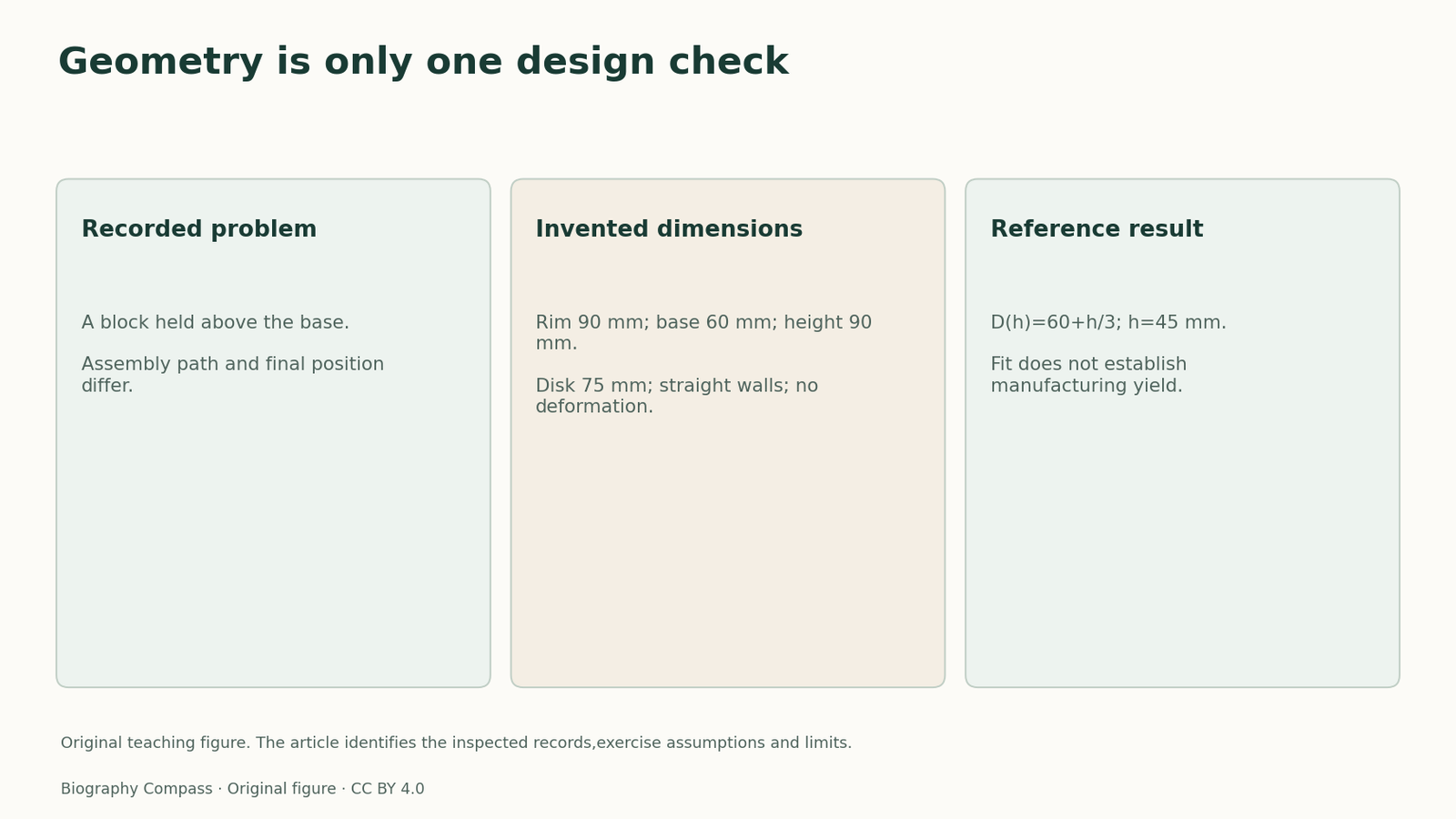
Nissin’s retrospective describes a noodle block held above the cup’s base. Dropping it into the cup could make it tilt; placing the inverted cup over the block offered an assembly solution.
The record joins two questions that can otherwise be separated too easily: how a component sits inside a finished package, and how the factory gets it there. The published account is a participant history, not an independently measured line-yield report.
Sources for this section: [1]
Drying and packaging answer different questions
The earlier instant noodles were dried and flash-fried, then rehydrated with hot water.
That explains a relationship between the food’s condition and preparation. It does not determine the dimensions of a later container. Conversely, a cup that holds a block securely does not itself explain the drying process. Treat these as connected design requirements rather than interchangeable inventions.
Original tapered-container problem
Use an invented rigid circular cup with straight tapered walls: internal diameter 60 mm at the base and 90 mm at the rim, over a height of 90 mm. A rigid horizontal disk has diameter 75 mm. Assume perfect dimensions, no deformation and a linear change of diameter with height. At what height above the base does the disk meet the wall? Does this calculation establish that an assembly line can reliably fill the cup?
Reference answer: D(h)=60+(30/90)h. Set D=75, so h=45 mm. The disk fits through the 90 mm opening but cannot pass to the 60 mm base. The model describes a possible support position. It supplies no tolerance, friction, breakage rate or equipment motion, so it does not establish reliable automated assembly.
Sources for this section: [1]
Use the calculation for a design brief
A useful brief would keep three checks separate: the final position, the insertion path and the variation around the intended dimensions. Ask what measurements would be needed for each. The same nominal geometry could behave differently if the component crumbles, the wall flexes or dimensions vary. Those are proposed tests, not findings from an experiment performed here. This exercise interprets a historical packaging problem through supplied abstract dimensions; it is not a manufacturing or food-safety recipe.
Sources for this section: [1]
Continue the chronology
Related history guides
Biography context
Explore Japan through connected lives
Connected biographies
The connected careers
1910–2007
Momofuku Ando
Food inventorConvenience became a problem of production, packaging and use.Read biographyQuick answers
Common questions
- Does geometric fit prove reliable assembly?
- No. Dimensions alone do not supply tolerances, material behaviour or the machine’s insertion path.
Primary and institutional sources
How this history was checked
Read these dated records together; the original task states its own assumptions and separates them from reported facts. This article was reviewed on 31 October 2026.