
The short answer
How a c.1945–46 window-sill painting makes colour and inside-outside relationships active.
Read the evidence
Sources, interpretation and production roles
The records answer different questions about this work. The final exercise is an original teaching model.
| Record or question | Supported reading | Boundary or contrast |
|---|---|---|
| GAC object record | Identifies a c.1945–46 painting purchased in 1947. | The publication date of a colour essay is a separate event. |
| Artist’s colour writing | Documents a sustained intellectual enquiry. | It does not supply a compulsory symbolic code for every hue. |
| Original arrangement model | Keeps objects fixed while colour relations change. | The colours are invented, not sampled from Nicholson’s work. |
A mid-century flower painting
The Government Art Collection dates Flowers on a Window Sill to around 1945–46. It is an oil painting on board, purchased in 1947. The title identifies both a subject and a spatial relationship: flowers stand near a boundary between an interior and the world beyond. Nicholson repeatedly used such situations to explore colour. The useful starting point is the specific painting, not a general rule that all flowers symbolise the same emotion.
Sources for this section: [1]
A subject capable of carrying a colour argument
A flower arrangement offers several related kinds of difference: petal, leaf, vessel, background and changing light. The window creates another interval between near and far. In this reading, the objects provide a structure through which colours can be compared. A viewer can attend to the subject while also noticing how one passage gains force beside another. The painting does not need to cease representing flowers in order to organise an abstract relationship. Still life and colour enquiry can be active at the same time.
Writing beside painting
The collection account connects Nicholson’s work with her interest in colour symbolism and her 1944 article Liberation of Colour. The estate also records her earlier contribution Unknown Colour to Circle under the name Dacre. These are historically specific writings, not statements composed by a later viewer to explain her pictures. Their existence gives a firmer basis for discussing colour as deliberate intellectual work. It does not establish a universal code in which every painted hue must stand for a particular feeling. Nor does the painting simply illustrate a chart. The practical arrangement of a vase, sill and surrounding space remains a separate act of making.
Original study: one arrangement, two colour relations
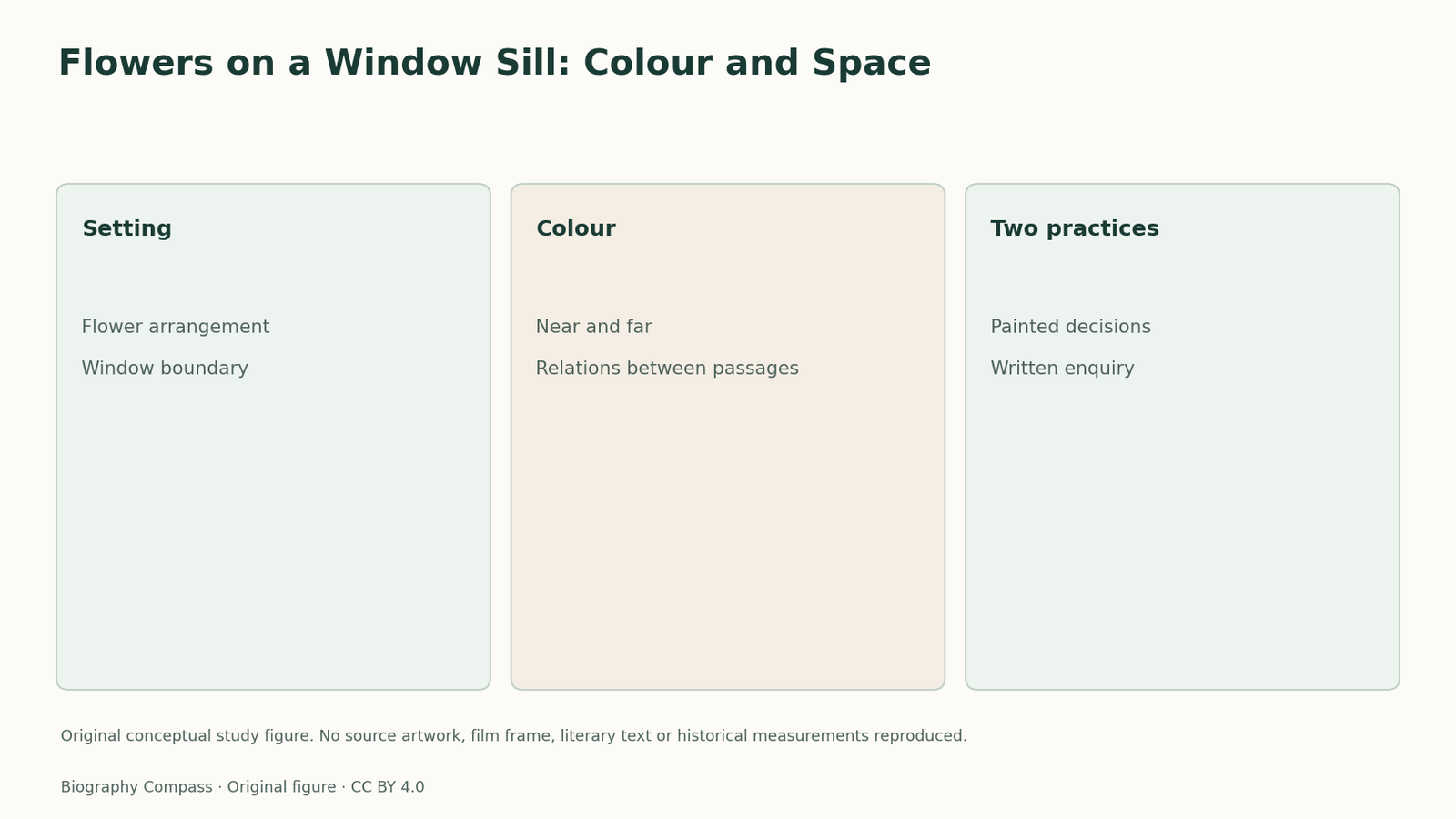
Imagine a vase with three invented flowers set on a sill. Keep the outlines and positions unchanged in two written plans. In the first, place a pale flower against a darker imagined background; in the second, make flower and background close in value but different in hue. Ask how a viewer might distinguish the flower in each plan. A possible answer identifies contrast in lightness in the first and a subtler colour interval in the second. Neither answer claims to reconstruct Nicholson’s palette. Next place a distant patch of colour beyond the window and explain how it could connect near and far without changing the objects. This makes a concrete comparison between subject identity and pictorial relationship: the same flower remains recognisable while its visual role changes. Return to the historical record by explaining why a painter might write about colour and still keep returning to observed flowers. The exercise supports that connection without reducing the painting to an illustration of a predetermined theory.
Continue the chronology
Related history guides
Biography context
Explore United Kingdom through connected lives
Connected biographies
People and related creative practices
1893–1981
Winifred Nicholson
British painter and writer on colourWinifred Nicholson sustained an independent career in flower painting, landscape and colour writing across Britain, France and repeated journeys abroad.Read biography1869–1947
Frances Hodgkins
Painter and art teacherFrances Hodgkins was a New Zealand-born painter whose long working life centred increasingly on Europe. Teaching, travel, friendships and commercial support helped sustain a career that moved from figure painting towards a distinctive modernist language.Read biography1894–1982
Ben Nicholson
British painter and maker of abstract reliefsBen Nicholson moved between still life, landscape and abstraction, developing reliefs while working within a wide network of artists and collectors.Read biographyQuick answers
Common questions
- Is this the 1920s Daffodils and Hyacinths painting?
- No. This guide follows the Government Art Collection’s Flowers on a Window Sill, dated c.1945–46.
- Does colour theory replace the subject?
- No. The guide considers how an observed subject can support colour relationships without disappearing into a verbal theory.
Primary and institutional sources
How this history was checked
Sources include production records, institutional collections and the specifically identified passages discussed here. Interpretations and teaching models are distinguished from credits and publication facts. This article was reviewed on 8 November 2026.