
The short answer
What does Kettle’s Yard’s small incised-card relief reveal about actual depth, hand-drawn geometry and a surface’s changing light?
Read the evidence
Sources, interpretation and production roles
The records answer different questions about this work. The final exercise is an original teaching model.
| Record or question | Supported reading | Boundary or contrast |
|---|---|---|
| Object record | Names incised card and shallow physical layers. | The title does not identify every 1934 relief as the same material. |
| Geometric vocabulary | Circles and squares were drawn by eye. | Geometry does not necessarily imply mechanical manufacture. |
| Original two-surface test | Compares a painted patch with a physical recess. | No Nicholson design or exact dimensions are reproduced. |
A small relief with a precise identity
The small Kettle’s Yard 1934 (relief) uses incised coloured card with oil and graphite. Its catalogue distinguishes it from carved white wooden panels. The object makes a precise question available: how does a support acquire real depth rather than only represent it? A small change of level can matter even when an object remains close to the scale of a sheet of paper. The relationship is physical before it becomes a description of a distant scene.
Sources for this section: [2]
Cutting changes the support
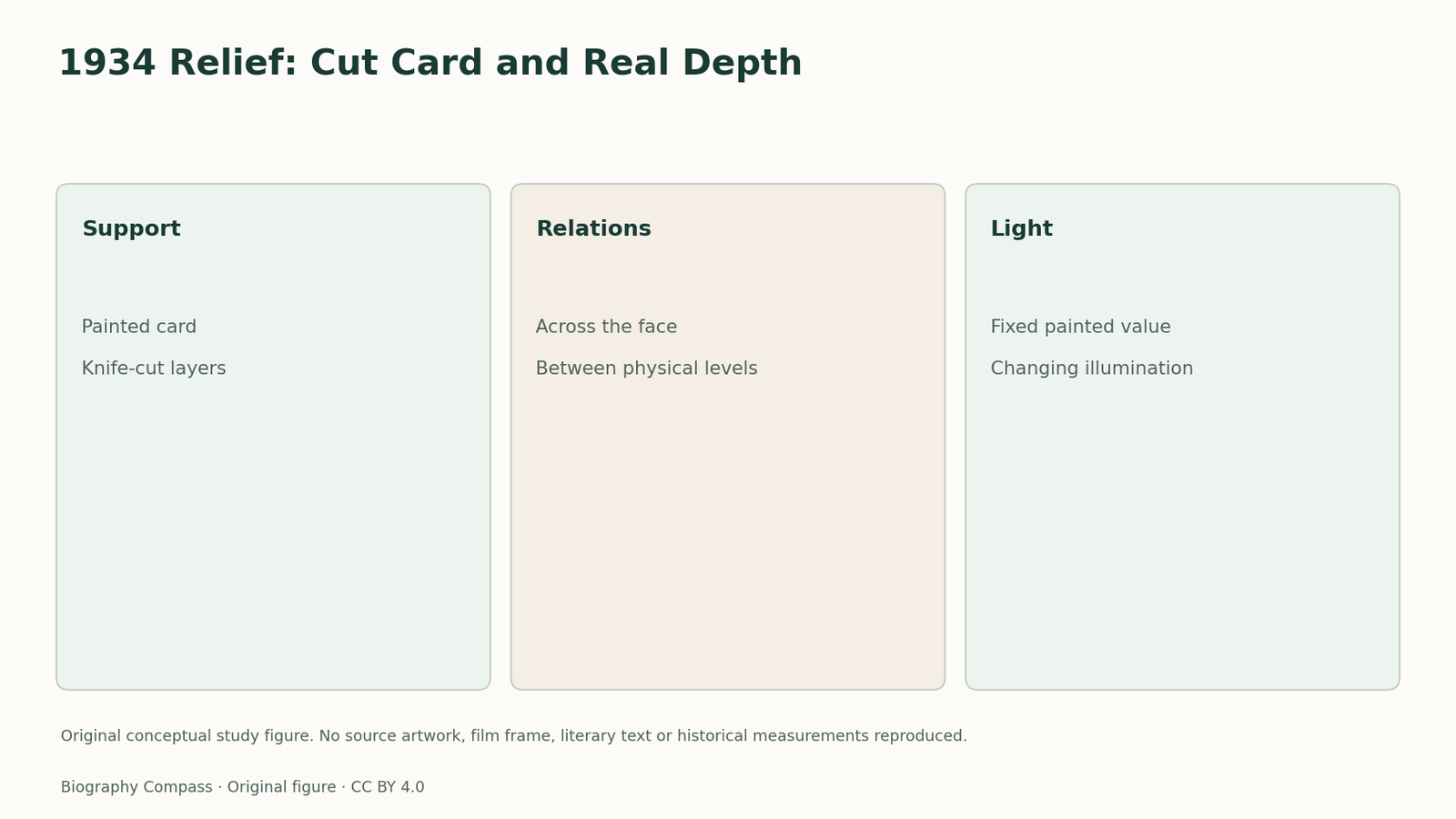
The card was cut and layers peeled away, then painted and rubbed down. That procedure differs from drawing a shadow to make a flat shape look recessed. In the relief, the recess is part of the material object. Light falling on a shallow edge can interact with painted relationships. A viewer’s movement or a change in illumination can therefore affect the appearance without requiring a new mark. The artist has arranged a support whose continuing material behaviour helps make the image.
Sources for this section: [2]
Geometry made by hand
The record says the circles and squares were drawn by eye. In this guide’s reading, chosen geometric forms need not become impersonal merely because they are recognisable as geometry. Their placement can establish balance across the face, while their physical levels introduce a second set of relations. A square that is close to another square need not be at the same depth. Keeping those comparisons separate makes the work more intelligible than naming shapes alone. Nicholson’s wider practice offers a context in which painted relationships and an object’s presence can continue together without requiring every relief to use the same material.
Original comparison: a painted square and a stepped square
Make two imaginary study plans without copying Nicholson’s arrangement. In the first, draw a dark square on an otherwise flat sheet. In the second, describe a square recess cut into a thick blank card. Ask what changes when a lamp moves from left to right. A reference answer distinguishes the fixed dark patch in the drawing from a physical edge whose illumination can change. Both remain designed images, but they recruit light differently. Add a second recess at a different level and explain how a viewer could compare depth with placement across the face. Finally, imagine the entire object enlarged. The relationships can be described at a new scale, but the material and method may need to change; enlarging a diagram is not evidence that the actual work was made that way. This exercise explains the stakes of the small 1934 object while preserving the distinction between cut card, carved wood and drawn space. A second test keeps the same paint on both imagined surfaces. The difference in depth remains, showing why colour and physical construction should be described as related but separate decisions.
Continue the chronology
Related history guides
Biography context
Explore United Kingdom through connected lives
Connected biographies
People and related creative practices
1894–1982
Ben Nicholson
British painter and maker of abstract reliefsBen Nicholson moved between still life, landscape and abstraction, developing reliefs while working within a wide network of artists and collectors.Read biography1903–1975
Barbara Hepworth
SculptorBarbara Hepworth developed an abstract sculpture practice and a major public career. Single Form was unveiled at the United Nations in 1964, with artist and donor separately credited.Read biography1893–1981
Winifred Nicholson
British painter and writer on colourWinifred Nicholson sustained an independent career in flower painting, landscape and colour writing across Britain, France and repeated journeys abroad.Read biographyQuick answers
Common questions
- Is this relief entirely flat?
- No. Its cut card layers create shallow physical depth.
- Were its circles mechanically drawn?
- The collection record says the circles and squares were drawn by eye.
Primary and institutional sources
How this history was checked
Sources include production records, institutional collections and the specifically identified passages discussed here. Interpretations and teaching models are distinguished from credits and publication facts. This article was reviewed on 8 November 2026.