
The short answer
How do a memorial commission, a radial window and a religious subject organise different kinds of meaning?
Read the evidence
Sources, interpretation and production roles
The records answer different questions about this work. The final exercise is an original teaching model.
| Record or question | Supported reading | Boundary or contrast |
|---|---|---|
| Flemish heritage record | Identifies the gift and 21 May 1938 unveiling. | The English account is a paraphrase of the inspected Dutch passage. |
| DIB subject account | Te Deum supplies a religious framework. | A religious subject and memorial dedication answer different questions. |
| Original three-box model | Separates purpose, subject and structure. | No actual glazing pattern or protected figure is copied. |
A memorial in a reconstructed city
Wilhelmina Geddes’s Te Deum window occupies the south-transept rose opening of St Martin’s at Ypres. The heritage inventory identifies it as a gift from British troops to King Albert I and records its unveiling by Leopold III on 21 May 1938. These particulars establish the memorial relationship. They also distinguish this commission from a generic decorative church window, while stopping short of assigning every pane an undocumented military meaning.
A religious subject within a memorial purpose
The Dictionary of Irish Biography identifies the subject with divine glory expressed in the Te Deum. The patronage and the religious subject therefore describe different aspects of the same work. One explains whom the gift commemorates and who provided it; the other explains the larger sacred framework. A memorial does not have to narrate a particular battle in order to participate in remembrance.
Why the circular format matters
A rose window is a circular opening commonly divided into radiating panels, as the Stained Glass Museum glossary explains. That structure presents a different compositional problem from a row of equal rectangular pages. Geddes had to make a designed whole within an architectural subdivision. The 1935–38 project is discussed in the BSMGP lecture review as a major late commission, following work in both Dublin and London studios. The format helps explain the technical and artistic ambition without requiring a copied diagram of the actual glass. A radial opening does not merely reduce the space available for a rectangular picture. It creates a centre and directions around it, requiring an arrangement that responds to those relationships within the building.
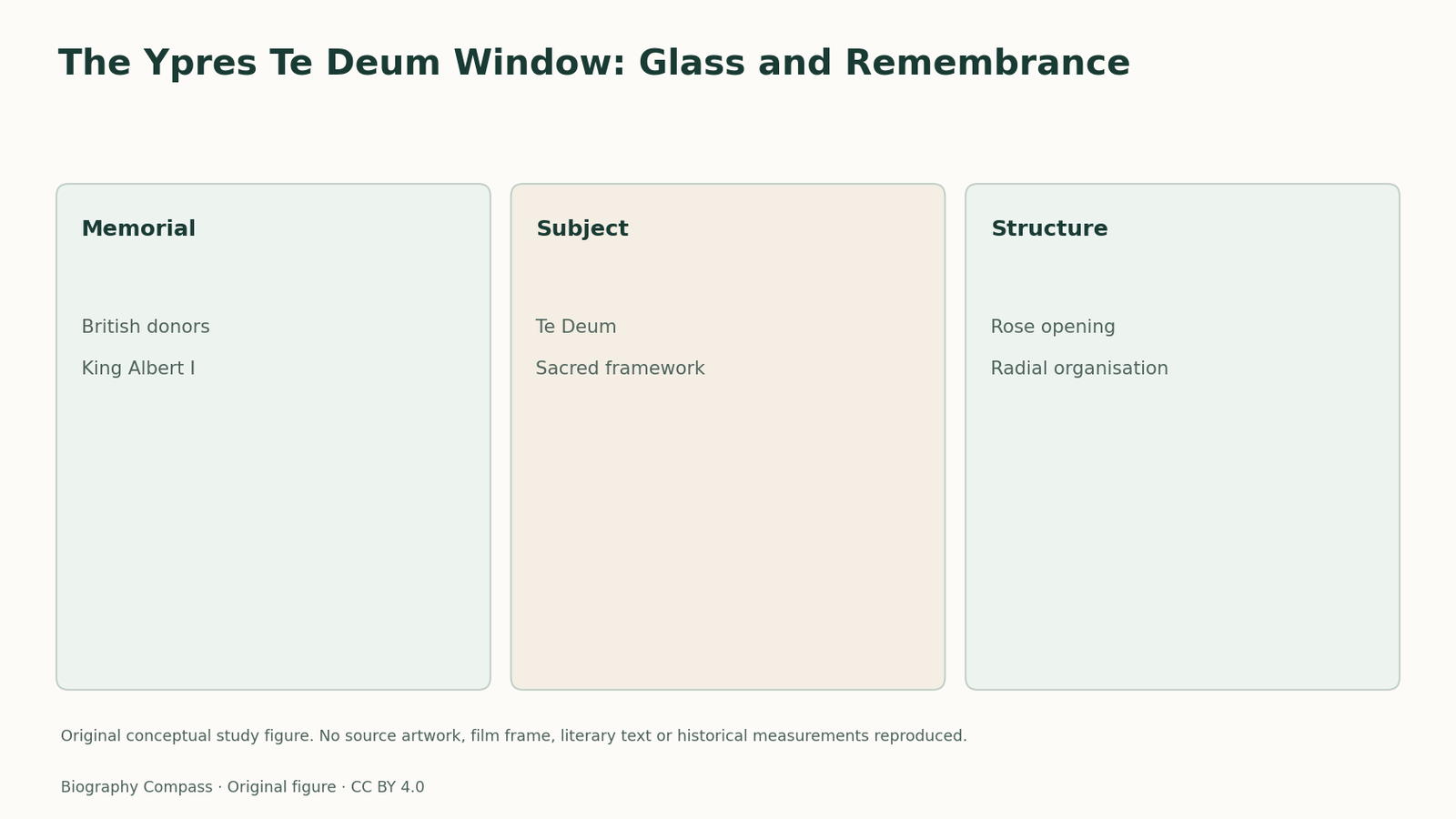
Original exercise: purpose, subject and structure
Draw three empty boxes labelled memorial relationship, religious subject and architectural structure. Place Albert I and the British donors in the first, Te Deum in the second and radial opening in the third. A reference answer explains that the first box concerns commemoration, the second a sacred theme and the third the conditions under which figures and colour are organised. Ask whether one box can replace the others. A supported response says no: knowing the donor cannot by itself describe the window’s geometry, and identifying a circle cannot establish whom the work commemorates. Next propose a hypothetical change from a circular opening to three tall lights. The subject and purpose might remain, but the arrangement would need rethinking. This final proposal is an original teaching model, not a reconstruction of an abandoned Geddes design. It offers a practical explanation of how public art can connect remembrance, belief and material structure. Readers can then compare Hone’s Eton work through those same categories while preserving the different commission histories and openings.
Continue the chronology
Related history guides
Biography context
Explore Ypres, Belgium through connected lives
Connected biographies
People and related creative practices
1887–1955
Wilhelmina Geddes
Irish stained-glass artist and designerWilhelmina Geddes developed a powerful figurative stained-glass practice across Irish and London studios, receiving commissions in several countries.Read biography1848–1943
Sarah Purser
Painter and cultural organiserAn Irish portrait painter and organiser who helped build stained-glass practice and public art institutions.Read biography1894–1955
Evie Hone
Irish painter and stained-glass artistEvie Hone brought experience of cubist painting into a major stained-glass career, working through Irish studio networks and international commissions.Read biographyQuick answers
Common questions
- Is the Ypres window in St George’s memorial church?
- No. The sources identify the Te Deum rose window with St Martin’s Cathedral at Ypres.
Primary and institutional sources
How this history was checked
Sources include production records, institutional collections and the specifically identified passages discussed here. Interpretations and teaching models are distinguished from credits and publication facts. This article was reviewed on 8 November 2026.
- Dictionary of Irish BiographyGeddes, Wilhelmina Margaret
- British Society of Master Glass PaintersLecture review: Nicola Gordon Bowe on Geddes
- Flemish Heritage AgencySint-Maarten memorial inventory
- The Stained Glass MuseumFaith, Hope and Charity acquisition
- The Stained Glass MuseumGlossary of stained-glass terms