
The short answer
A fixed number of shares and a fixed sum of money are different promises. The historical records let us separate the entitlement unit, a dated market illustration and the later event that implemented the arrangement.
Evidence and interpretation
Keep the claim attached to the record
Each row answers a different part of the question.
| Record | Supported reading | Limit |
|---|---|---|
| Entitlement | 1.31 new ordinary shares per old ordinary share. | A ratio, not fixed cash. |
| Illustration | 23.98×1.31 rounds to 31.41. | A dated market-value illustration. |
| Original case | 131 shares; 2620 or 3275 currency units. | Invented prices and simplifying assumptions. |
Chronology
A timeline of the turning points
Price observation
The illustration has a particular market date.
Record date
Eligibility and valuation are different questions.
Implementation
The transaction reached its stated implementation stage.
First identify the entitlement unit
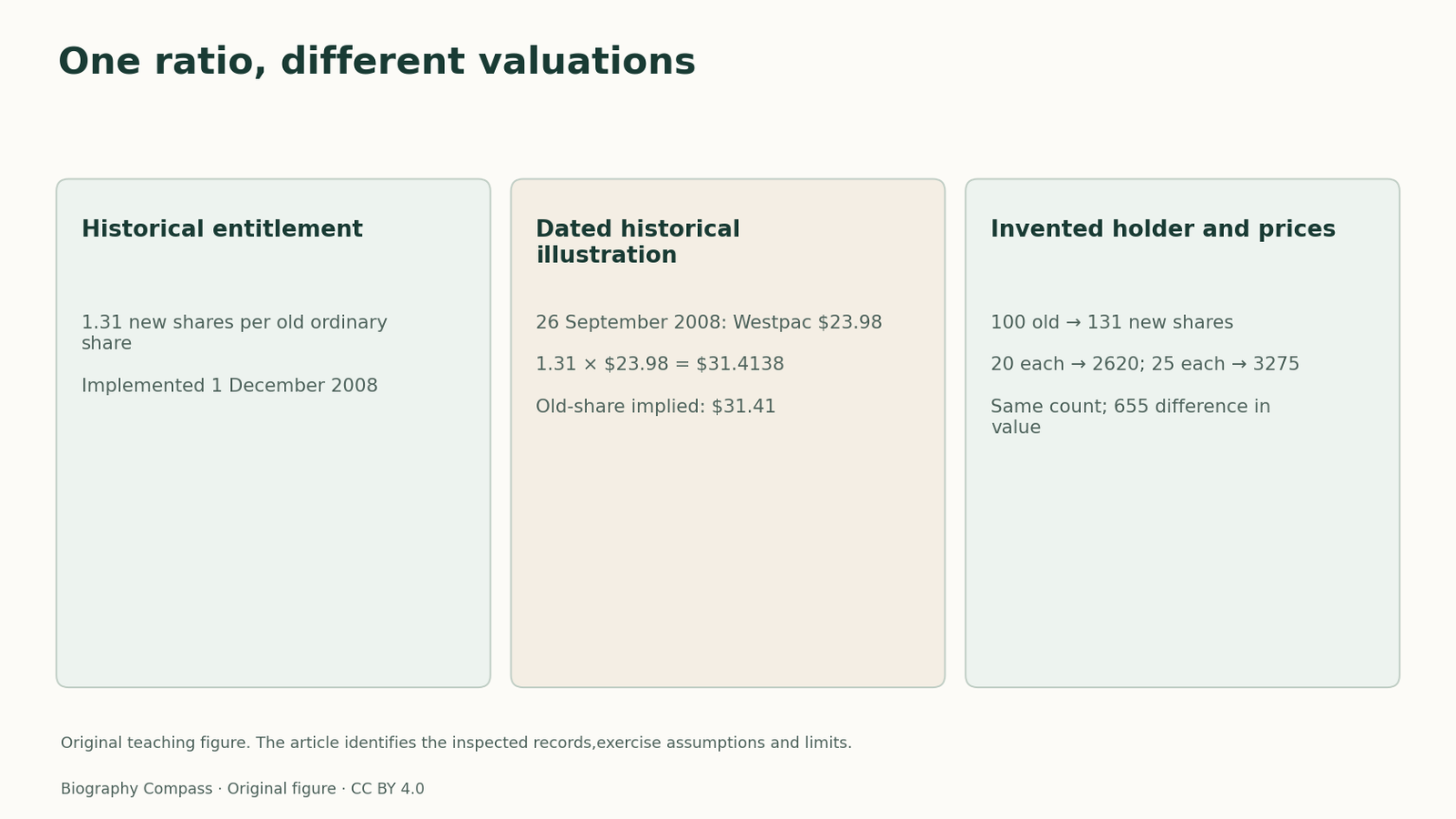
Westpac’s historical record says the merger was implemented on 1 December 2008. Eligible St.George ordinary shareholders at the 24 November record date received 1.31 Westpac ordinary shares for each ordinary share held.
The unit matters: this is shares per share. It is not a currency-per-share promise. The record date defines the stated entitlement boundary, while implementation identifies the later transaction event.
Sources for this section: [1]
Then inspect the dated illustration
The scheme booklet’s printed page 15 uses Westpac’s 26 September 2008 closing price of $23.98 to show an implied consideration of $31.41 for each St.George share. The table also displays other dates and averaging windows with different implied values.
Multiplying a ratio by a dated market price produces a dated implied value. It does not convert that illustration into a guaranteed cash payment. The page’s proposed operating benefits likewise remain expectations in a proposal, not a measured result of implementation.
Sources for this section: [2]
Original two-price case
Invented illustration: an eligible holder has 100 ordinary shares and receives 1.31 new shares per old share. Assume no fractional-share issue, fees, taxes, dividends or other adjustment. If the new share is valued at 20 currency units on one date and 25 on another, how many shares are received and what is the implied total on each date?
Sources for this section: [1]
Reference answer and historical boundary
The holding becomes 131 shares. At 20 units each its implied value is 2620; at 25 it is 3275. The number of shares is unchanged while the valuation changes by 655. Separately, the historical table’s 1.31×23.98=31.4138 rounds to 31.41 per old share. This comparison explains a unit distinction; it does not reconstruct an individual’s tax position, recommend a transaction or promise a subsequent market value.
Continue the chronology
Related history guides
Biography context
Explore Australia through connected lives
Connected biographies
The working life
Born 1956
Gail Kelly
Bank executiveKelly led banking teams through a major institutional transition.Read biographyQuick answers
Common questions
- Does a fixed share ratio fix the cash value?
- No. The number of shares and a price assigned to each share are separate inputs.
Primary and institutional sources
How this history was checked
Compare the selected accounts and objects below; each has a stated date and scope, and the learning task supplies its own instructions. This article was reviewed on 31 October 2026.