
The short answer
Homeworking changes where work happens; it does not remove the need to organise dependencies. Two retrospective accounts show how delivery could depend on people, written procedures and access to a remote computer.
Evidence and interpretation
Keep the claim attached to the record
Each row answers a different part of the question.
| Record | Supported reading | Limit |
|---|---|---|
| Responsibility | Manager checks; programmers write. | Not a named credit list for every contract. |
| Handoff | Computer results return after submission. | Submission is not successful execution. |
| Original case | Six serial durations total eleven days. | The dependency assumptions are supplied, not historical data. |
Chronology
A timeline of the turning points
Participant recollection
Responsibility and turnaround are described retrospectively.
Later public account
The performance emphasis is described again.
Who produced the work, and who checked it?
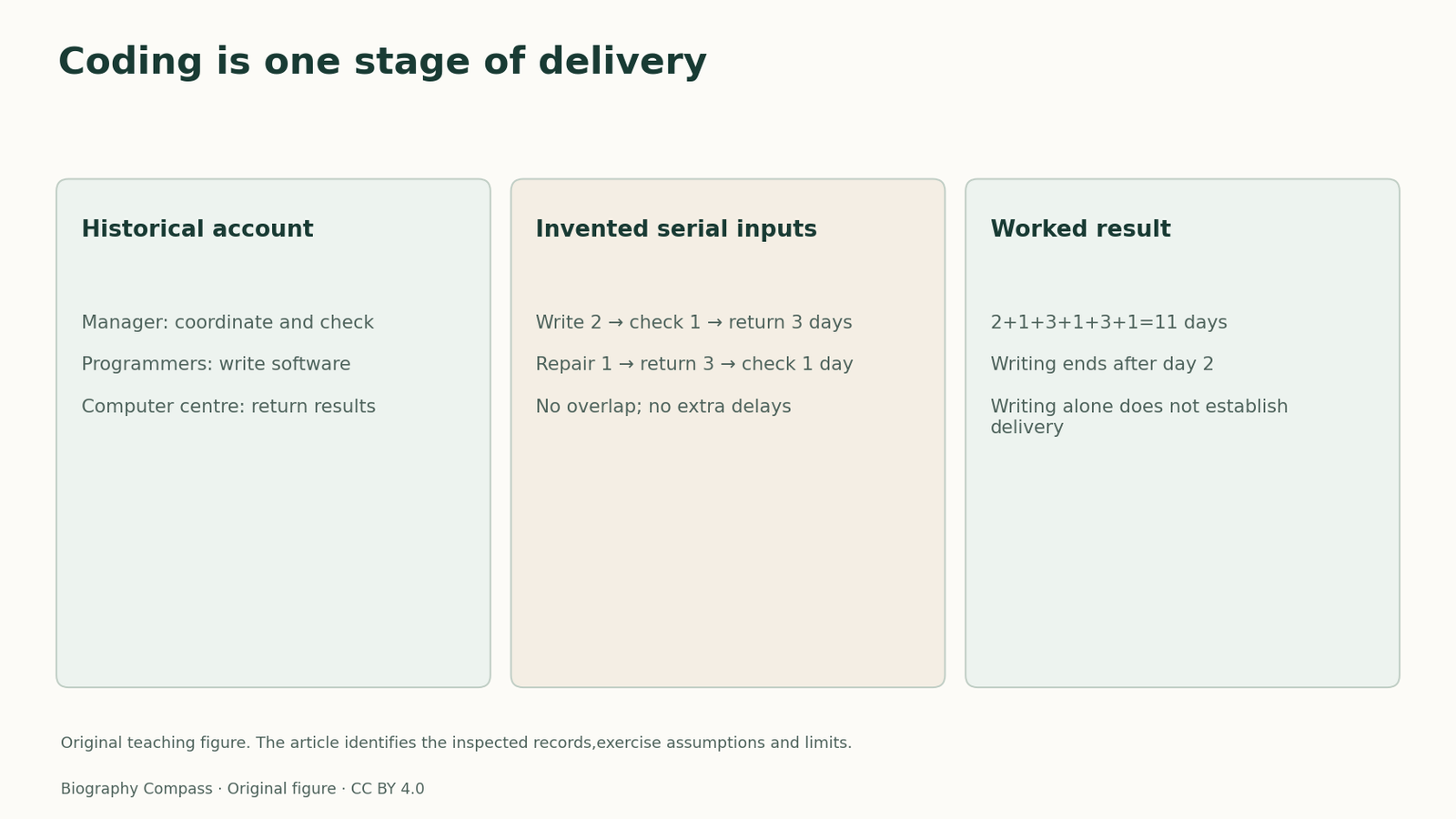
In her 2001 oral history, Shirley distinguishes her project management and supervision from software written by other women. Remote coordination used post and telephone. Fixed-price, fixed-delivery work required assessing the work content rather than watching people in an office.
This is a division of responsibility. Writing a program and accepting a deliverable are different actions, even when one person can sometimes perform both. A later founder’s recollection also cannot identify every contributor to a particular contract.
Sources for this section: [1]
The delivery chain included the machine
She recalled sending paper-written programs to a computer centre and waiting days for results; a failed input routine could prevent a run from starting. Some later contracts depended on two computer turnarounds a week.
Her 2020 BCS account separately connects fixed-price work with measuring performance and describes early software-management standards.
The later interview-based study treats written standards as central to the firm’s reputation and questions why its original employment ethos did not survive growth.
The useful comparison is between a description of responsibility and a description of process. Neither permits treating typing, a machine run, checking and client acceptance as interchangeable evidence.
Original scheduling task
Invented case, not a historical contract: writing takes 2 days, checking 1, a first computer return 3, repair 1, a second return 3 and final checking 1. Assume every stage begins only after the preceding stage finishes, no overlap, and no weekends or additional delay. What is the earliest completion time? Does finishing the writing establish delivery?
Sources for this section: [1]
Reference answer and a diagnostic question
The earliest completion is 2+1+3+1+3+1=11 days. Writing ends after day 2; the assumed chain has nine further days. Delivery therefore cannot be inferred from writing alone. If a reviewer claims a shorter total, ask which dependency has been removed and what evidence permits overlap. The exercise makes the dependency explicit; it does not reconstruct a real project or estimate modern programming productivity.
Sources for this section: [1]
Continue the chronology
Related history guides
Biography context
Explore United Kingdom through connected lives
Connected biographies
The working life
1933–2025
Stephanie Shirley
Software entrepreneurShirley made software work compatible with care responsibilities.Read biographyQuick answers
Common questions
- Does homeworking imply that checking disappeared?
- No. Separate the location of work from the responsibility for deciding that a deliverable is ready.
Primary and institutional sources
How this history was checked
Compare the selected accounts and objects below; each has a stated date and scope, and the learning task supplies its own instructions. This article was reviewed on 31 October 2026.
- IEEE History Center / ETHWOral history of Dame Stephanie (Steve) Shirley, Janet Abbate, 20 April 2001
- BCSDame Stephanie Shirley at BCS Virtual Insights 2020
- Archives of ITInterview with Dame Stephanie Shirley, 20 February 2017
- First MondayWhatever happened to F International?
- Computer History MuseumIn Memoriam: Dame Stephanie Shirley, 1933–2025