
The short answer
Who controls the message when a portrait subject writes the words in the photograph?
Compare the records
What the sources allow us to say
Read the object record alongside the contextual account.
| Record | Evidence | Reading limit |
|---|---|---|
| British Council account | Participants write their thoughts and hold them for a photograph. | One statement does not reveal an entire life. |
| Guggenheim survey | Places the series within a career about public/private identity. | Participation remains within an artist’s chosen framework. |
The instruction changes the encounter
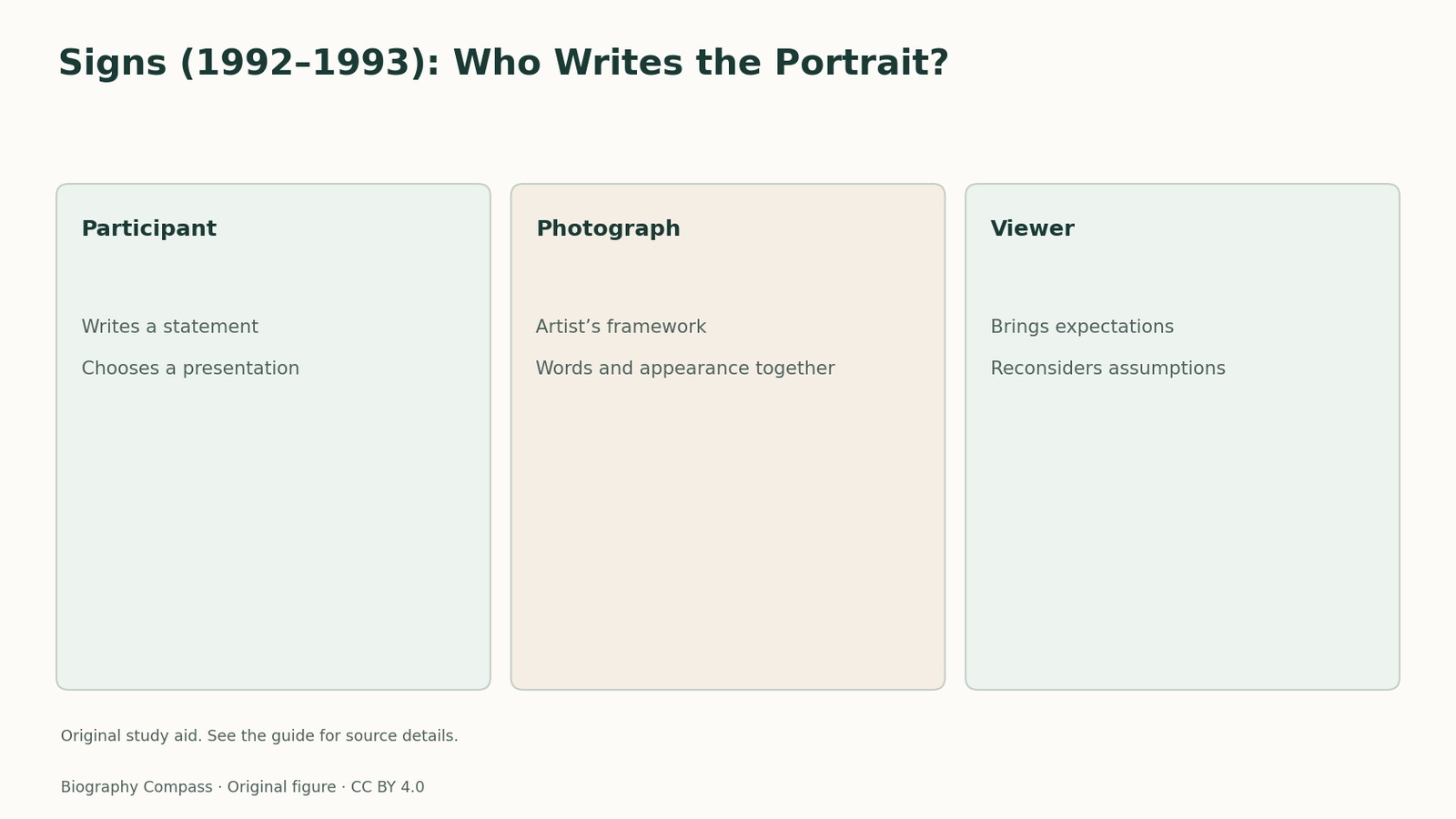
The British Council describes Wearing asking passers-by to write down their thoughts and be photographed holding the paper. This is a specific procedure, not an instance of the photographer simply supplying captions afterward. The participant’s written statement enters the image at the moment of making. A viewer therefore encounters a person and a chosen verbal message together. The procedure opens the portrait to information that clothing, facial expression or location might not communicate on their own.
Sources for this section: [1]
Self-expression remains framed
The Guggenheim places Signs within Wearing’s sustained inquiry into public and private identities. Participation does not remove the photographer’s decisions. Wearing still makes the image and determines the artistic framework in which it is encountered. The useful question is how responsibilities are distributed: who writes, who poses, who photographs and who interprets? Distinguishing those roles avoids two opposite simplifications, either treating the participant as a passive object or claiming the resulting photograph is entirely free from artistic selection and mediation.
A reading exercise with a clear answer
Make a diagram with four positions labelled participant, written sign, camera and viewer. Connect each action to its responsible party. A supported answer says that the participant supplies the words, while the artist supplies the photographic project and the viewer brings expectations that may be challenged. It should not claim that one short sentence reveals the participant’s complete identity or permanent beliefs. The series gains force from a particular encounter between visible appearance and a chosen utterance, preserving the possibility that people exceed both the stereotypes attached to them and the limited information held in a single picture.
Continue the chronology
Related history guides
Biography context
Explore United Kingdom through connected lives
Connected biographies
Read the artist’s biography
b. 1963
Gillian Wearing
Artist and filmmakerA British artist who uses photography, film and performance to examine the gap between public appearance and self-presentation.Read biographyQuick answers
Common questions
- Did Wearing write all the placards?
- The recorded procedure asked participants to write their own thoughts before being photographed holding the signs.
Primary and institutional sources
How this history was checked
The listed records support the facts. Observation exercises and arguments are Biography Compass editorial interpretations. This article was reviewed on 7 November 2026.