
The short answer
How do repeated photographs and text work together in Guarded Conditions?
Compare the records
What the sources allow us to say
Read the object record alongside the contextual account.
| Record | Evidence | Reading limit |
|---|---|---|
| Artist’s 1989 record | Eighteen prints, twenty-one plaques and seventeen letters. | Component counts differ from repeated-figure counts. |
| CAM St.Louis guide | Six figures in three parts; misalignment and contextual interpretation. | Interpretation is not a record of specific incidents. |
Count the units before naming the meaning
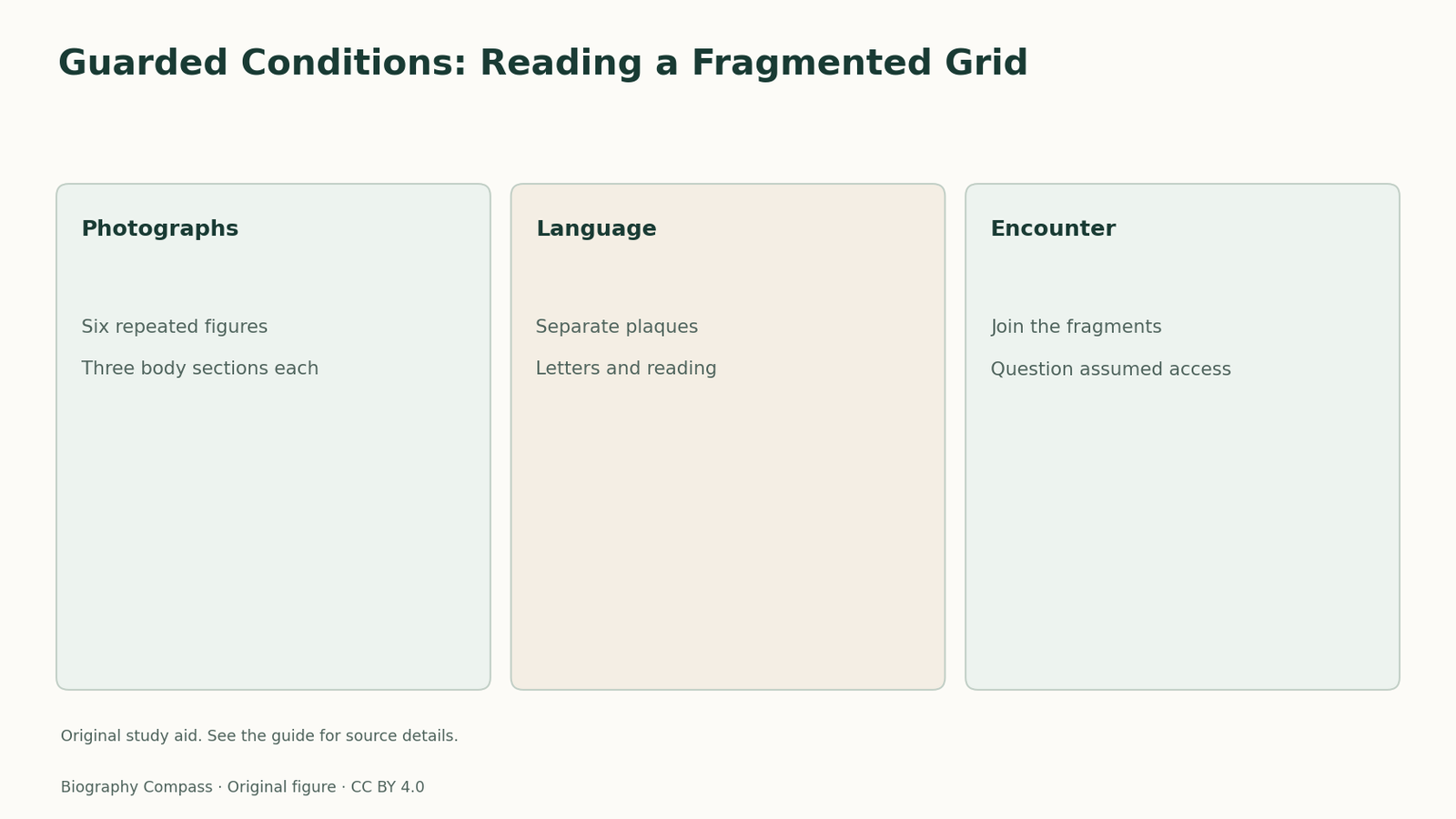
The artist’s record lists eighteen Polaroid prints, twenty-one engraved plaques and seventeen plastic letters in Guarded Conditions. The St. Louis guide explains the photographic organisation as six versions of a figure, each divided into head, torso and legs. These are related but different counts: components listed in a medium field and the figure arrangement a viewer encounters. Begin by separating those levels. The grid is built from individual prints, while the repeated body is assembled across them.
The divisions prevent a seamless portrait
The museum guide notes subtle misalignment between the photographic sections. The body therefore does not settle into a single continuous photographic surface. Repetition and division make viewing an active process of joining and comparing. Because the figure faces away, the audience cannot rely on facial expression to explain identity or emotion. The work’s text adds another layer rather than supplying a straightforward personal name and life story. Its meaning emerges through relations among parts that remain visibly separate.
Sources for this section: [3]
Compare description with interpretation
The studio record preserves a critical reading by Beryl J. Wright, while the museum guide relates fragmentation to violence and protection. Put a neutral diagram of six three-part columns beside a separate band labelled text. A supported answer first describes the organisation, then explains how a source interprets it. This sequence avoids claiming that the image documents six separate incidents or reveals the photographed person’s private experience. The guide is a study of how a work constructs representation and invokes social conditions, not a factual case report about the model before the camera.
Continue the chronology
Related history guides
Biography context
Explore United States through connected lives
Connected biographies
Read the artist’s biography
b. 1960
Lorna Simpson
Conceptual artistAn American artist whose photographs, texts, collages and moving images question how bodies and identities are represented.Read biographyQuick answers
Common questions
- Are there eighteen different people in Guarded Conditions?
- The museum describes six versions of a figure divided into three photographic parts; eighteen is the number of prints.
Primary and institutional sources
How this history was checked
The listed records support the facts. Observation exercises and arguments are Biography Compass editorial interpretations. This article was reviewed on 7 November 2026.