
The short answer
Why did identifying Taxol’s composition not settle how its side chain was connected?
Read the evidence
Taxol: Formula Versus Molecular Structure
Compare an inventory of parts with evidence about how those parts connect.
| Record or comparison | What the record supports | What remains separate |
|---|---|---|
| Composition or formula | Constrains which parts and how many are present | Does not uniquely establish connectivity or the attachment position |
| Structure investigation described by participants and ACS | Addresses arrangement using several analytical approaches | The unreviewed original spectra and exact attachment argument are not reconstructed |
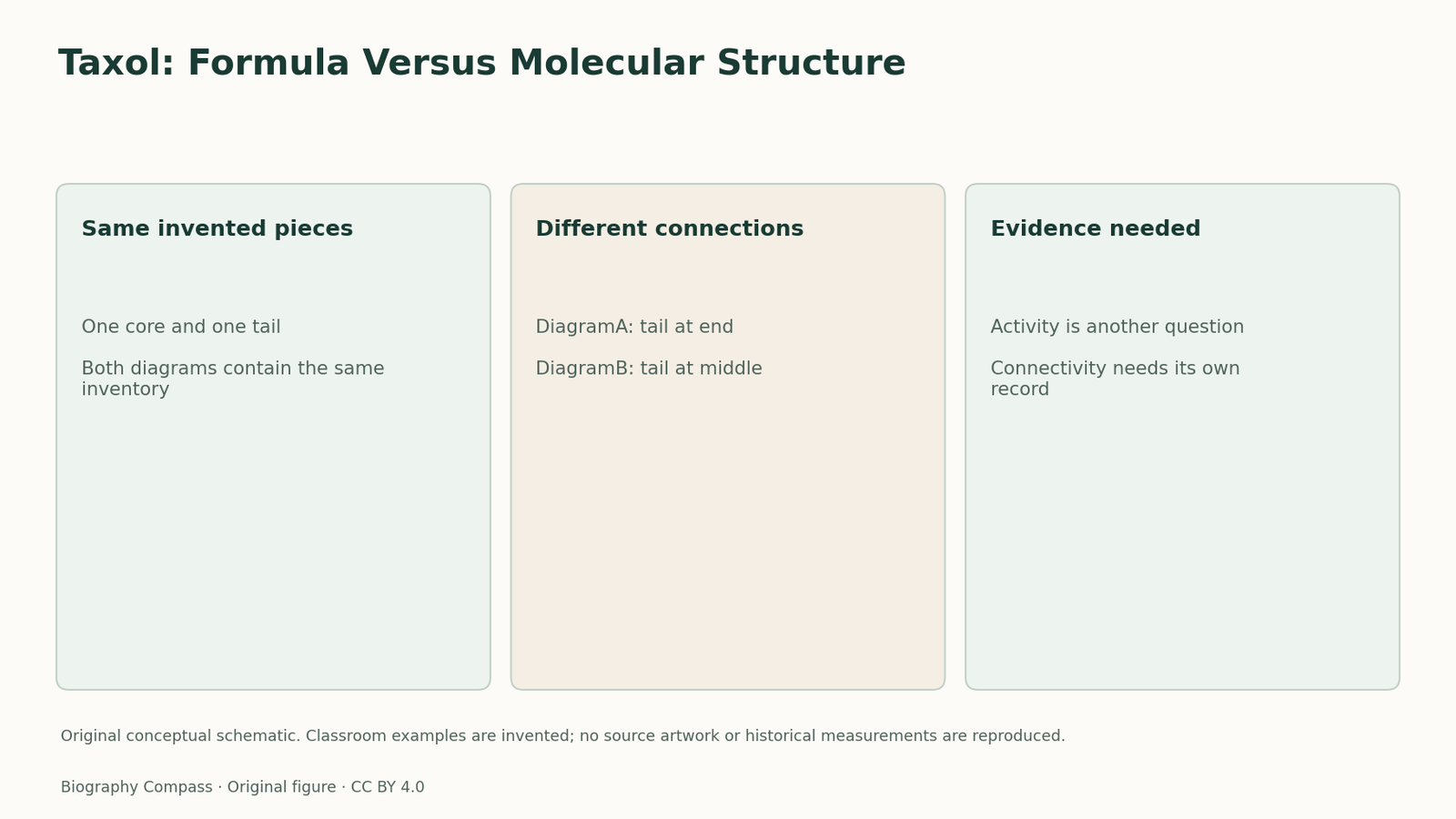
A formula did not settle the connection
The ACS history describes a difficulty beyond obtaining active material: establishing Taxol’s molecular structure. It reports the use of mass spectrometry, X-ray crystallography and NMR, and describes a large portion connected to a smaller side chain. It also says the team nearly published the side chain in the wrong position. This makes the reader’s question specific. Knowing the overall composition of a compound is not the same as knowing how its parts connect. That structural problem differs from Wall’s bioassay-guided question of which fraction carries activity.
Sources for this section: [7]
What the available records can support
The 1971 publication record names Wani, Taylor, Wall, Coggon and McPhail and identifies isolation and structure as its subject. Wall and Wani’s 1996 participant abstract describes several analytical approaches used in their natural-product research. Those records support a collaborative structure-investigation history, but they do not give this guide access to the original spectra or the detailed argument fixing the attachment site. Consequently no specific peak, coordinate or structural drawing is reconstructed here. The ACS anecdote is a later account, not a newly checked original analytical result.
An original same-parts, different-connections exercise
Make two invented diagrams with the same four labelled pieces. In diagram A, attach a small tail to the left end of a three-piece core; in diagram B, attach it to the middle. Ask whether counting the pieces distinguishes the diagrams. It does not: the inventory is the same while the connections differ. Then give students a card that merely says the material was active in an assay. Ask whether that identifies the correct attachment. It does not. A record addressing connectivity would be needed. Finally ask why agreement among different analytical approaches could matter. Different observations can constrain an explanation in different ways, although the assumptions and sample identity still require scrutiny. This model is an original exercise in composition versus connectivity. Its pieces are not Taxol atoms, and neither attachment reproduces the historical chemical structure.
Keep later biological questions separate
The later 1979 microtubule paper addresses biological action, not the earlier side-chain assignment. Chemical characterisation and mechanism research can therefore be important without answering the same question. In reading the collaboration, credit the 1971 team for its dated chemical report and keep later experiments attached to their own authors. The useful conclusion is narrower than a complete reconstruction: an inventory of parts does not establish their arrangement, and an activity observation cannot substitute for a structural argument. The source limits remain visible because the original 1971 full article was blocked.
Continue the chronology
Related history guides
What does bioassay-guided isolation establish that an active crude plant extract cannot?
Compare activity tracking during separation with chemical identification.
Read the timeline1971–1996How did the 1979 Taxol experiments distinguish microtubule stabilisation from preventing polymer formation?
Read the distinct1979 and1980 microtubule research questions.
Read the timelineBiography context
Explore India through connected lives
Connected biographies
Researchers and related questions
1925–2020
Mansukh Wani
Natural-products chemistMansukh Wani trained in India and the United States before a long RTI career investigating biologically active natural products.Read biography1916–2002
Monroe Wall
Natural-products chemistMonroe Wall led natural-products research at RTI, connecting chemical investigation with biological testing through a network of collaborators.Read biography1937–
Susan Horwitz
Biochemist and molecular pharmacologistSusan Band Horwitz investigated the actions of natural-product compounds, including the unusual effects of Taxol on the microtubule cytoskeleton.Read biographyQuick answers
Common questions
- Does a molecular formula uniquely specify a structure?
- No. The same inventory of parts can permit different connections; a structural argument must address arrangement.
- Was the original 1971 structural argument independently reconstructed?
- No. The article was blocked; this guide distinguishes its bibliographic record from accessible participant and ACS accounts.
Primary and institutional sources
How this history was checked
The question of composition versus connectivity is grounded in an ACS participant-based history and a later participant abstract. The original 1971 analytical data were not accessible. This article was reviewed on 7 November 2026.
- RTI InternationalIn memoriam: Mansukh Wani
- American Association for Cancer ResearchIn Memoriam: Mansukh C. Wani
- HerbalGram / American Botanical CouncilMansukh C. Wani — In Memoriam
- National Institute of Informatics, CiNii ResearchPlant antitumor agents.VI.Isolation and structure of taxol
- Journal of Ethnopharmacology / PubMedCamptothecin and taxol: from discovery to clinic
- NaturePromotion of microtubule assembly in vitro by taxol
- American Chemical SocietyDiscovery of Taxol — chemical-structure account