
The short answer
How did the 1979 Taxol experiments distinguish microtubule stabilisation from preventing polymer formation?
Read the evidence
Taxol: Assembly and Stability Compared
Distinguish what forms, what persists and where the observation was made.
| Record or comparison | What the record supports | What remains separate |
|---|---|---|
| 1979 purified-system abstract | Taxol promoted assembly and the structures resisted tested disassembly conditions | Inhibiting cell division does not automatically imply inhibiting assembly |
| 1980 cellular abstract | Cellular structures and bundles persisted in a specified comparison | A cellular endpoint is not identical to a purified-protein assay |
Assembly and disassembly are separate questions
The 1979 paper by Schiff, Fant and Horwitz reports that Taxol promoted microtubule assembly in a purified system. It contrasts that action with compounds that inhibit assembly. The resulting microtubules also resisted disassembly under tested conditions. These observations are related but distinct: increasing the formation of a structure and reducing its loss are not logically the same measurement. A compound’s effect on cell division cannot by itself tell readers which of these processes was changed. The experimental comparison supplies the more specific evidence.
Sources for this section: [3]
The cell study added a different setting
The 1980 abstract reports cellular microtubules observed through electron microscopy and immunofluorescence. In the described cold comparison, untreated cells lost microtubules while pretreated cells retained structures and bundles. The paper therefore adds evidence from a cellular environment rather than merely repeating the purified-system result in different words. Its observations of cell movement also have their own limits: altered migration did not mean every form of surface movement stopped. The endpoints must remain separate even when they appear in the same abstract.
Sources for this section: [4]
An original assembly-and-persistence model
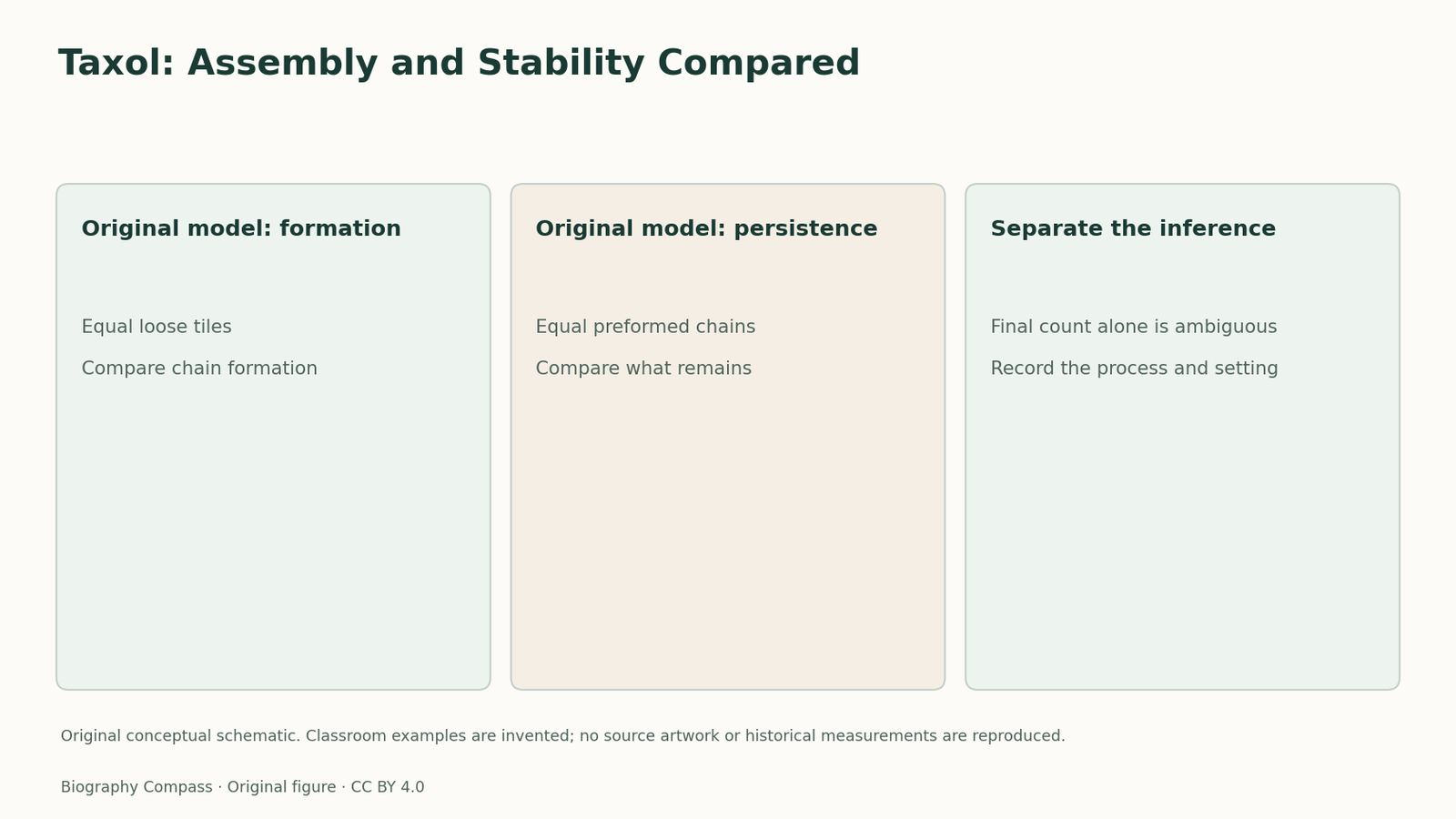
Use an invented classroom model with loose tiles and chains. In round one, compare how many chains form from equal sets of tiles under two stated rules. In round two, begin with equal numbers of preformed chains and compare how many remain after a separate removal rule. Ask which round addresses assembly and which addresses persistence. The first addresses formation; the second addresses loss of existing structures. Next ask whether a greater final chain count can, without a timeline, distinguish faster formation from slower loss. It cannot. Both processes can affect the same final count. The model illustrates a measurement problem; it does not reproduce tubulin chemistry, historical assay conditions or Taxol’s molecular binding. No tile count should be described as an experimental result from either paper.
Why mechanism deserves its own record
Horwitz’s institutional research profile concerns interactions between natural compounds and the microtubule cytoskeleton. That focus helps locate the two papers within a wider career without making the biography a substitute for their results. Read together, the studies show why the mechanism question mattered: a compound could interfere with cell division while promoting, rather than preventing, assembly in the investigated system. The conclusion is bounded by the material, comparison and endpoint in each record. It should not be expanded into a claim about every microtubule-directed compound or every biological context.
Continue the chronology
Related history guides
What does bioassay-guided isolation establish that an active crude plant extract cannot?
Read the chemical-isolation work that preceded the mechanism experiments.
Read the timeline1979–1980Why did identifying Taxol’s composition not settle how its side chain was connected?
Separate identifying the compound from explaining its biological action.
Read the timelineBiography context
Explore United States through connected lives
Connected biographies
Researchers and related questions
1937–
Susan Horwitz
Biochemist and molecular pharmacologistSusan Band Horwitz investigated the actions of natural-product compounds, including the unusual effects of Taxol on the microtubule cytoskeleton.Read biography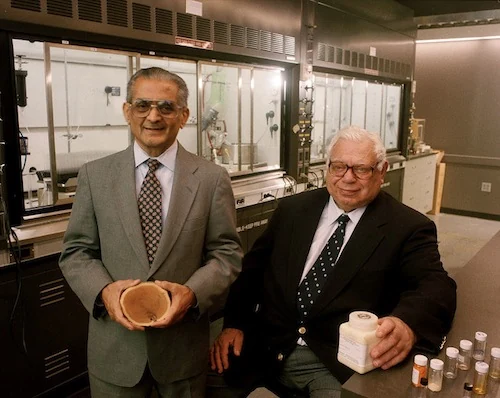
1916–2002
Monroe Wall
Natural-products chemistMonroe Wall led natural-products research at RTI, connecting chemical investigation with biological testing through a network of collaborators.Read biography1925–2020
Mansukh Wani
Natural-products chemistMansukh Wani trained in India and the United States before a long RTI career investigating biologically active natural products.Read biographyQuick answers
Common questions
- Did Taxol simply prevent microtubules from assembling?
- The 1979 report found promotion of assembly in its experimental system, distinguishing Taxol from assembly inhibitors.
- Are the tile chains models of molecular geometry?
- No. They illustrate formation versus persistence and do not reproduce tubulin structure or binding.
Primary and institutional sources
How this history was checked
Complete primary abstracts are compared with an interview-based profile and an official institutional record. No original images or full-paper datasets were reproduced. This article was reviewed on 7 November 2026.