
The short answer
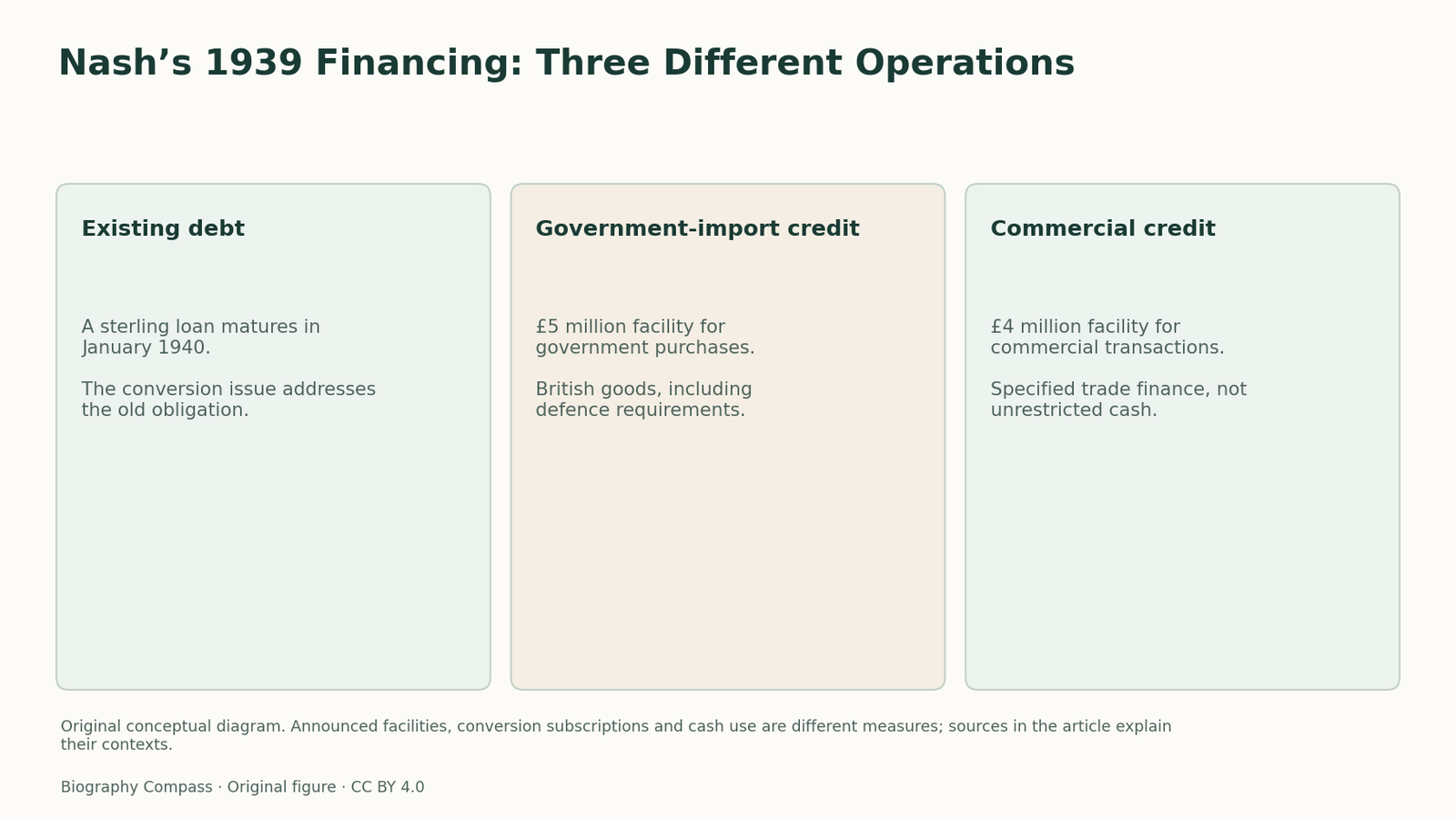
Nash negotiated over existing debt and new credit facilities in the same London mission. Separating those operations explains why headline sums cannot simply be added together as new spending money.
Evidence comparison
A contemporary statement and a retrospective banking account
Separate what was announced from the explanation of how the financing was arranged.
| Record | What it establishes | Question to keep open |
|---|---|---|
| 1939 Financial Statement | The government distinguishes the conversion issue from government-import and commercial credits. | What transaction, maturity and conditions does each headline sum describe? |
| Bank of England archival history | The retrospective account discusses weak demand and the arrangements behind the conversion. | How do the Bank’s institutional position and hindsight shape its explanation? |
Chronology
A timeline of the turning points
Exchange controls
The government responds to pressure on overseas sterling funds.
London negotiations
Nash negotiates over a maturing loan and separate British credit facilities.
Financial statement
The government explains the conversion issue and import-credit arrangements.
Existing debt due
The original loan’s maturity creates the refinancing deadline.
Separate an old obligation from new facilities
New Zealand entered the negotiations with a substantial sterling loan falling due in January 1940. The government’s August 1939 financial statement identified £17,172,000 outstanding and described a £16 million cash-and-conversion issue, with separate arrangements for the balance. Converting a maturing obligation concerned how existing debt would be replaced or repaid. It should not be described as an equal amount of fresh purchasing power becoming available for unrelated government programmes.
Read the new credits by purpose
The same financial statement described two additional facilities: £5 million for government imports and £4 million for commercial purposes. Both concerned purchases of British goods, with defence requirements accounting for much of the government’s import need. These credits addressed particular transactions and had conditions of their own. Adding their headline amounts to the conversion issue would mix different operations, concealing the distinction between refinancing an existing liability and financing new purchases.
Compare the institutions’ presentations
The contemporary government statement praised Nash’s negotiations and presented the terms to Parliament. The Bank of England’s later archival history emphasised weak investor demand and the difficulty of arranging a conventional conversion issue. These accounts illuminate the same negotiation from different institutional positions. The Bank’s retrospective explanation is not a verbatim transcript of every meeting, and its judgments about policy or motive should not be mistaken for facts accepted by all participants.
Build a financing map rather than a misleading total
Draw one branch for the maturing debt and conversion issue, another for government-import credits, and a third for commercial credits. Ask readers why the last two total £9 million but the three branches cannot be labelled a single cash windfall. A sound answer identifies the existing liability, the purposes and conditions of the facilities, and the difference between an announced issue and subscriptions actually obtained. The exercise explains a financing problem without claiming to reconstruct every subsequent repayment or credit transaction.
Continue the chronology
Related history guides
Biography context
Explore New Zealand through connected lives
Walter Nash
Read the career and source record behind this study.
Explore the biographiesDomestic reform contextNew Zealand’s Social Security Act, 1938
Read the existing detailed guide to the domestic welfare reform; this study examines the separate London financing negotiation.
Explore the biographiesConnected biographies
People behind the records
1882–1968
Walter Nash
Finance minister and prime ministerNash moved from commercial and party work into finance, helping fund Labour’s social reforms and steering the 1938 social security legislation.Read biographyQuick answers
Common questions
- Was the £16 million conversion issue simply extra money to add to the £9 million credits?
- No. The issue addressed existing maturing debt, while the separate credits financed specified British purchases. An announced amount also differs from cash subscribed or credit actually used.
Primary and institutional sources
How this history was checked
The contemporary financial statement and the Bank’s retrospective account support the financing comparison; Nash’s biography supplies career context. Selected passages, institutional perspectives and uncertain OCR details are identified in the research scopes. This article was reviewed on 7 November 2026.