
The short answer
In the early hours of 25 August 1989 UTC, Voyager 2 flew roughly 4,800 kilometres above Neptune’s cloud tops. About five hours later it passed Triton. At Neptune it imaged a dark atmospheric feature and faint rings. At Triton its pictures recorded dark features interpreted as plumes rising from the surface.
Three targets
What the encounter showed at Neptune and Triton
The flyby combined pictures with measurements and gave each feature a different kind of context.
| Target | Evidence | How to interpret it |
|---|---|---|
| Neptune’s atmosphere | Disk and cloud images | The Great Dark Spot describes a feature observed during the Voyager encounter. |
| Neptune’s rings | Faint ring features surrounding the planet | Bright segments can occur within a larger ring system. |
| Triton’s surface and atmosphere | Surface photographs and observations of plume-like features | Dark deposits and features rising above the surface support an interpretation of activity. |
Chronology
A timeline of the turning points
Voyager 2 passes Uranus
The encounter bends its trajectory toward Neptune.
Closest approach to Neptune
Images and instruments document the atmosphere, rings and magnetic field.
Voyager reaches Triton
The camera system images the largest Neptunian moon, including the southern region.
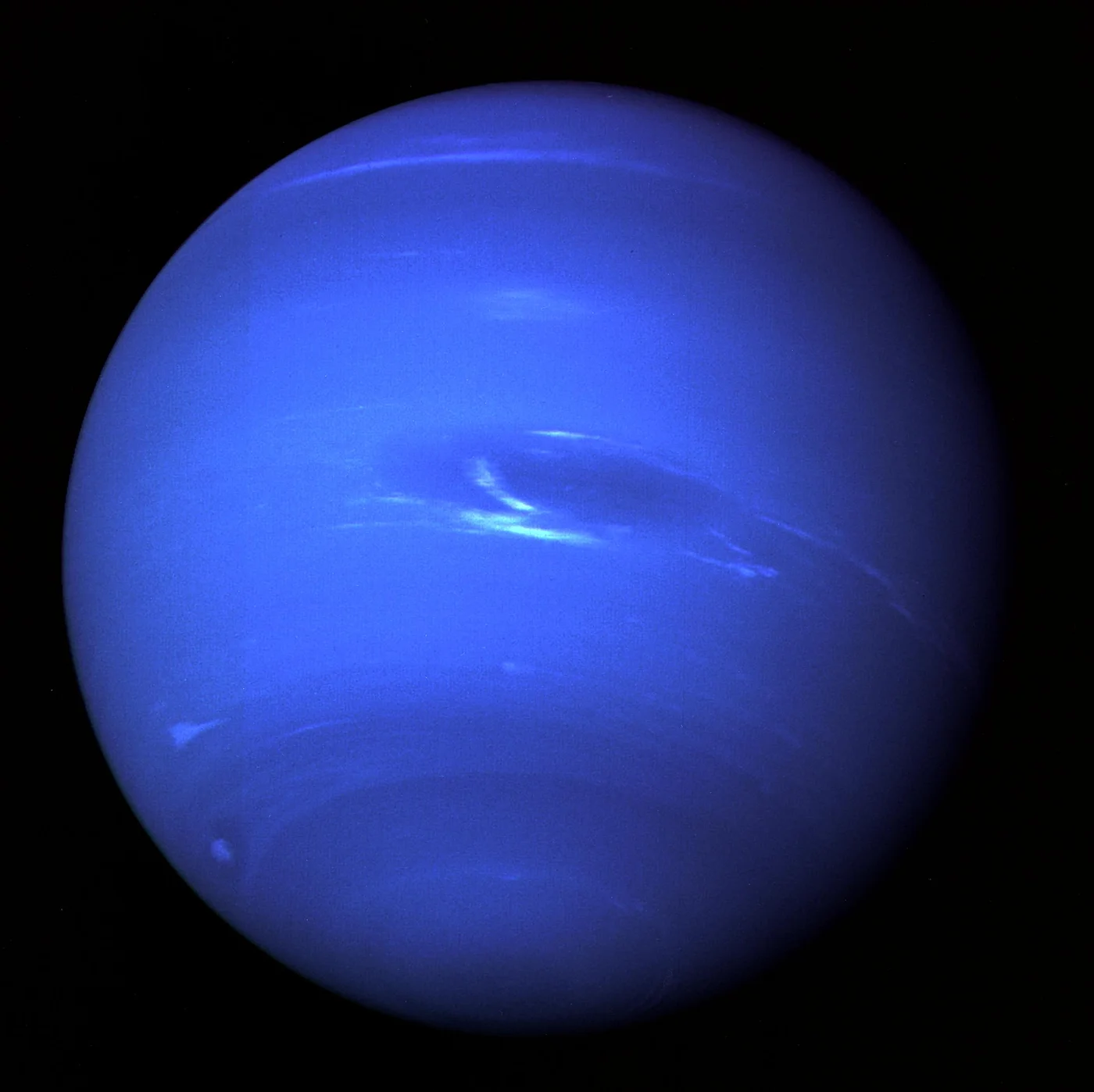
The Great Dark Spot records a moment in Neptune’s weather
Voyager’s approach supplied views wide enough to place the dark spot in Neptune’s atmosphere. The conspicuous feature can be understood as a feature in the 1989 observations. Its name and appearance in a well-known image say little about how long a particular storm will persist.
The full-disk photograph reproduced here combines frames through two camera filters. Disk images help readers see the feature’s location relative to the visible hemisphere. The distance in the mission log refers instead to closest approach, a different moment from the full-disk view.
How possible arcs fit into the ring system
Ground-based observations had indicated that some material might lie in arcs. Voyager’s views established rings with denser segments. An observer who catches a bright part can report a prominent arc without seeing the much fainter portions. The planet-wide view and the local measurements therefore answer complementary questions about the same system.
The ring findings also illustrate why Neptune’s bright disk and faint surroundings called for different observations. An image that shows cloud features beautifully may give little information about tenuous ring material.
Why the Triton evidence is different
Triton’s ice and dark markings can be seen on the surface. The spacecraft also captured features that NASA interprets as plumes. Those observations distinguish material apparently in motion from older deposits. Explanations for how a plume is powered require additional physical reasoning beyond the presence of a dark streak.
The Neptune distance and the Triton distance refer to separate targets. NASA puts the Triton pass at roughly 40,000 kilometres. The gap of about five hours is the travel time between the two encounters.
Continue the chronology
Related history guides
Connected biographies
People connected to this history
Quick answers
Common questions
- When did Voyager 2 fly by Neptune and Triton?
- It flew by both on 25 August 1989 UTC, with the Triton encounter roughly five hours after the Neptune pass.
- Did Voyager 2 orbit Neptune?
- The spacecraft followed a flyby trajectory, continuing past Neptune and Triton after the encounter.
Primary and institutional sources
How this history was checked
Dates, legal milestones and historical claims are checked against the official and institutional records below. This article was reviewed on 19 November 2026.