
The short answer
A tax-inclusive price cannot be decomposed by subtracting just one known component. The trial record also needs to be read beside Desmond’s account of the refused exchange and the later pardon.
Record and inference
Keep the stated quantities separate
The original exercise uses explicit assumptions.
| Question | Available input | Limit |
|---|---|---|
| Gross difference | 40−30=10 cents. | Not the provincial-tax difference. |
| Known component | 3−2=1 cent provincial tax. | Federal amounts remain unspecified. |
| Balance after P | 28 and 37 cents. | Still includes F; not established net receipt. |
Chronology
A timeline of the turning points
Incident
Desmond was removed from the theatre.
Conviction document
Date written in the contemporaneous record.
Pardon
Grant of free pardon.
Read all four pages before calculating
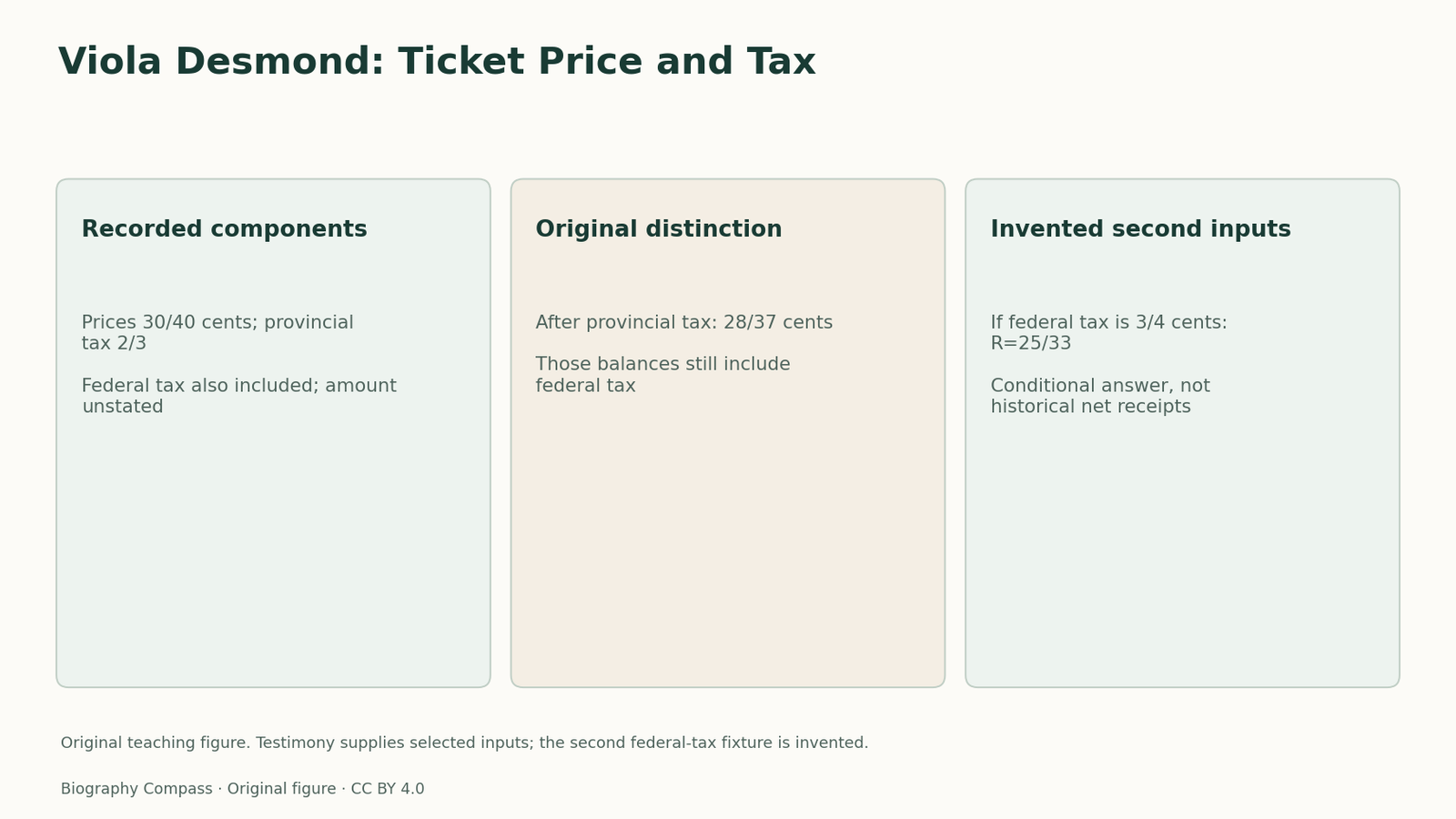
The seller gives upstairs and downstairs prices of 30 and 40 cents, with provincial taxes of 2 and 3 cents. The manager says the prices include both federal and provincial taxes, but does not give the federal amounts.
Desmond’s own statement says she offered to pay the difference and was refused. The conviction document is dated 9 November 1946.
The 2010 pardon instead recites 8 November as the conviction date.
The incident occurred on 8 November.
Keep the difference explicit. A later recitation should not silently replace the date written in the contemporaneous conviction document.
An original decomposition task
Let total price T consist of provincial tax P, federal tax F and remaining receipt R: T=P+F+R. Using the recorded amounts, find the gross price difference, provincial-tax difference, and the balances after subtracting P. Can you determine R or its difference between the two seats?
For a second, invented calculation only, stipulate F=3 cents upstairs and 4 cents downstairs, with no other deductions or refunds. Find R under those assumptions. These federal figures are ours, not recovered historical rates.
Sources for this section: [1]
Reference answer
Gross prices differ by 10 cents; the provincial component differs by 1 cent. Subtracting that component leaves 28 and 37 cents. These are F+R, not R alone. Their 9-cent difference is therefore not an established difference in the operator’s net receipt or profit.
With the invented federal values, R becomes 30−2−3=25 cents and 40−3−4=33 cents, a difference of 8. This conditional result illustrates the missing input; it is not an estimate of the historical federal tax or theatre profit.
The charge’s financial terms also do not answer why Desmond was denied a downstairs ticket. The Bank of Canada’s historical account explicitly describes the racial restriction; the records answer related but different questions.
What the comparison preserves
The later instrument grants a posthumous free pardon from the specified conviction.
A precise reading can therefore preserve the inclusive prices, the unquantified component, Desmond’s testimony, the conviction’s date and the later act of redress. No single figure or administrative label should replace that sequence.
Continue the chronology
Related history guides
Biography context
Explore Canada through connected lives
Connected biographies
The related working life
Quick answers
Common questions
- Were the example federal amounts found in the record?
- No. They are invented inputs for the second calculation.
Primary and institutional sources
How this history was checked
Selected passages and their limits are identified below. Exercises and reference answers are original. This article was reviewed on 31 October 2026.
- Nova Scotia Archives, RG39C volume937 SupremeCourt13347Magistrate’s record of proceedings, 9 November 1946, four pages
- Bank of Canada, historical selection accountA Bank NOTE-able Canadian Woman: Viola Desmond
- Province of Nova Scotia, Lieutenant-Governor Mayann E. FrancisGrant of Free Pardon, 15 April 2010