
The short answer
An observed activity does not reveal every option a person had. Brown’s argument supplies a historical reason to ask that question; an original counterexample makes the inference testable.
Record and inference
Keep the stated quantities separate
The original exercise uses explicit assumptions.
| Question | Available input | Limit |
|---|---|---|
| Observed activity | A and B both work for pay. | Their options differ in the fixture. |
| Expanded options | C gains a paid-work option. | C need not choose it. |
| Historical inference | A speech can challenge a claim about freedom. | A counterexample is not a population estimate. |
Chronology
A timeline of the turning points
Assembly
Brown entered the British Columbia legislature.
Address
National Congress of Black Women in Canada.
Later career
She left the legislature.
Locate the argument in the speech
Brown addressed the National Congress of Black Women in Canada on 7 April 1973. She thanked the Canadian Negro Women’s Association and treated racial and women’s liberation as connected struggles.
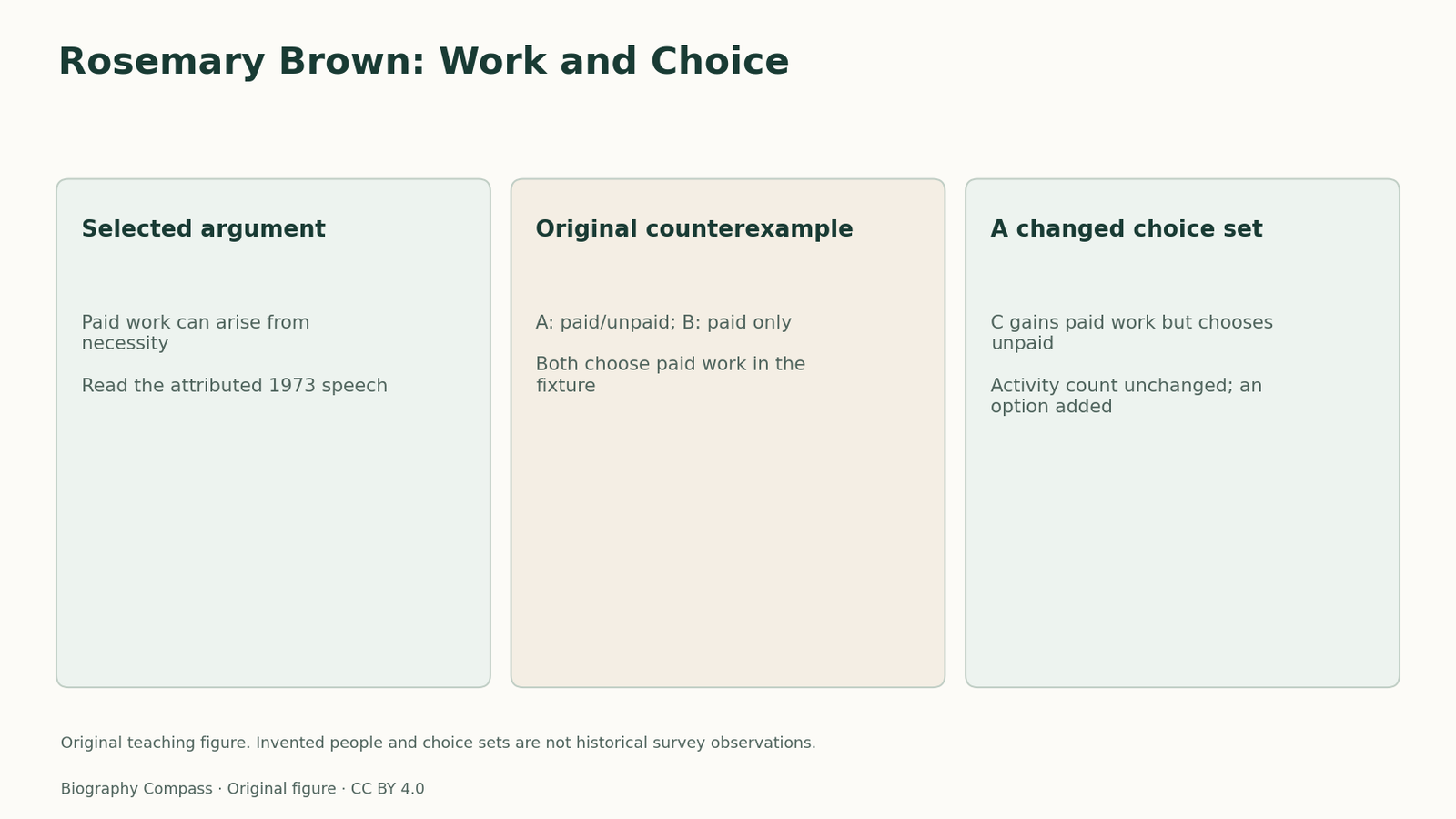
She rejected the inference that Black women’s long participation in paid work proved liberation: work could reflect economic necessity rather than a genuine choice.
This is an attributed argument from a historical address. We do not turn the speech’s generalisations or quoted studies into a current survey result.
Sources for this section: [1]
Original counterexample: activity and options
Invent three people. A can choose paid work or unpaid activity and chooses paid work. B has only paid work available under the stipulated constraints and works. C has only unpaid activity available and does not enter paid work. These are deliberately simplified choice sets, not historical people.
A report says that two of the three work for pay. Does it follow that all paid workers have both options? Now give C access to paid work as well, while C still chooses unpaid activity. Has the observed paid-work count changed? Has the supplied choice set changed?
Sources for this section: [1]
Reference answer and a limit
A and B perform the same observed activity but have different stipulated options. The claim that both necessarily had a free choice is defeated by B. When C gains an option but does not exercise it, the paid-work count remains two while C’s choice set expands.
The counterexample tests an inference. It does not estimate how many people experienced each constraint, rank actual households, or claim that its two-option model measures freedom completely. Those empirical and normative questions need more evidence and argument.
Sources for this section: [1]
Read the coalition argument too
The address also argues that women’s liberation needs connections with struggles against racial and economic oppression.
Ask how that wider claim changes a reading focused only on an individual job. A useful note should distinguish the speaker’s argument, the observation cited, an inference being challenged and the additional evidence a historical account would require. This keeps a counterexample from replacing social history.
Sources for this section: [1]
Continue the chronology
Related history guides
Biography context
Explore Canada through connected lives
Connected biographies
The related working life
Quick answers
Common questions
- Does the example reconstruct an actual household?
- No. People, constraints and choices are original teaching fixtures.
Primary and institutional sources
How this history was checked
Selected passages and their limits are identified below. Exercises and reference answers are original. This article was reviewed on 31 October 2026.