
The short answer
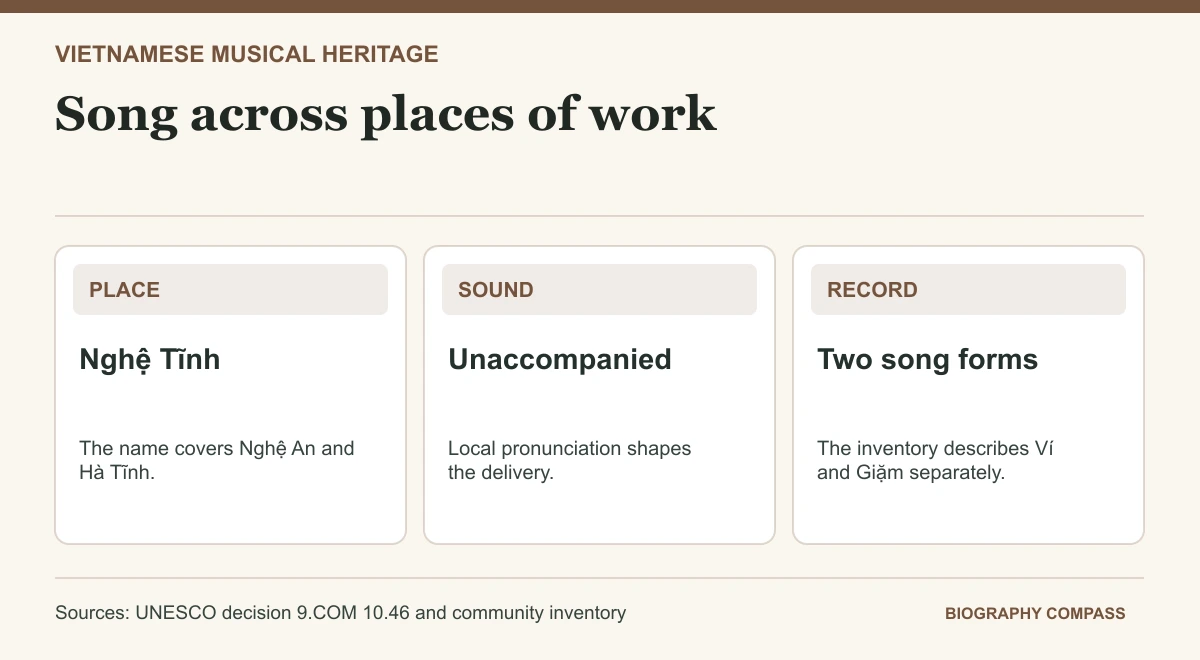
Ví and Giặm are sung traditions of Nghệ An and Hà Tĩnh. UNESCO’s 2014 entry describes singing associated with tasks and social exchanges, from agricultural labour to lullabies. The accompanying inventory helps a listener distinguish two forms that a short list entry necessarily presents together.
Vietnamese musical heritage
Song across places of work
The decision gives the broad form and the inventory supplies examples of phrasing.
| Question | Document | What it clarifies |
|---|---|---|
| What is shared? | Representative List entry | Regional dialect and unaccompanied singing |
| How do the forms differ? | English ICH inventory | Different phrasing and customary patterns of exchange |
| How is it transmitted? | Committee decision | Master practitioners, local groups and occasions for singing |
Chronology
A timeline of the turning points
Songs accompanied work and leisure
The file identifies several kinds of work and social setting.
UNESCO inscription
The committee inscribed the joint element under its Nghệ Tĩnh name.
Local teaching and performance
The committee describes community and school opportunities for learning and performance.
Work shaped the occasions for singing
UNESCO describes people singing while tending fields, rowing, making hats or comforting children. These occasions help explain why a form can carry counsel, humour or courtship while retaining a rhythm familiar to the singers. The inventory records a wider range of village settings. Its examples let readers study how singers adapt their delivery to a particular task or gathering.
How to hear differences within the pair
The inventory describes Ví phrasing and types of Giặm that use storytelling, advice or commentary. It also distinguishes several situations for Giặm, including an exchange between men and women. A useful starting point is to listen for the length and shape of a line and whether a second singer answers it. The inventory’s examples provide more precision than using a single English label for both forms.
The role of Nghệ Tĩnh speech
The UNESCO decision identifies vocabulary, idiom and pronunciation as part of the practice. They carry so much information that written lyrics give only part of what a singer performs. Festivals and village groups offer ways to hear that spoken texture in singing. The decision also discusses passing on the practice among generations, including community and school opportunities.
Continue the chronology
Related history guides
Quan Họ Bắc Ninh: How Host and Guest Singers Exchange Songs
Compare how a second singer answers in Quan Họ Bắc Ninh.
Read the timeline2011–2017Xoan Singing of Phú Thọ: Why UNESCO Changed Its Listing
See how Phú Thọ guilds transmit a different regional tradition.
Read the timeline2017Bài Chòi: The New Year Game and Its Hô Hiệu Performers
See how a central Vietnamese card game gives music and verse a shared setting.
Read the timelineConnected biographies
People in this history
Quick answers
Common questions
- Is instrumental accompaniment typical of Ví and Giặm?
- UNESCO describes the songs as unaccompanied.
- Where are the songs from?
- Nghệ An and Hà Tĩnh, collectively referred to as Nghệ Tĩnh.
Primary and institutional sources
How this history was checked
Dates, legal milestones and historical claims are checked against the official and institutional records below. This article was reviewed on 19 November 2026.