
The short answer
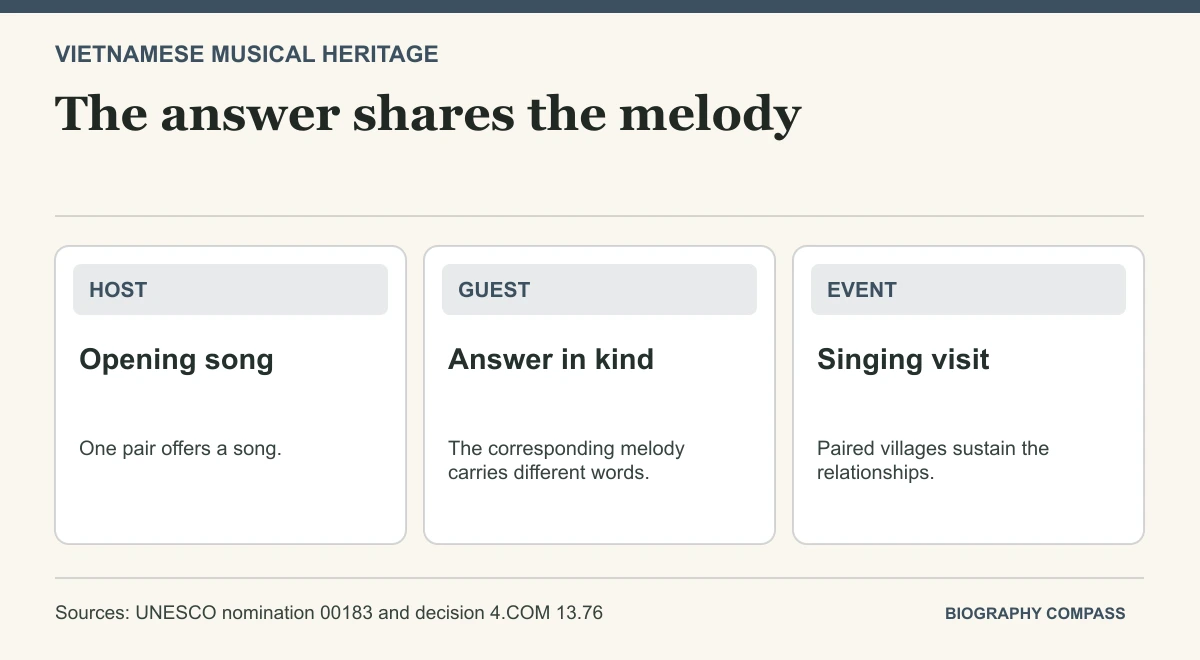
Quan họ Bắc Ninh gives host and guest singers a structured way to greet and answer one another. UNESCO’s 2009 decision describes groups using corresponding melodies while changing the words. The exchange belongs to relationships between villages in Bắc Ninh and Bắc Giang as well as to a body of songs.
Vietnamese musical heritage
The answer shares the melody
Compare what each group contributes to a reply.
| Feature | Host contribution | Guest contribution |
|---|---|---|
| Song exchange | Offers a song | Responds with a corresponding melody |
| Words | Sings one set of lyrics | Uses different lyrics |
| Setting | Receives visiting singers | Sustains the relationship through reciprocation |
Chronology
A timeline of the turning points
Village pairs
Matched villages sustain reciprocal gatherings.
Heritage committee decision
The committee inscribed file 00183.
Transmission continued
The 2024 periodic report describes work with practitioner groups.
What makes one song an answer to another
The committee’s description explains a dialogue between paired singers from different villages. One pair offers a melody and the responding pair uses a matching melody with its own lyrics. The response is therefore musical and social at once. Recognising the tune helps a listener follow the exchange even before understanding the content of the words.
Why there are two kinds of number in the file
The record cites more than 400 song texts and 213 melodic variations. Lyrics and melodies are separate parts of an exchange, so these are different measures of repertoire. The numbers also describe the account used for the nomination. They give an idea of how much a singer can learn from partners and elders without freezing the practice at that count.
Private visits and public performances have different settings
The UNESCO description places the songs in ritual observances, festivals and visiting relationships. A festival performance can show the musical responses. Understanding the paired village custom explains the hospitality and obligations that surround those responses in community practice. Vietnam’s periodic report supplies a later source for the roles of practitioners and organised groups. The early decision is the better reference for what the committee recognised in 2009.
Continue the chronology
Related history guides
Connected biographies
People in this history
Quick answers
Common questions
- Where is Quan Họ Bắc Ninh practised?
- The UNESCO record concerns communities in Bắc Ninh and Bắc Giang in northern Vietnam.
- What is repeated in a song exchange?
- The melody corresponds across the two groups’ songs while the words differ.
Primary and institutional sources
How this history was checked
Dates, legal milestones and historical claims are checked against the official and institutional records below. This article was reviewed on 19 November 2026.