
The short answer
How does the report separate committee findings, witnesses and appended documents?
Evidence comparison
Read the records together
The records were created for different purposes and support different kinds of claims.
| Record | What it establishes | Question to keep open |
|---|---|---|
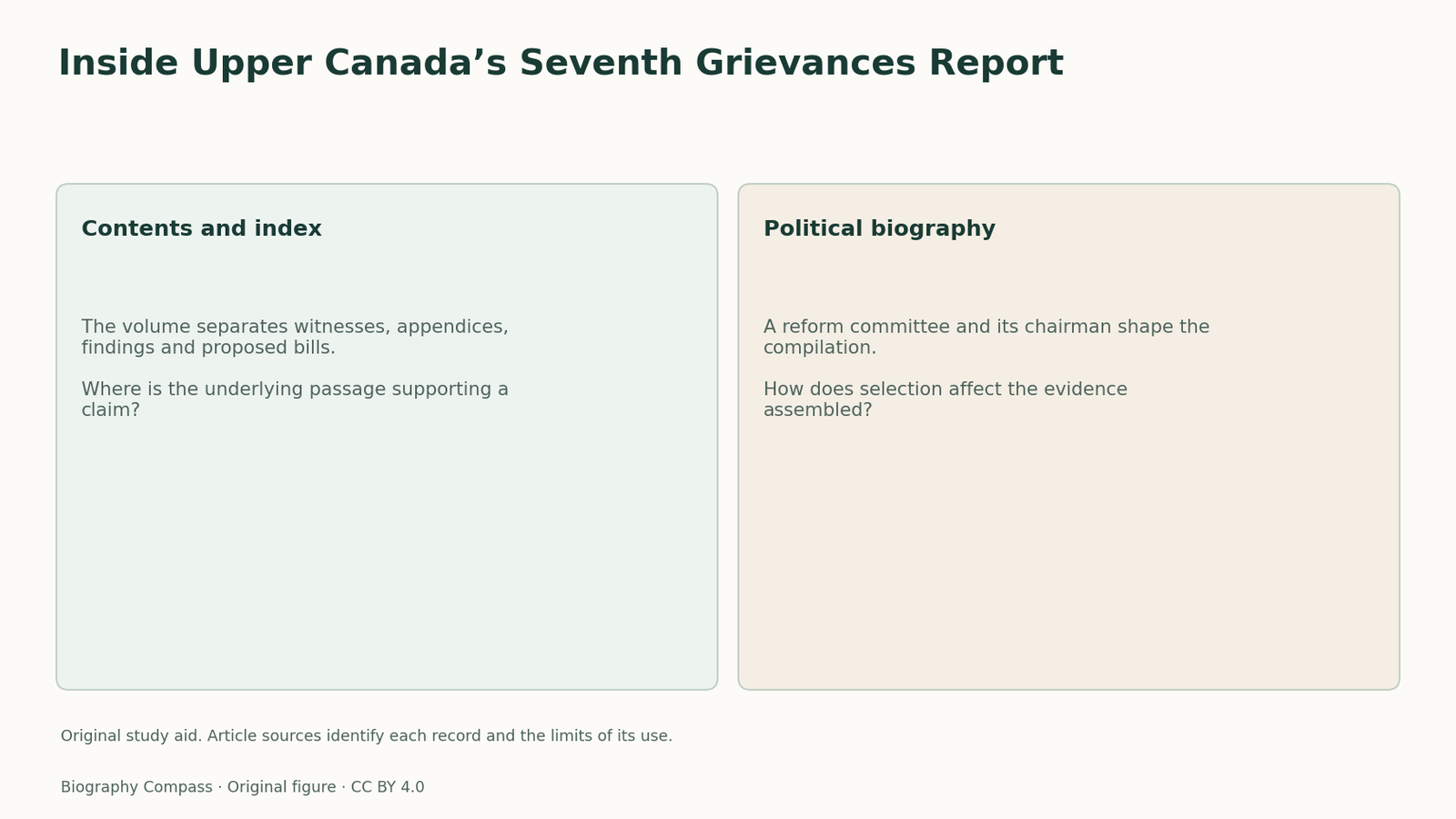
| Contents and index | The volume separates witnesses, appendices, findings and proposed bills. | Where is the underlying passage supporting a claim? |
| Political biography | A reform committee and its chairman shape the compilation. | How does selection affect the evidence assembled? |
Chronology
A timeline of the turning points
Reform victory
Mackenzie returns to the provincial Assembly.
Report compiled
The committee gathers grievances and supporting records.
Begin with the contents
The digitised volume contains more than a committee’s conclusions. Its contents identify minutes of evidence, documents appended to the report, a separate inquiry concerning William Forsyth and draft bills. Before citing a passage, identify which part contains it. The shared title of the bound volume does not make every printed sentence a conclusion formally adopted by the committee, nor does it turn a draft remedy into an enacted law.
Sources for this section: [2]
Follow a claim through the index
The index sends readers to witness questions, page references and report sections. For example, its entries on public accounts and government offices point toward different records and speakers. Those distinctions provide a practical route for checking provenance. An index summary is useful for locating evidence, but the underlying page remains necessary before quoting a witness or making a detailed claim about the contents of an official return.
Sources for this section: [2]
Place the compilation in political context
Mackenzie’s committee chairmanship followed a reform victory in the Assembly. His political biography describes the compilation as wide-ranging and strongly shaped by his concerns. That context explains why particular grievances were gathered without invalidating the individual documents reproduced. The task is to distinguish selection, testimony and conclusion. A researcher can examine a useful administrative return within a partisan compilation while remaining explicit about how it reached that setting.
Write a provenance note
Choose an entry from the contents and prepare a citation note identifying document type, author or witness, date and location within the volume. Add one sentence specifying whether it supports an allegation, an official figure or a committee recommendation. A strong answer leaves uncertain details unfilled until the relevant page is checked. This method makes a large political compilation usable without pretending that reading its title or index amounts to verifying every statement it contains.
Continue the chronology
Related history guides
Biography context
Explore Canada through connected lives
Connected biographies
People behind the records
1795–1861
William Lyon Mackenzie
Journalist and Upper Canadian reformerMackenzie combined journalism, elected office and committee investigation in Upper Canada, leaving a substantial report of grievances and supporting records.Read biographyQuick answers
Common questions
- Is every statement in the volume a committee finding?
- No. Witness testimony, reproduced documents, the committee’s conclusions and draft remedies need separate identification.
Primary and institutional sources
How this history was checked
Sources support the chronology and the record comparison. The reading exercise is original. This article was reviewed on 7 November 2026.