
The short answer
To whom did the new ministry have to remain responsible?
Evidence comparison
Read the records together
The records were created for different purposes and support different kinds of claims.
| Record | What it establishes | Question to keep open |
|---|---|---|
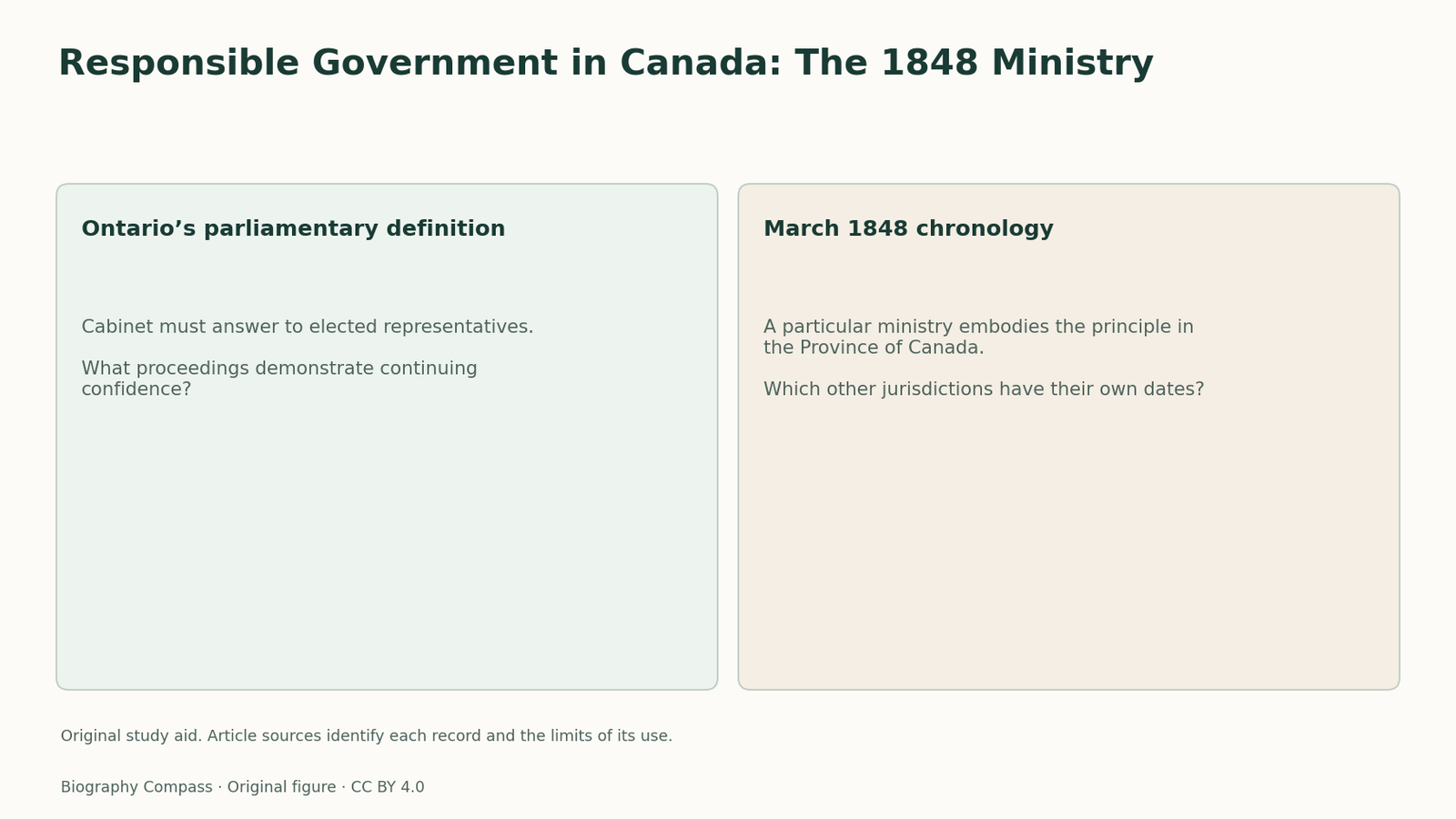
| Ontario’s parliamentary definition | Cabinet must answer to elected representatives. | What proceedings demonstrate continuing confidence? |
| March 1848 chronology | A particular ministry embodies the principle in the Province of Canada. | Which other jurisdictions have their own dates? |
Chronology
A timeline of the turning points
Ministry formed
LaFontaine and Baldwin return to government.
Partnership ends
Both leaders leave ministerial office.
Define the relationship first
Responsible government names a relationship between a ministry and the elected representatives whose support allows it to govern. The important question is therefore not simply who holds a title, but where the ministry must maintain political confidence. Ontario’s legislative history describes the principle as Cabinet responsibility to the elected representatives. That definition is more precise than treating responsible as a general claim that officials behaved wisely or honestly.
Sources for this section: [2]
Place the ministry in its jurisdiction
The LaFontaine–Baldwin ministry formed in March 1848 in the Province of Canada. The Dictionary of Canadian Biography’s account distinguishes that event from Nova Scotia’s earlier development. British North America contained multiple colonial governments, so one date cannot be assumed to describe every jurisdiction. The partnership’s composition also matters, because governing required support across Canada East and Canada West rather than the victory of one linguistic community over the other.
Distinguish constitutional changes
A ministry’s dependence on the elected chamber does not establish full independence from Britain, nor does it prove that everyone could vote for that chamber. Those are different constitutional questions. The 1848 milestone changed how executive government operated within the existing framework. To assess participation, one would need franchise rules; to assess imperial authority, one would need records concerning the powers retained elsewhere. The ministry’s formation cannot supply both sets of answers.
Test a cabinet scenario
Imagine a governor prefers a ministry that has lost support among elected representatives. Identify the conflict using the parliamentary definition of responsibility, then specify what evidence would show whether support had been regained. A sound answer asks for the chamber’s proceedings rather than relying on the governor’s preference alone. The scenario turns an abstract constitutional phrase into a practical question about which institution authorises a government to continue.
Continue the chronology
Related history guides
Biography context
Explore Canada through connected lives
Connected biographies
People behind the records
1804–1858
Robert Baldwin
Reform politician and government leaderBaldwin’s partnership with LaFontaine helped make ministerial responsibility to elected representatives a working principle in the Province of Canada.Read biographyQuick answers
Common questions
- Did responsible government mean independence?
- It concerned how ministers held office within the constitutional framework. Independence and the extent of voting rights are separate questions.
Primary and institutional sources
How this history was checked
Sources support the chronology and the record comparison. The reading exercise is original. This article was reviewed on 7 November 2026.