
The short answer
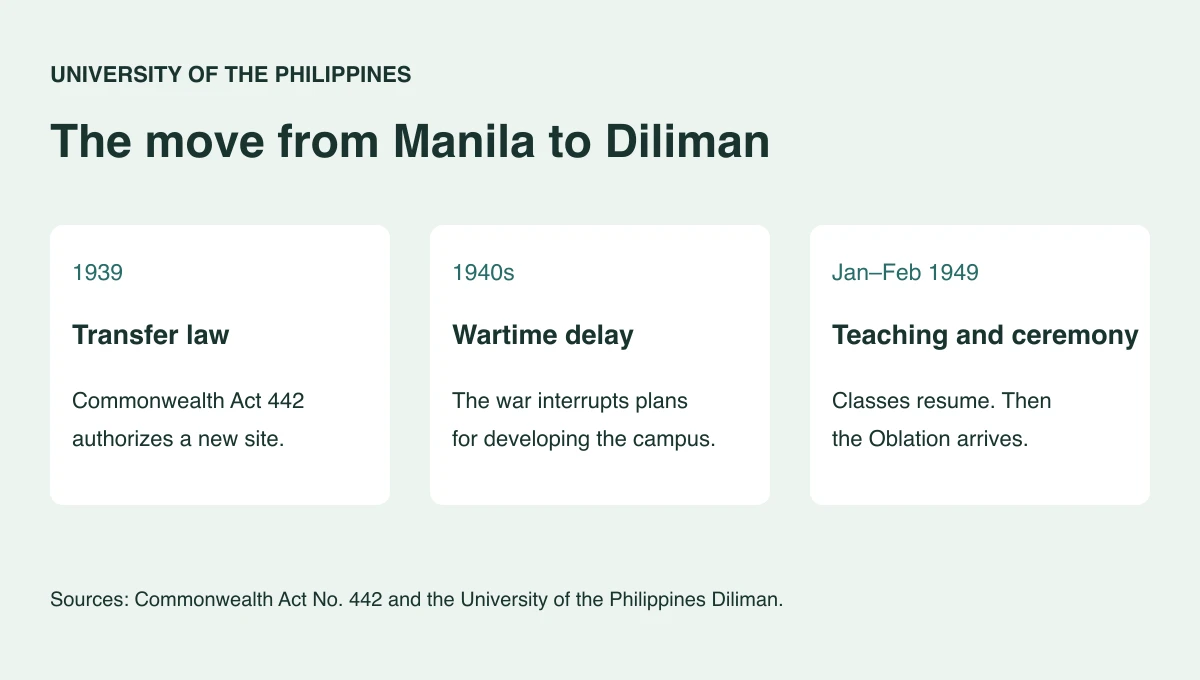
Classes resumed at the University of the Philippines’ new Diliman site on 12 January 1949. The move had been authorised in 1939 and interrupted by the war. The transfer of the Oblation statue in February marked the move publicly after teaching had already resumed.
How a university moves
Authority, instruction and ceremony
The move entailed three distinct kinds of work. Dated records let readers trace each one.
| Milestone | When | What it documents |
|---|---|---|
| Legal authority | June 1939 | The Commonwealth authorises relocation and provision of facilities. |
| Classes resume | January 1949 | Students can return to teaching at the new location. |
| Oblation transferred | February 1949 | The former campus sends a symbol of university life to the new site. |
Chronology
A timeline of the turning points
Law authorises relocation
The Commonwealth provides for the transfer of university units from their city site.
War interrupts development
The site and building plans precede the postwar move.
University moves to the new campus
The library’s chronology dates the transfer and resumption of classes.
Motorcade brings the Oblation to Diliman
The relocation becomes part of a university anniversary celebration.
Why Manila’s campus was difficult to expand
The university’s history points to the limits of its site in Manila. The Board of Regents acquired land in Diliman in 1939, and the Commonwealth Act authorised the transfer of Manila-based colleges and units to a site outside the city.
The plans show the university considering its buildings as well as its land. The library history records discussion over the design of the new buildings, including President Manuel L. Quezon’s preference that they avoid showy expenditure.
What moved before the public ceremony
According to the library’s record, the main transfer ran from 16 December 1948 to 11 January 1949. Classes resumed the next day. This provides a specific date on which academic work can be documented at the new campus.
The 1939 law dates the authority to move, not the resumption of teaching. Wartime disruption explains part of the gap between choosing a site and operating there.
What the Oblation transfer meant
The university library dates the motorcade to 11 February 1949. The Oblation was the final movable item transferred from the old campus in the library’s account, and the university made its journey part of the anniversary celebration.
A statue can give the move a memorable date, but it answers a different question from the date students returned to class. Following both records gives a view of the logistical move and how the university chose to mark it.
Continue the chronology
Related history guides
How Philippine Science High School Became a National System
Follow the separate origin of Philippine Science High School and its first campus in Quezon City.
Read the timeline1960Why IRRI Was Founded in Los Baños in 1960
Follow a later use of the University of the Philippines’ wider network of academic sites.
Read the timelineConnected biographies
People connected to this history

1878—1944
Manuel L. Quezon
President of the Commonwealth of the PhilippinesThe statesman who secured Commonwealth status, became its first president and led the Philippine government in exile during the Second World War.Read biographyQuick answers
Common questions
- When did UP begin classes at Diliman?
- The University Library dates resumption of classes at Diliman to 12 January 1949.
- When was the Oblation moved from Manila to Diliman?
- The university’s library records its transfer in a motorcade on 11 February 1949.
Primary and institutional sources
How this history was checked
Dates, legal milestones and historical claims are checked against the official and institutional records below. This article was reviewed on 19 November 2026.