
The short answer
A convenient indicator can make a problem visible while leaving important changes unexplained. The question here is what was counted, who entered the denominator and what additional evidence would be needed before claiming an improvement in living conditions.
Record comparison
Read the evidence by function
Separate the object established by a record from an inference requiring other evidence.
| Record | What it establishes | What it does not establish |
|---|---|---|
| Archival abstract | A stated institutional poverty problem. | Not the restricted lecture’s full argument. |
| Later critical discussion | A reproduced definition and criticism. | Not direct access to the cited original. |
Chronology
A timeline of the turning points
An institutional poverty question
The accessible abstract supplies scope, not the restricted full lecture.
A later critical discussion
A reproduced proposal is examined as a proxy.
A poverty question before an indicator
The accessible abstract of Ungku Aziz’s 1963 rural-development work connects poverty with unequal income and wealth and disadvantage in market relationships. It proposes collective and institutional responses.
That is a question about the organisation of economic life. A count of possessions might contribute evidence, but it cannot by itself identify the mechanism that produced a household’s situation.
Sources for this section: [1]
The definition reaches us through a later discussion
On printed 112, Sudhir Anand reproduces Ungku’s 1964 proposal: divide household sarongs by residents above one year old; a value below one was proposed as an extreme-poverty signal. Anand objects that fashion and reliance on a single commodity weaken the proxy.
The consulted passage is a later discussion containing a quotation. It is not a direct reading of the original article, and the proposed historical threshold is not presented here as a current official poverty line.
Sources for this section: [2]
Exercise: a denominator changes
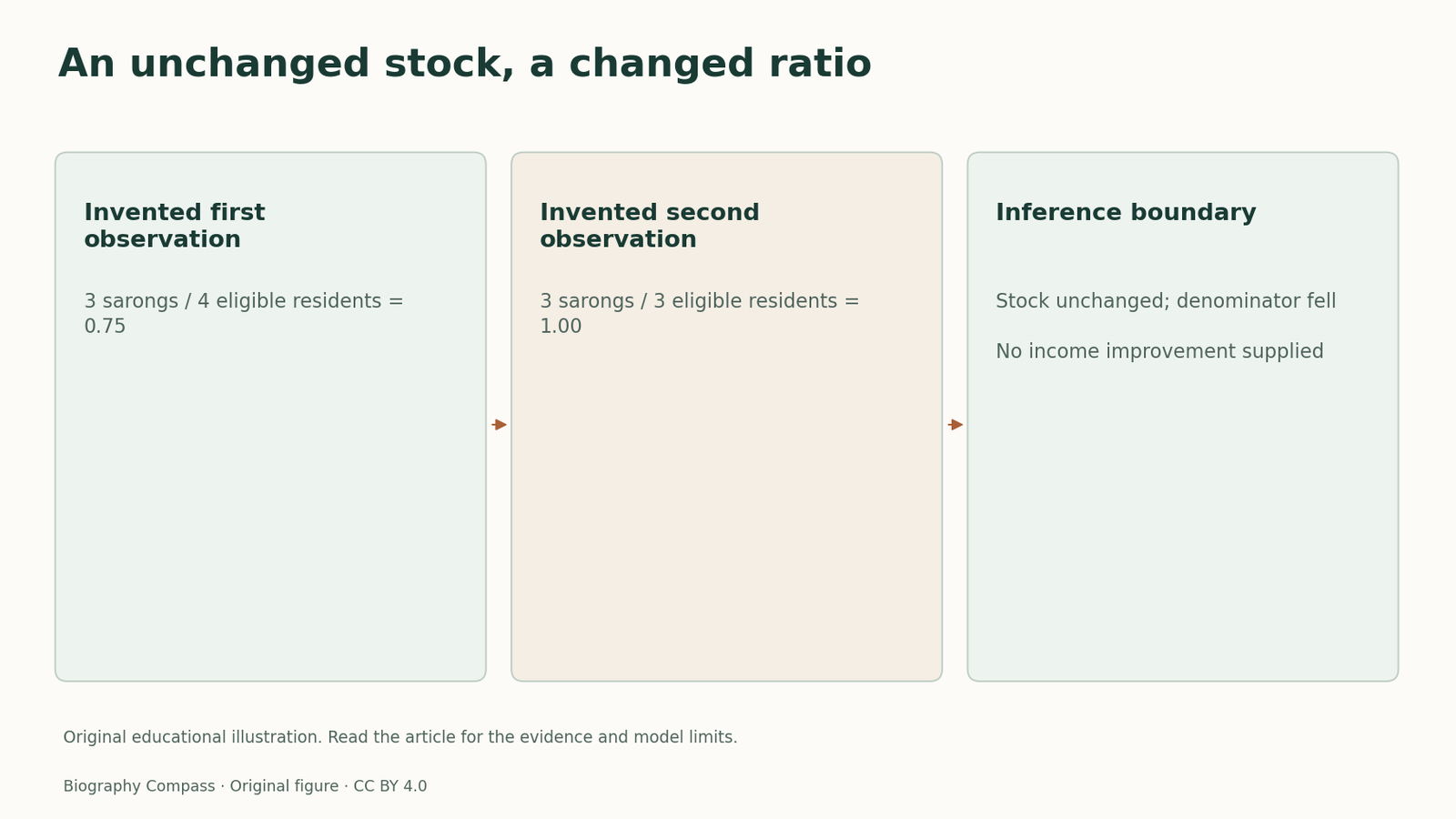
Invent a household with three sarongs and four residents, all older than one. At a second observation it still owns three sarongs, but one resident has moved away. Assume total household income, prices and the quality of the remaining clothes are unchanged. Compute the two ratios. Which statement is justified: the ratio increased, clothing increased, or poverty was reduced?
Reference answer: 3 / 4 = 0.75 and 3 / 3 = 1.00 sarongs per eligible resident. The ratio increased by 0.25 because the denominator fell. The household acquired no additional clothes under the assumptions. The calculation alone does not establish a gain in total household income, the welfare of the departing resident or a poverty-reduction effect.
A follow-up design should record household composition, clothing quality, prices and resources, then explain how the chosen measure relates to the intended concept. The invented example diagnoses a possible ambiguity; it does not refute every use of material-possession data.
What a before-and-after claim would require
A policy evaluation must account for changes that could occur without the policy. If an indicator crosses a threshold, ask whether this followed a real gain, a change in membership or a different way of counting. Retaining the underlying numerator and denominator makes that question answerable. An improvement in an indicator is evidence to investigate, rather than a substitute for explaining a change in welfare.
Sources for this section: [2]
Continue the chronology
Related history guides
Biography context
Explore Malaysia through connected lives
Connected biographies
People connected with this study

1922–2020
Ungku Aziz
Economist and university leaderEconomist concerned with rural poverty.Read biographyQuick answers
Common questions
- Does a higher ratio prove higher income?
- No. Its numerator, denominator and relationship to income must be investigated.
Primary and institutional sources
How this history was checked
Read the named selected records together; the notes distinguish direct texts, later accounts and limits of access. This article was reviewed on 31 October 2026.