
The short answer
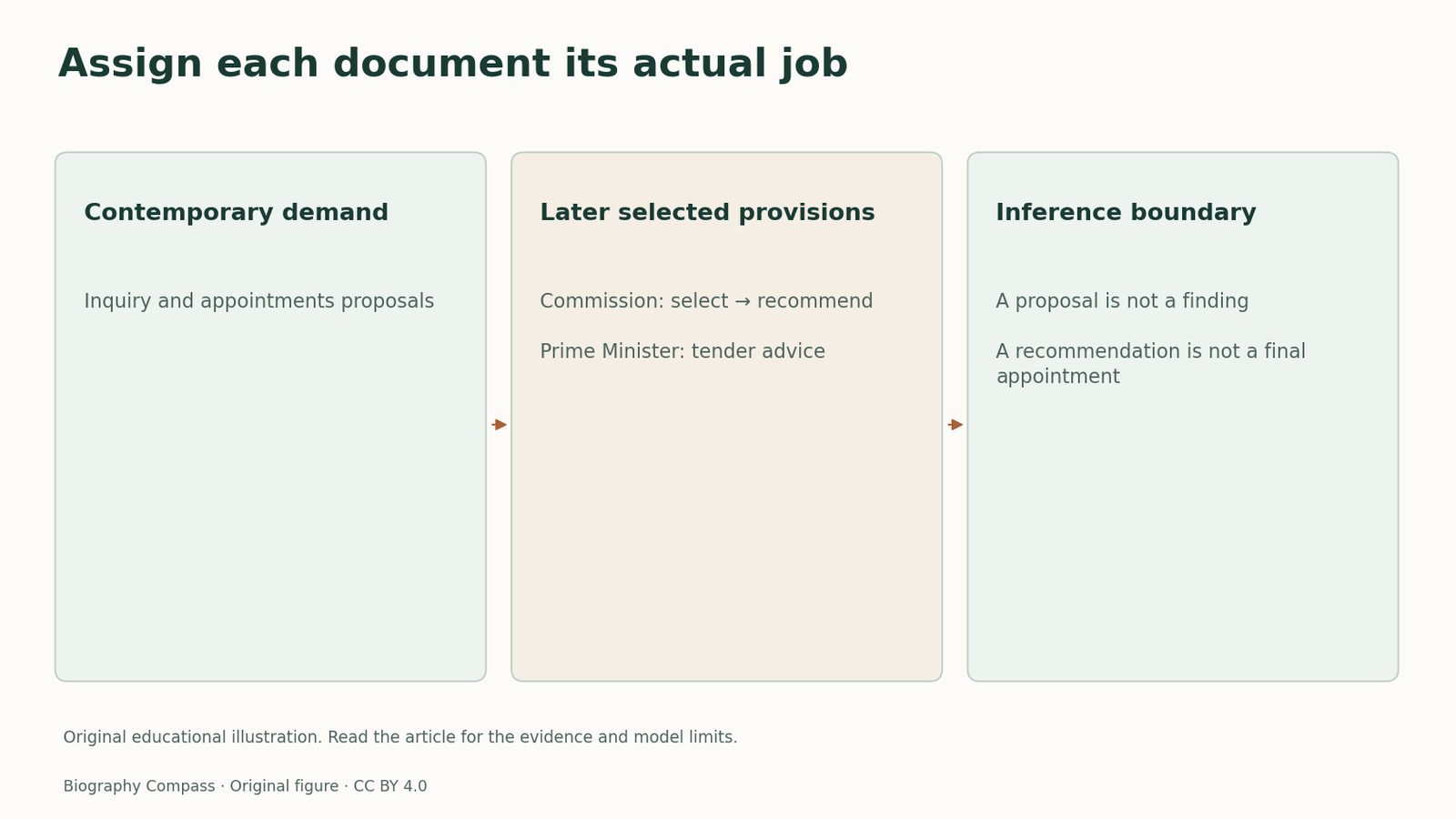
Two proposals can respond to the same concern while assigning different jobs to different bodies. This study follows those jobs through a contemporary circular and selected provisions of a later statute.
Record comparison
Read the evidence by function
Separate the object established by a record from an inference requiring other evidence.
| Record | What it establishes | What it does not establish |
|---|---|---|
| Contemporary circular | Two requested institutions and a planned walk. | Not a misconduct finding. |
| Later selected statute | Selection, reporting and advice stages. | Not the complete constitutional process. |
| Event account | Reported occurrence of the walk. | Not independent proof of every campaign claim. |
Chronology
A timeline of the turning points
A prospective circular
Separate a planned action from evidence of occurrence.
Reprint’s stated version date
The selected provisions belong to this identified version.
A prospective circular distinguishes the demands
Circular 198 / 2007, dated 25 September, sought a Royal Commission of Inquiry concerning a video and the judiciary, plus an independent judicial appointments commission. It distinguished these demands from the government panel’s reportedly narrower authentication task.
Those are the Bar’s stated positions, not findings that misconduct occurred. The circular announces planned action; the separate event report is needed to establish what subsequently happened.
The Bar’s 26 September report records the march and memorandum handover.
Read the later institution through its functions
The consulted Act 695 reprint is expressly as at 1 September 2019. Sections 22–23 concern selection and criteria; section 26 requires a recommendation report to the Prime Minister; section 28 concerns the Prime Minister’s tender of advice after accepting a recommended person.
The selected provisions describe stages, not one body exercising every power. They should not be presented as the full constitutional appointment process or as proof that the earlier campaign alone caused the legislation.
Sources for this section: [2]
Exercise: sort the institutional tasks
Classify these invented file labels: A, “establish what happened in a disputed incident”; B, “assess candidates and explain a recommendation”; C, “make a final appointment”; D, “announce an intended demonstration.” Which inspected document supports asking about each task, and where does the supplied evidence stop?
Reference answer: A corresponds to the inquiry demand; B to the later selection and reporting provisions. C is not established as the commission’s power by those excerpts; the wider appointment framework would need its own records. D belongs to the prospective circular, while the separate event account supplies occurrence evidence.
The categories are a teaching device. They neither decide the underlying allegations nor advise a real candidate or officeholder. When a document proposes a body, keep its desired function distinct from the powers a later instrument actually gives.
Version control is part of the comparison
The reprint’s amendment schedule identifies a 2010 amendment to section 3. Therefore this is not labelled the untouched 2009 text. Comparing a proposal with a later version can establish similarities and differences in institutional design; it cannot, without further evidence, establish a single cause or complete implementation history.
Sources for this section: [2]
Continue the chronology
Related history guides
Biography context
Explore Malaysia through connected lives
Connected biographies
People connected with this study
1956–present
Ambiga Sreenevasan
Lawyer and civic advocateFormer Malaysian Bar president.Read biographyQuick answers
Common questions
- Does establishing a commission prove every earlier allegation?
- No. An institutional response and a finding on a disputed incident require different evidence.
Primary and institutional sources
How this history was checked
Read the named selected records together; the notes distinguish direct texts, later accounts and limits of access. This article was reviewed on 31 October 2026.