
The short answer
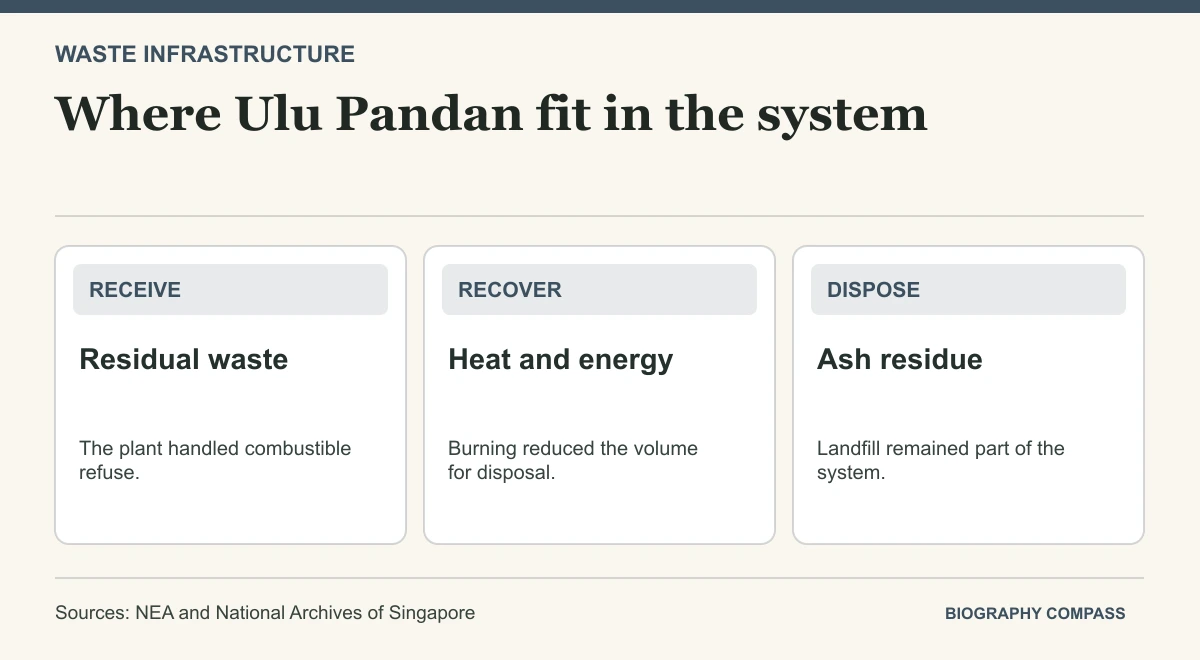
Ulu Pandan began operating in 1979 as Singapore’s first waste-to-energy plant. It changed the volume of waste that needed landfill space and the kinds of materials sent there. The plant’s retirement in 2009 also reveals how Singapore arranged the next round of incineration capacity.
Reading the records
The route of residual waste
Which facility handled the material depended on whether it could be incinerated.
| Material | Processing stage | Destination |
|---|---|---|
| Incinerable residual waste | Thermal treatment with energy recovery | Ash goes onward for disposal. |
| Incinerator ash | Consolidate for transport | Semakau Landfill. |
| Non-incinerable waste | Bypasses the incinerator | Landfill disposal. |
Chronology
A timeline of the turning points
First plant in operation
The environment agency’s national inventory dates the first facility to 1979.
A connected disposal route
The ministry described burning incinerable residual waste and sending ash to Semakau.
Ulu Pandan decommissioned
The environment agency records the closing ceremony.
Replacement plant began commercial operations
Keppel Seghers Tuas entered service under a public-private arrangement.
Why land constraints drove the decision
The environment agency’s national inventory describes landfill as the prevailing disposal method in the 1960s and 1970s. Its retrospective gives roughly 90 percent as the reduction in waste volume offered by incineration. That percentage concerns volume, so it cannot be read as the fraction of mass destroyed or the electricity recovered. Ulu Pandan inaugurated the new approach in 1979.
Sources for this section: [2]
Follow what was left after burning
An archived 2006 ministry statement describes incineration for material that could neither be recovered nor recycled, followed by disposal of ash at Semakau. The two types of infrastructure worked in sequence. A historian tracing the fate of waste therefore needs a record of the incineration plant and a record of where the resulting ash went.
A change in how new capacity was acquired
The environmental protection division records Ulu Pandan’s decommissioning on 11 August 2009. The new Keppel Seghers plant followed in October under a design, build, own and operate arrangement. The agency contracted for incineration services over a specified period. The transition continued the use of incineration while changing who developed the facilities and how the agency secured their capacity.
Continue the chronology
Related history guides
Connected biographies
People in this history
Quick answers
Common questions
- When did Ulu Pandan begin operating?
- The National Environment Agency’s inventory gives 1979.
- Where did incineration residues go?
- In the mature disposal system described by the ministry, residual ash went to Semakau.
Primary and institutional sources
How this history was checked
Dates, legal milestones and historical claims are checked against the official and institutional records below. This article was reviewed on 19 November 2026.