
The short answer
Singapore created an offshore landfill by enclosing sea space between Pulau Semakau and Pulau Sakeng. The first phase used multiple cells. The second phase formed one large cell. That choice affected where trucks could place ash and how displaced water could leave the enclosed space.
Reading the records
How ash and displaced water moved
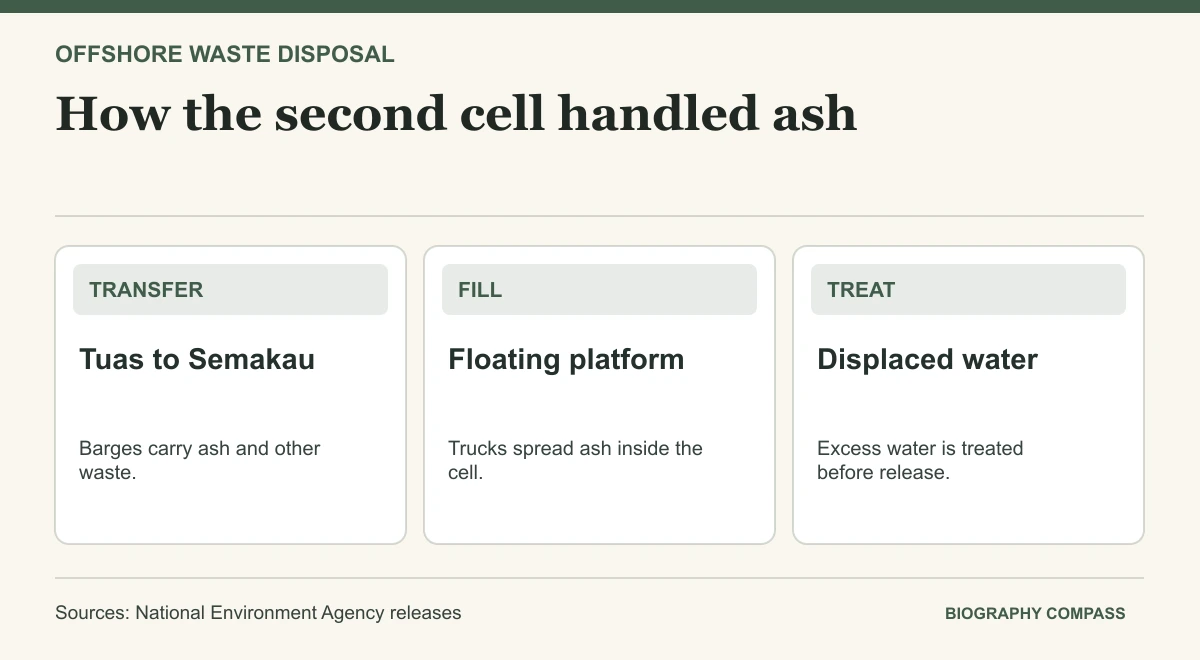
Phase II needed a route for solids entering the cell and water leaving it.
| Facility | Handles | Function |
|---|---|---|
| Tuas transfer station | Ash and non-incinerable waste | Transfers material to barges. |
| Floating platform | Incinerator ash | Allows trucks to distribute ash in the cell. |
| Floating treatment plant | Excess water | Treats water before it leaves the enclosure. |
Chronology
A timeline of the turning points
Offshore landfill opened
The opening followed the run-up to closure of the last mainland dumping ground.
Phase II development began
NEA began converting the remaining sea space into a single cell.
Phase II completion announced
NEA set out the enclosing works, discharge platform and treatment facility.
Creating one cell at sea
A perimeter bund separates the working space from the open sea. The 2015 release describes closing a remaining gap at the southern end to form one large cell from the remaining enclosed water. Placing solids into that volume displaces water, while rainfall can add to the amount inside. Those two effects explain why the second cell needed more than a barrier and access road.
Why the ash platform floated
The seabed in the second cell was uneven. NEA described a floating platform that allowed trucks to spread ash and level it before bulldozers and compactors could operate conventionally. A different floating facility treated excess water. The two structures solved different parts of the filling problem. Ash arrived at Semakau by barge from the Tuas Marine Transfer Station.
Two published figures for Phase II
The 2015 opening release gave 16.7 million cubic metres of additional capacity. NEA’s twentieth-anniversary release in 2019 listed 14.5 million cubic metres for Phase II and 13.6 million for Phase I. The announcements give different values for Phase II and provide no reconciliation. Use the date and wording of the announcement when citing either number.
Continue the chronology
Related history guides
Connected biographies
People in this history
Quick answers
Common questions
- When did Semakau open?
- Phase I opened on 1 April 1999. Phase II followed on 11 July 2015.
- Why did the second cell need its own treatment plant?
- Ash placement and rainfall increase the water that must leave the enclosure. Excess water was treated before discharge.
Primary and institutional sources
How this history was checked
Dates, legal milestones and historical claims are checked against the official and institutional records below. This article was reviewed on 19 November 2026.