
The short answer
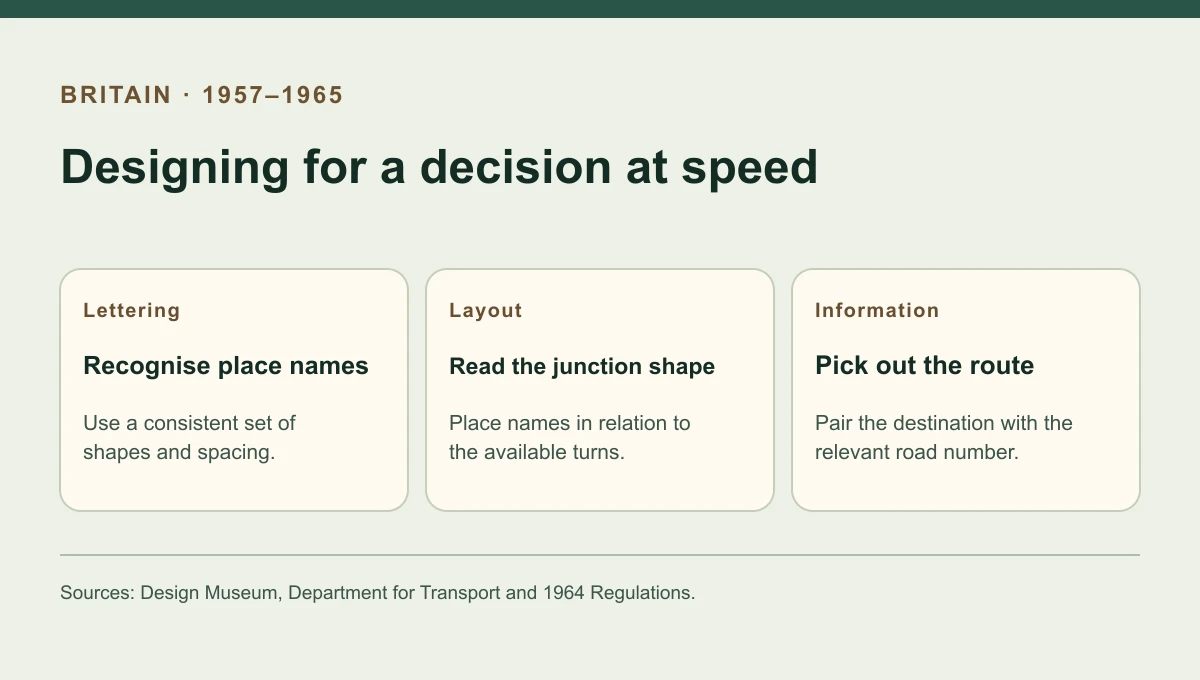
A motorway driver has a short interval to recognise a place name and prepare for an exit. Jock Kinneir and Margaret Calvert worked on signs that treated lettering, layout and road speed as one problem. The project began with Britain’s early motorways and influenced the wider approach recorded in regulations made in 1964 and brought into operation on 1 January 1965.
Reading a road sign
Three decisions behind a message at speed
Road signs have to make several kinds of information legible in a brief glance.
| Feature | Job | Evidence to check |
|---|---|---|
| Place names | Identify a destination quickly | Look at letter proportions and spacing. |
| Directional layout | Show how a junction is organised | Read the names in relation to the branches or arrows. |
| Visual categories | Give warning or directions a familiar form | Compare the type of sign before reading its particular message. |
Chronology
A timeline of the turning points
Motorway sign design begins
Kinneir starts work on early motorway navigation with Calvert contributing to the design work.
Worboys review covers the wider system
The review considers how road signs can communicate through consistent shapes and symbols.
Regulations specify the new system
The instrument made in November 1964 takes effect the following January.
Starting with motorways
The motorway problem pushed designers to take speed and reading distance seriously. The Design Museum traces the early work to Kinneir’s 1957 assignment and describes the partnership he developed with Calvert. A destination can be technically present on a sign yet be difficult to recognise in moving traffic. The shape of the letters, the space separating words and the field around them all affect how much time the driver has to act.
From a bigger board to a broader design system
The motorway work established a context for the broader Worboys review. The Department for Transport describes a move toward the main European approach, including symbols inside familiar sign shapes. That convention gives a reader a first clue about the type of instruction before every detail is visible. Lettering still has an important role where the sign must identify a named town or an exact route. Those two jobs coexist at a junction and require different kinds of information.
What the legal document added
The 1964 instrument includes diagrams, sign categories, dimensions and letter proportions. It also sets a precise commencement date of 1 January 1965. Reading the schedule beside the design history separates a principle, such as grouping related directions, from the specification used to put it on public roads. The schedules show how a design idea became a repeatable set of official signs, with rules extending from lettering to the shape and appearance of the sign itself.
Continue the chronology
Related history guides
How Edward Johnston Lettered the London Underground
Compare a historic alphabet commissioned for a different transport reading environment.
Read the timeline1974–1979How the U.S. DOT and AIGA Developed Passenger Symbols
See why an American passenger-sign project also studied the value of a repeated visual vocabulary.
Read the timelineConnected biographies
People connected to this history
Quick answers
Common questions
- Who designed the British road sign system in this period?
- The Design Museum credits Jock Kinneir and Margaret Calvert with the road and motorway system.
- When did the 1964 Traffic Signs Regulations take effect?
- The regulations made in November 1964 came into operation on 1 January 1965.
Primary and institutional sources
How this history was checked
Dates, legal milestones and historical claims are checked against the official and institutional records below. This article was reviewed on 19 November 2026.