
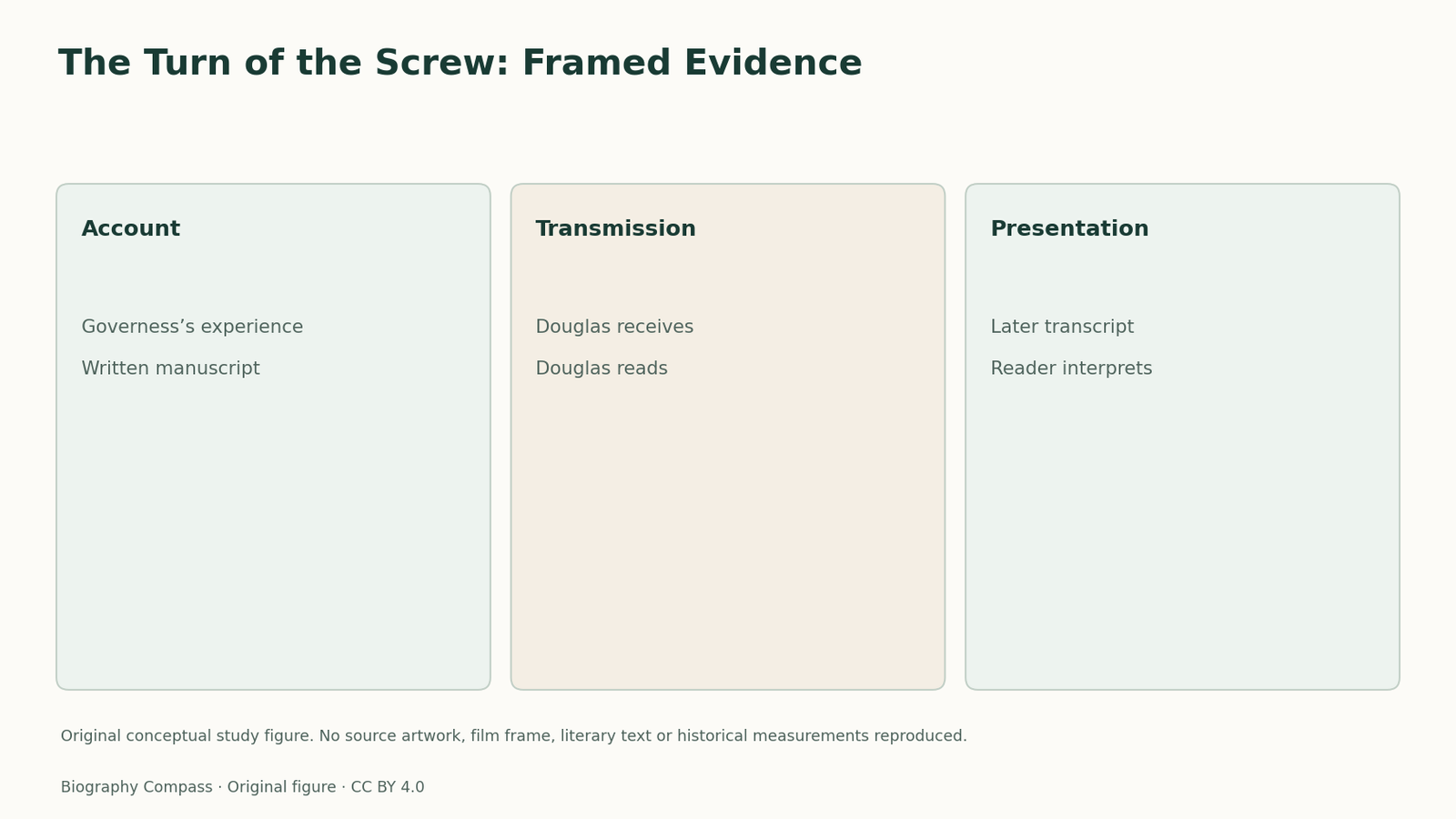
The short answer
What does the layered narrative frame let a reader know or leave unresolved?
Read the evidence
Sources, interpretation and production roles
The records answer different questions about this work. The final exercise is an original teaching model.
| Record or question | Supported reading | Boundary or contrast |
|---|---|---|
| Douglas’s acquaintance | He knew the writer of the account. | He did not personally experience every narrated event. |
| Later transcript | The outer narrator supplies another presentation stage. | Mediation alone proves neither deception nor supernatural truth. |
| Original chain | Separate experience, manuscript, reading and transcript. | A character endorsement is not independent event corroboration. |
The story arrives through other people
The Turn of the Screw appeared in 1898. Its opening gathering introduces a story that is not immediately available to be told. Douglas must send for a manuscript kept in London. The delay gives the account an object, a history of custody and an audience waiting to hear it. Before any explanation of the governess’s later perceptions is attempted, the novella asks the reader to encounter the circumstances in which her account becomes available.
Sources for this section: [4]
Douglas is a witness to a person, not every event
Douglas knew the woman who wrote the manuscript, but the opening explicitly distinguishes his acquaintance with her from direct experience of the events she describes. He speaks about her character and the impression she made on him. That personal endorsement may influence the listeners. It is still different from independent observation of what happened in the household she served. The distinction is essential when assessing how a narrative frame produces confidence.
Sources for this section: [4]
The transcript adds another layer
The outer narrator says that the account being presented comes from a transcript made later. The reader therefore encounters a written story through a further act of preservation and presentation. This does not automatically prove alteration or deception. It establishes mediation. The frame makes room for questions about memory, admiration and the transmission of a voice without answering every question about the experiences inside the manuscript.
Sources for this section: [4]
An original chain-of-knowledge task
Draw four boxes: governess’s experience, her written account, Douglas’s reading and the later narrator’s transcript. Under each, write what the next person receives. A supported answer distinguishes experience from testimony, testimony from an oral presentation, and presentation from a later written version. Now ask whether Douglas’s admiration can independently confirm a reported apparition. It cannot by itself, because knowing the writer is different from seeing the event. That conclusion concerns the chain of testimony; it does not settle whether the apparition is real within the fiction.
Sources for this section: [4]
Why the frame preserves more than one question
A useful discussion separates two tasks. First reconstruct the story’s transmission; then examine the governess’s particular descriptions and the responses of other characters. Collapsing those tasks can make the opening seem like a guarantee of truth or a ready-made diagnosis of unreliability. Neither follows from the frame alone. The National Trust’s account supplies a separate production fact: James wrote the novella in London during the renovation of Lamb House. A historical location of composition and a fictional location of authority answer different questions, and both can be stated precisely.
Continue the chronology
Related history guides
Biography context
Explore United States through connected lives
Connected biographies
People and related creative practices
1843–1916
Henry James
Novelist, short-story writer and criticHenry James developed fiction around perception, interpretation and social relations, while living much of his working life in England.Read biography
1775–1817
Jane Austen
Novelist and author of fiction, letters and youthful satiresJane Austen was an English novelist whose six completed novels turned courtship, money, family expectations and errors of judgement into sharply observant fiction.Read biography1804–1864
Nathaniel Hawthorne
Novelist and short-story writerNathaniel Hawthorne combined a career in public employment with fiction about judgement, secrecy and the stories a community tells about its past.Read biographyQuick answers
Common questions
- Does Douglas witness the governess’s experiences?
- No. The frame distinguishes his knowledge of her from direct experience of the events.
- Does a transcript prove unreliability?
- No. It establishes a stage of mediation that readers should examine without assuming a conclusion.
Primary and institutional sources
How this history was checked
Sources include production records, institutional collections and the specifically identified passages discussed here. Interpretations and teaching models are distinguished from credits and publication facts. This article was reviewed on 7 November 2026.