
The short answer
How does the novel contrast public judgement with knowledge held privately?
Read the evidence
Sources, interpretation and production roles
The records answer different questions about this work. The final exercise is an original teaching model.
| Record or question | Supported reading | Boundary or contrast |
|---|---|---|
| Scaffold scene | A community sees punishment and hears an appeal. | Visibility does not give complete private knowledge. |
| Custom House frame | An imagined discovery lends the story documentary form. | Hester is not verified by a real customs dossier. |
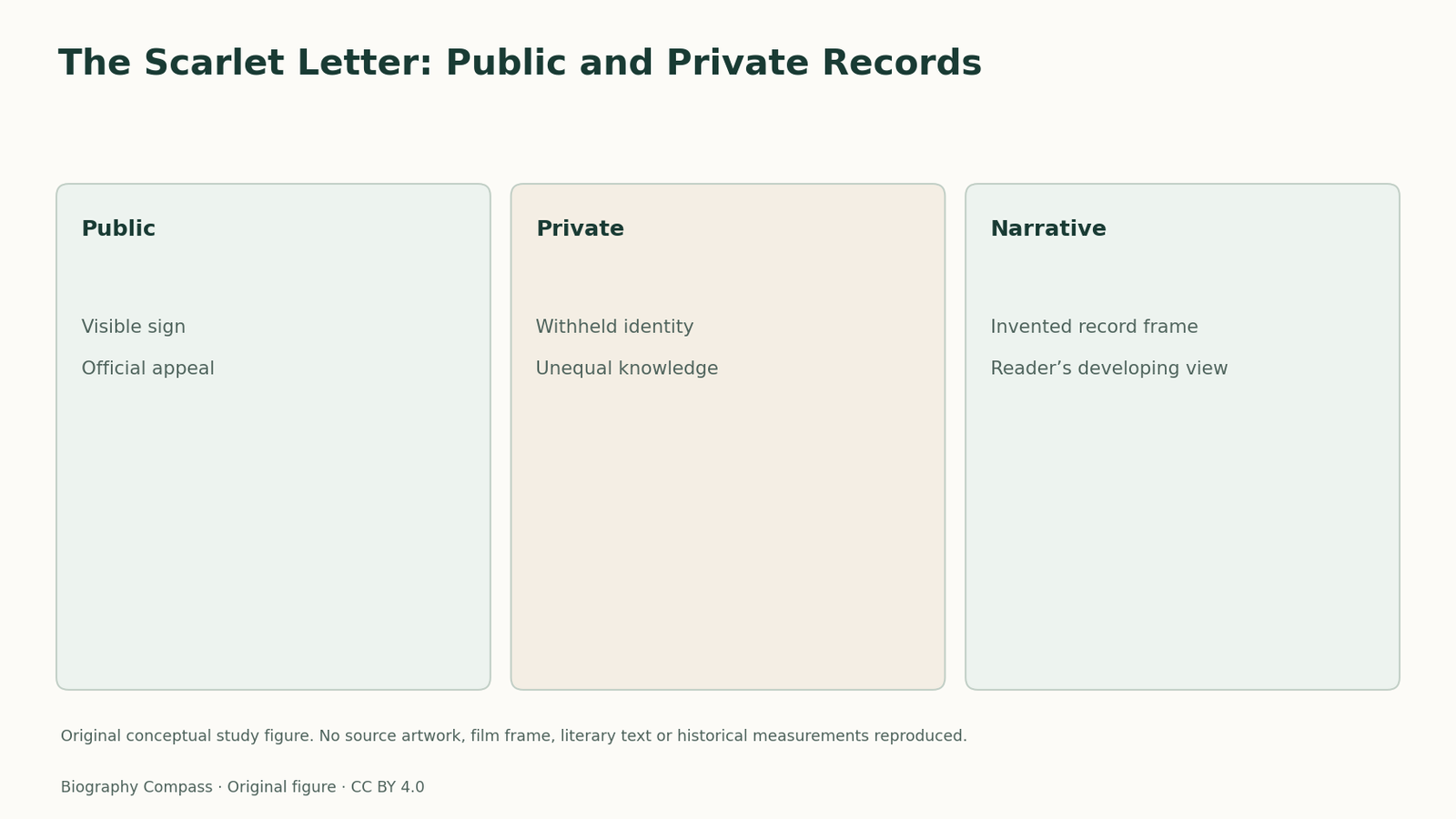
| Original map | Track crowd, authority, private knowledge and narrator. | Information and moral judgement are separate dimensions. |
A public sign is not a complete record
The Scarlet Letter appeared in 1850. Its public scaffold scene puts Hester Prynne before an audience and gives her punishment a visible sign. The crowd can see the sign, hear the authorities and participate in a communal judgement. It cannot thereby know every relationship behind the event. The scene sets up a fundamental difference between what a community has officially marked and what particular people privately know.
Sources for this section: [4]
The appeal to name another person
In the selected scaffold passage, a minister urges Hester to reveal her fellow sinner. The appeal links confession, punishment and the prospect of spiritual relief. It also exposes how authority works through speech: the demand asks her to convert private knowledge into a publicly usable identity. Her position is therefore more complex than silent submission to an already complete record. The community’s account remains dependent on information it does not possess.
Sources for this section: [4]
Why the introductory frame matters
The Custom House introduction creates another layer between the reader and Hester’s story. Its imagined discovery of earlier materials gives the narrative a documentary appearance. The National Park Service explicitly distinguishes this fiction from Hawthorne’s actual customs employment. Reading the frame as a verified archival find would erase an important artistic device. The novel asks readers to enter a story that borrows the authority of records while also being shaped by a narrator’s reconstruction.
An original information map
Make four columns: visible to the crowd, stated by an authority, known privately and supplied by the narrator. Place the embroidered sign in the first column and the demand for a name in the second. Where should the unnamed person’s identity go at the moment of the appeal? A supported answer places it in the private-knowledge column, because the appeal itself shows that a public declaration is still being sought. The map records the scene’s distribution of information; it is not a claim that all readers must reach the same moral judgement.
Sources for this section: [4]
From map to interpretation
Now ask how the scene would change if every spectator already knew the identity being demanded. The public appeal would lose much of its narrative function, because disclosure would no longer be at stake. This counterfactual demonstrates that suspense depends on unequal knowledge as well as punishment. A discussion can then distinguish the community’s judgement from the reader’s developing view. Hawthorne’s Salem employment supplies a historical context for the framing device, while the literary argument rests on the novel’s arrangement of signs, speech and withheld knowledge.
Continue the chronology
Related history guides
Biography context
Explore United States through connected lives
Connected biographies
People and related creative practices
1804–1864
Nathaniel Hawthorne
Novelist and short-story writerNathaniel Hawthorne combined a career in public employment with fiction about judgement, secrecy and the stories a community tells about its past.Read biography
1835–1910
Mark Twain
Writer, humorist and lecturerWriting as Mark Twain, Samuel Langhorne Clemens turned experiences of printing, river work, travel and journalism into fiction, humor and searching criticism of American society.Read biography1843–1916
Henry James
Novelist, short-story writer and criticHenry James developed fiction around perception, interpretation and social relations, while living much of his working life in England.Read biographyQuick answers
Common questions
- What does the scaffold scene reveal?
- It reveals a gap between public punishment and privately held information.
- Why study the invented record?
- It shows how a story can borrow documentary authority without being an actual recovered dossier.
Primary and institutional sources
How this history was checked
Sources include production records, institutional collections and the specifically identified passages discussed here. Interpretations and teaching models are distinguished from credits and publication facts. This article was reviewed on 7 November 2026.