
The short answer
The lid was not just a decorative finish on a bowl. Its form and material made a particular sequence of hand movements meaningful, creating a product that benefited from explanation.
Evidence and interpretation
Structure and demonstration answer different questions
The comparison links the patent with a historical account of product use.
| Question | What the record helps explain | What it cannot supply alone |
|---|---|---|
| Patent | Material deformation and groove/rim engagement. | The exact construction of every commercial bowl. |
| Product account | A two-step demonstration. | A complete manufacturing specification. |
| Selling history | How explanation enters distribution. | Sole credit for every kind of work. |
Read the closure as a structure
Tupper’s patent 2,487,400, filed in 1947 and published in 1949, describes a locally distortable closure with a peripheral groove engaging a container rim. Its claim connects downward pressure on the centre with local lifting at the edge.
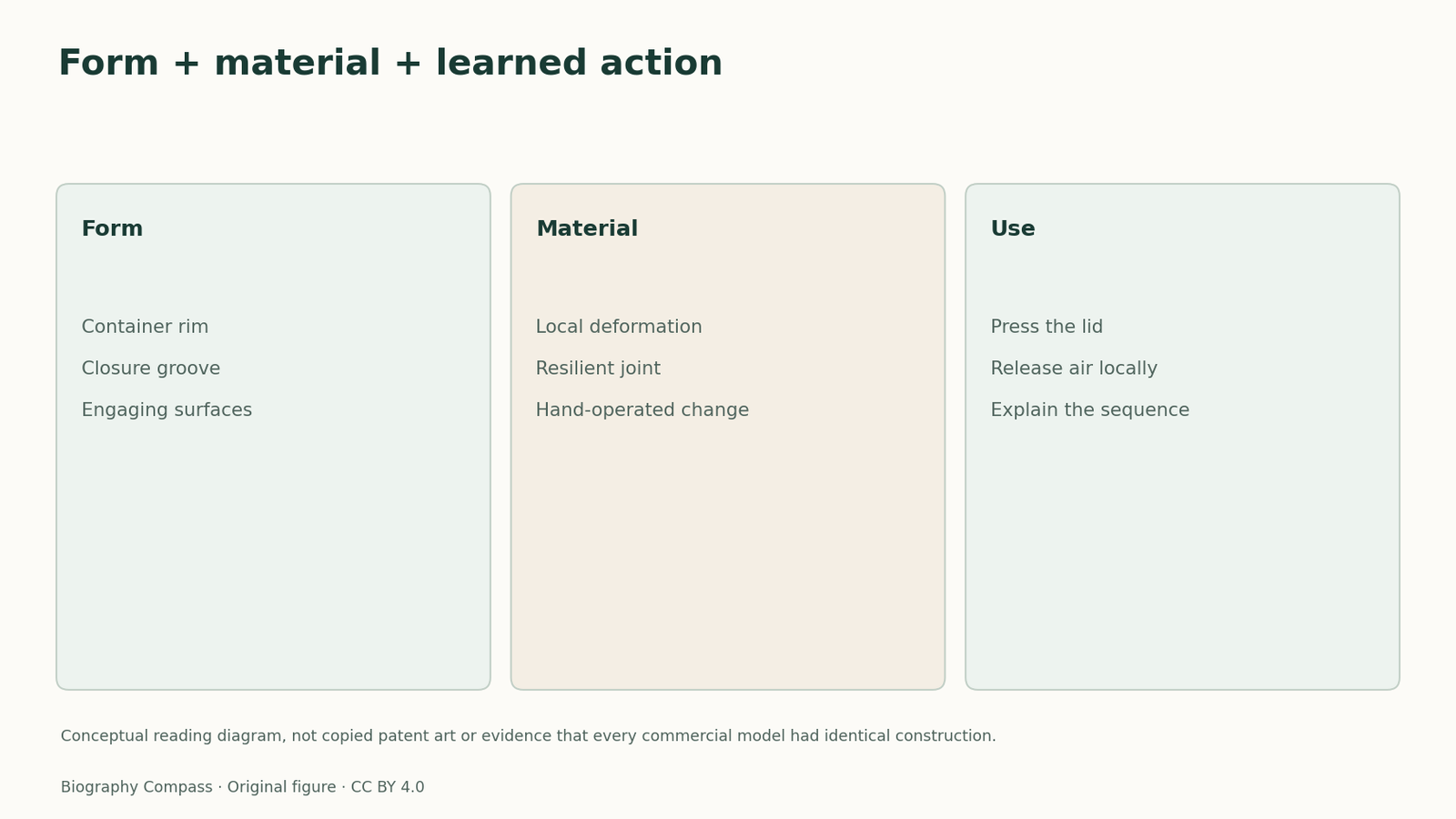
Two features work together in that description. Geometry supplies the places that engage; the material permits local deformation. Describing only a plastic material leaves out the form of the joint, while describing only a groove leaves out how a hand can change its engagement. The innovation needs a structural explanation, not merely a material name.
Sources for this section: [1]
Why the demonstration mattered
The Smithsonian Magazine account explains the Wonder Bowl’s two-step seal through pressing down the lid and lifting part of it to let air escape. It places the product beside Brownie Wise’s selling work.
The archival finding aid describes the closure as a marketing challenge and credits both Damigella and Wise in the development of home-party distribution.
The useful connection is between a visible action and a less visible state. A customer can see an edge being lifted; the explanation relates that movement to the air inside and the subsequent seal. The demonstrator helps the buyer understand what the design is asking them to do. This is different from claiming that every sale depended on one charismatic person.
A patent and a household object are different records
The patent defines a described construction and its claims. A historical product account explains a particular object and its use. They can illuminate each other without establishing that every bowl sold under the brand implemented every patent figure identically. A dated product sample or manufacturing record would be needed to make that stronger identification.
The two records also preserve different contributors. One names an inventor and specifies the joint; the other can identify demonstrators, distributors and users. Treating commercial success as proof of sole invention erases the first distinction. Treating the patent as a complete account of the business erases the second.
A three-part reading method
When explaining an unfamiliar household device, ask: which surfaces meet; what material property allows the operation; and what action must the user learn? Then find a record for each answer. For this closure, the selected patent addresses the first two and the product history describes the demonstration.
This method extends the existing Tupperware dealer-handbook study without repeating it. The handbook concerns selling roles and a period instruction record; this page concerns the physical closure and the relationship between design and use. The original diagram keeps that distinction visible rather than reproducing the company’s artwork.
Continue the chronology
Related history guides
Biography context
Explore United States through connected lives
Connected biographies
The working life
1907–1983
Earl Tupper
Inventor and plastics manufacturerTupper developed products that needed demonstration.Read biographyQuick answers
Common questions
- Why did the closure need a demonstration?
- The flexible lid changes its engagement at the rim when pressed and lifted; a demonstration makes the movement clear.
Primary and institutional sources
How this history was checked
Selected passages and records support the discussion below. Original reasoning and invented classroom cases are labelled; no whole-archive or product-testing claim is made. This article was reviewed on 4 November 2026.
- United States Patent Office; Google Patents transcriptionUS 2,487,400: Open mouth container and nonsnap type of closure therefor
- Smithsonian Magazine, Kat Eschner, 10 April 2018The Story of Brownie Wise, the Ingenious Marketer Behind the Tupperware Party
- Smithsonian Archives CenterEarl S. Tupper Papers, NMAH.AC.0470