
The short answer
A selling handbook tries to make something happen. Reading its instructions as evidence of a completed result erases the work between invitation and purchase. The selected passage lets us examine that gap without reproducing the handbook.
Evidence and interpretation
Keep the claim attached to the record
Each row answers a different part of the question.
| Record | Supported reading | Limit |
|---|---|---|
| Handbook selection | Encourages prospecting and demonstration. | Prescriptive material, not measured conversion. |
| Institutional context | The seal required demonstration. | Product explanation is not a guaranteed purchase. |
| Invented order | Records a stated quantity and price. | Does not establish profit. |
Chronology
A timeline of the turning points
Executive departure
Personal authority has a dated boundary.
Handbook edition
The publisher is identified; authorship is not inferred.
Read the edition and the publisher first
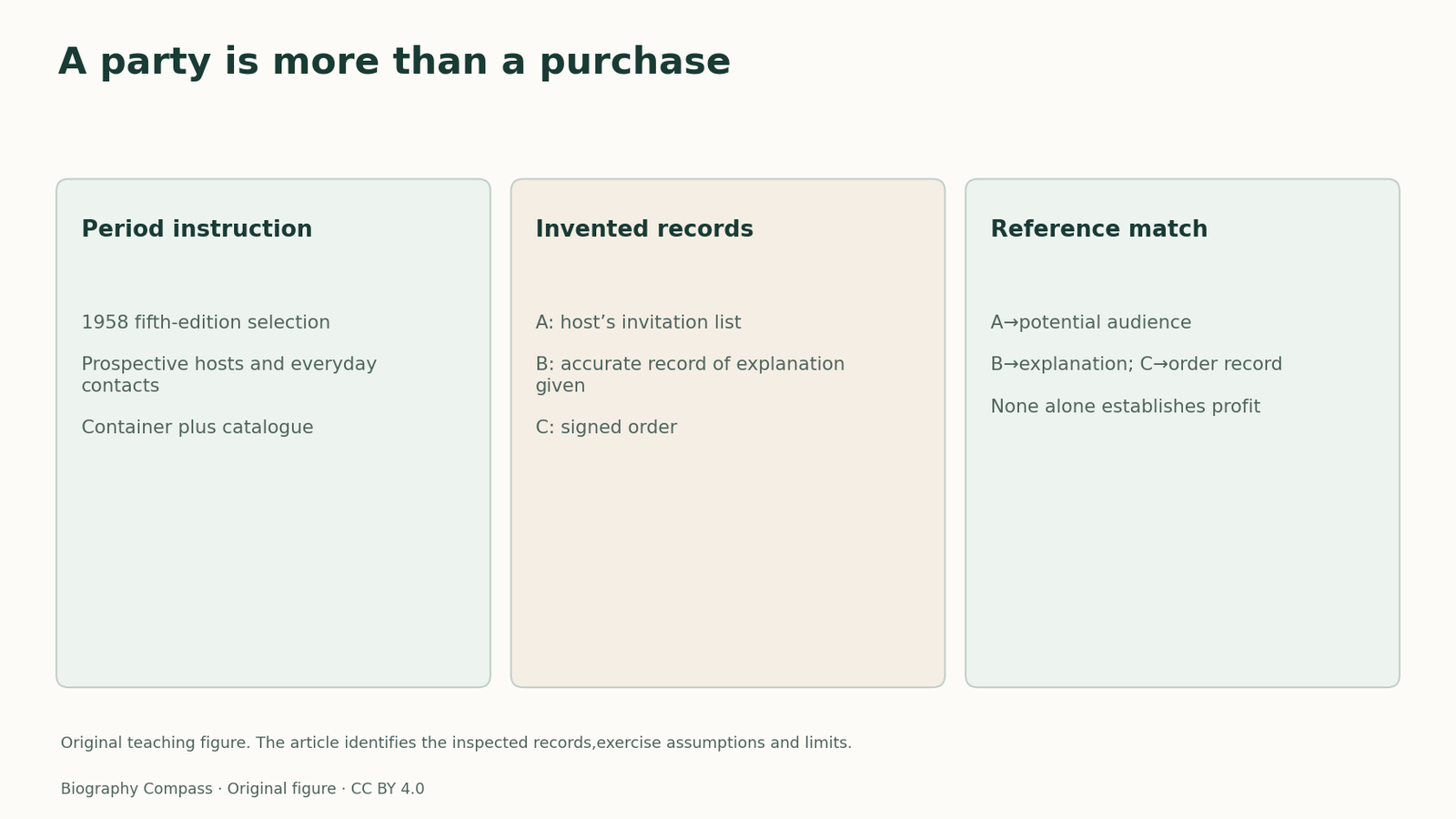
PBS reproduces a selection from the fifth edition of Know How! The Guide to Making Money with Tupperware, published by Tupperware Home Parties in 1958. The dialogue encourages a dealer to find prospective party hosts across everyday social contacts.
Wise’s executive tenure ended in January 1958. The edition year alone does not establish whether she wrote, approved or even saw this particular passage. Institutional continuity is not personal authorship.
The social network is part of the selling work
The passage ranges from homemakers and clubs to people encountered through routine services. It also recommends carrying a small sealed container and a catalogue. Its sweeping claim about universal demand belongs to the sales pitch.
The museum’s separate account explains why the product’s seal needed demonstration.
Invitation work draws on a host’s relationships; a demonstration gives a dealer an occasion to explain and sell. The source does not measure the host’s time, the dealer’s net earnings or the proportion of invitations that became orders.
Original record-matching task
Three invented records describe one hypothetical event. A is an invitation list prepared by a host. B is a stipulated accurate event record confirming that a demonstrator explained a feature during this event. C is a signed order with a stated quantity and price. Match each to the strongest supported claim: potential audience, explanation performed, or order recorded. Which record alone measures the profitability of the event?
Sources for this section: [1]
Reference answer: three different achievements
A supports a planned audience, B an explanation, C a recorded order. None alone measures profit: the order still supplies no complete costs or payment/return history. Nor does a list prove attendance. The lesson is specific to the labour the handbook recruits: finding people, showing a product and recording an order should remain visible as distinct achievements. It does not supply present-day selling advice.
Sources for this section: [1]
Continue the chronology
Related history guides
Lijjat: Branch Work and Shared Risk
Compare another specific record and learning task.
Read the timeline1947–1951Tupperware: The Bowl, Seal and Demonstration
Compare the Wonder Bowl’s two-step demonstration with Tupper’s 1949 closure patent, using an original explanation of material, groove, pressure and release.
Read the timelineBiography context
Explore United States through connected lives
Connected biographies
The working life
1913–1992
Brownie Wise
Sales executiveWise built selling into an organised social activity.Read biographyQuick answers
Common questions
- Is the handbook credited here to Wise as author?
- No. A publication’s relationship to an organisation does not establish the authorship of an individual executive.
Primary and institutional sources
How this history was checked
Compare the selected accounts and objects below; each has a stated date and scope, and the learning task supplies its own instructions. This article was reviewed on 31 October 2026.
- Tupperware Home Parties / PBS American ExperienceKnow How! The Guide to Making Money with Tupperware, fifth edition (1958), selected excerpt
- Smithsonian National Museum of American HistoryGuide to the Brownie Wise Papers, NMAH.AC.0509
- National Museum of American HistoryParties for plastic: How women used Tupperware to participate in business
- PBS American ExperienceTupperware! (2004), selected transcript passages