
The short answer
In 1982, Toyota brought manufacturing and sales into one corporation. Reading an agreement alongside a later speech reveals a useful distinction: the legal structure of a merger can be described precisely while its promised benefits remain claims to investigate.
Compare purpose and structure
Three questions, three kinds of evidence
Keep a document’s purpose and its time of writing visible.
| Question | Selected record | Reading boundary |
|---|---|---|
| Which entity survived? | Agreement. | Read the legal method separately from equality language. |
| What did management hope to achieve? | July speech by Shoichiro Toyoda. | A rationale is not a measured result. |
| How was the transition later described? | Toyota’s anniversary history. | Retrospective company history is not an independent audit. |
Chronology
A timeline of the turning points
Agreement
Terms announced.
New corporation
A subsequent contemporary speech identifies this as the start date.
Management explains its case
Shoichiro Toyoda addresses the Foreign Correspondents’ Club of Japan.
Two organisations with complementary responsibilities
In his 13 July 1982 speech, new president Shoichiro Toyoda described manufacturing and sales as organisations separated in 1950 but working together. He argued that combining their capabilities would improve the use of resources and responsiveness to customers.
The speech is a contemporary participant’s public explanation. It is useful evidence of the leadership’s stated purpose. It is not an independent comparison of employee experience, product prices or efficiency before and after the merger.
Sources for this section: [2]
Equal standing and a surviving corporation
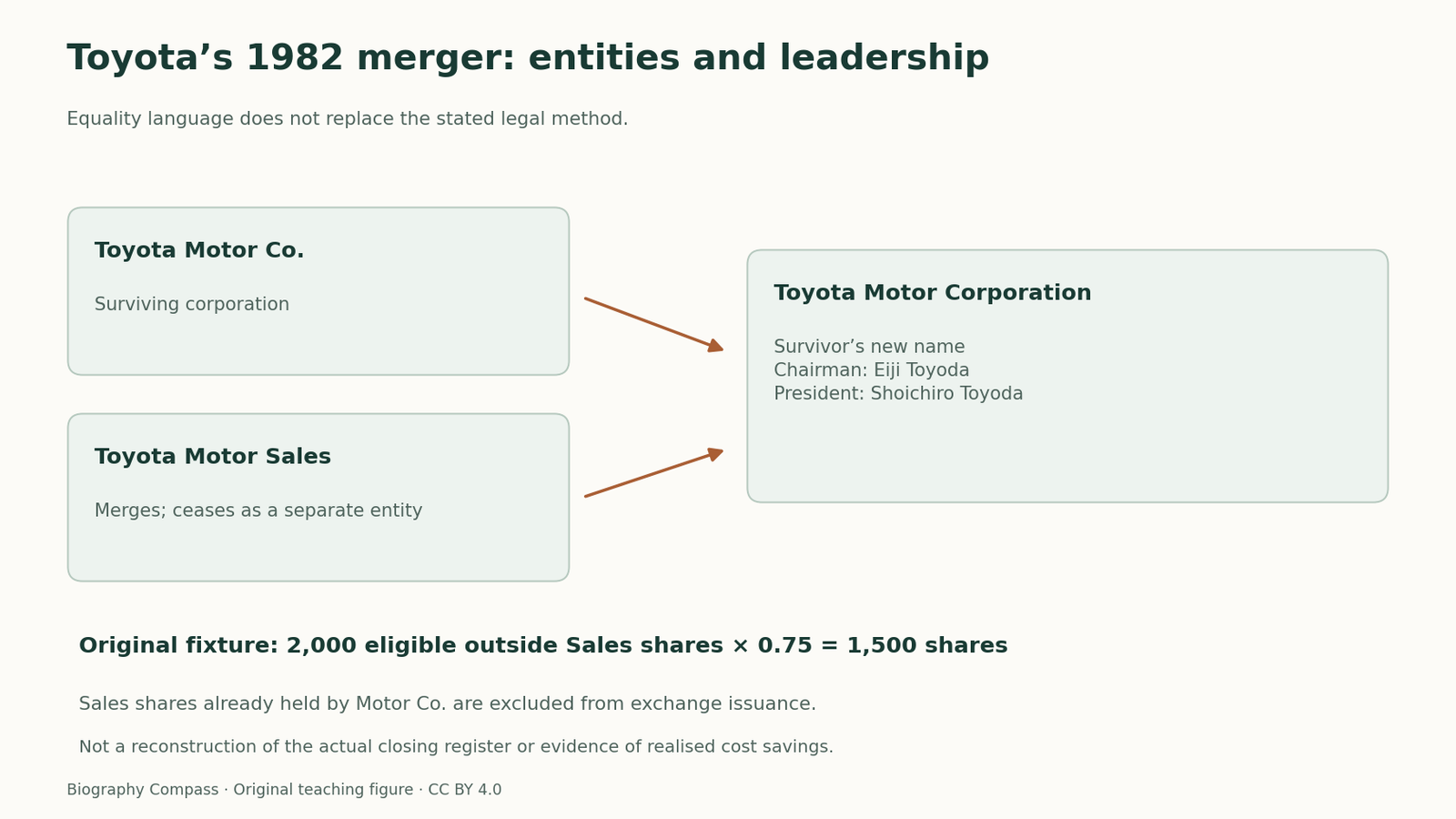
Toyota Motor Co. survived as Toyota Motor Corporation; Toyota Motor Sales ceased. The agreement also claimed equality.
These descriptions need not be forced into a contradiction. A statement about how partners present their relationship answers a different question from a clause identifying the legal survivor. A historical explanation should preserve both rather than use the word equal to imply that two corporations must survive unchanged.
Sources for this section: [1]
An exchange ratio with an explicit exception
Each eligible Sales share exchanged for 0.75 Motor Co. shares. Sales shares already held by Motor Co. were excluded.
Original classroom example: imagine 2,000 eligible sales-company shares held outside the surviving company. Applying 0.75 gives 1,500 shares. An excluded block receives no new shares under this clause. This exercise uses invented holding sizes, does not estimate anyone’s actual wealth and does not reconstruct the complete closing share register.
Sources for this section: [1]
An agreement, an effective date and an explanation
The agreement anticipated July. Shoichiro’s subsequent speech described the new company as having come into being on 1 July. Toyota’s later history places Eiji in the chairmanship and Shoichiro in the presidency when the new board met.
That comparison establishes a sequence of records with different temporal positions: an announcement looking forward, a speech after the event and a retrospective institutional account. Agreement and completion should be distinguished even when the intended date ultimately matches the reported one.
Exercise: test a management claim
Invented museum label: “The fact that the businesses merged proves that operating costs fell.” Write a replacement that distinguishes management’s stated purpose from an observed result. Specify the evidence needed to test a benefit without assuming that every later improvement was caused by reorganisation.
Reference answer: “Cost savings remain an expectation until comparable records establish a change.” A useful investigation would define the cost measure and observation period, then compare records while accounting for changes in demand, products and exchange rates. The wording corrects the inference without inventing an outcome.
An announcement and a public speech establish what managers described and advocated. They cannot themselves measure an effect. This is an original reading exercise, not a claim that a particular cost study was conducted or that the stated purpose was either achieved or disproved.
Continue the chronology
Related history guides
SoftBank’s Arm Acquisition in 2016
Compare conditional offers and completed ownership in a later technology transaction.
Read the timeline1950What Changed in Toyota’s 1950 Crisis?
Read the earlier financial and labour context rather than treating the sales organisation as a new invention of 1982.
Read the timelineConnected biographies
People connected with these records
1913–2013
Eiji Toyoda
IndustrialistToyoda led Toyota’s production and internationalisation.Read biographyQuick answers
Common questions
- Which corporation survived?
- Toyota Motor Co.
Primary and institutional sources
How this history was checked
Selected passages of the contemporary announcement and speech are compared with Toyota’s later anniversary history. The complete merger contract, court or regulatory files, and a post-merger outcome dataset were not inspected. This article was reviewed on 31 October 2026.